 Skip to main content
Vostok
In February 2010 the Chistopol Watch Factory held 101,000 rubles, 693 euros and $187 in its accounts, and a bankruptcy manager reported that restoring it was not possible. Three factory insiders put in their own money and restarted production in 2013. Their product: a dive watch whose compression seal is built to tighten as water pressure rises.
From Moscow to the Kama
A dive watch that strengthens under pressure, restarted by insiders
In February 2010, the Chistopol Watch Factory held 101,000 rubles, 693 euros and $187 in its accounts. The factory — maker of the Vostok (Восток, “East”) Amphibia, the dive watch a Soviet cosmonaut wore aboard Salyut 4 and whose seal is built to tighten the deeper you dive — was bankrupt. Three factory insiders would restart it with their own money, but the survival would be permanent, not comfortable.
The physics that defied logic
Most dive watches resist water through brute force — thicker gaskets, heavier cases, crowns engineered to withstand pressure from the outside. The Amphibia (Амфибия), completed in 1967 by engineers Mikhail Novikov and Vera Belova at the Chistopol factory, inverted the principle entirely. Its compression-seal case design uses external water pressure to push the caseback and crystal tighter against their gaskets. The deeper the watch descends, the stronger the seal becomes. At 200 metres, the Amphibia is more waterproof than at the surface.
The design emerged from constraint. Soviet engineers did not have access to the exotic alloys and precision machining that Swiss houses used for their dive watches. Novikov and Belova solved the problem with geometry: a loose-fitting caseback that water pressure itself would lock into place, a crystal seated so that compression compressed it against its gasket rather than against the movement. The crown — deliberately wobbly, a characteristic that baffles first-time owners — sits in a housing designed to absorb pressure differential rather than resist it. A military version, the NVCh-30, reached 300 metres.
Eight years after the Amphibia’s launch, cosmonaut Georgy Grechko wore one aboard Soyuz 17 to the Salyut 4 space station in 1975. He visited the factory the following year and presented the space-worn watch to it. The Amphibia, a dive watch with a 300-metre military version, had become a piece of space heritage.
That engineering distinction — genuine, defensible, and dependent on the institutional knowledge of how to manufacture it — would prove to be the single most important asset the factory possessed. Not the brand name. Not the military contracts. Not the buildings. The physics.
From wartime necessity to Soviet peak
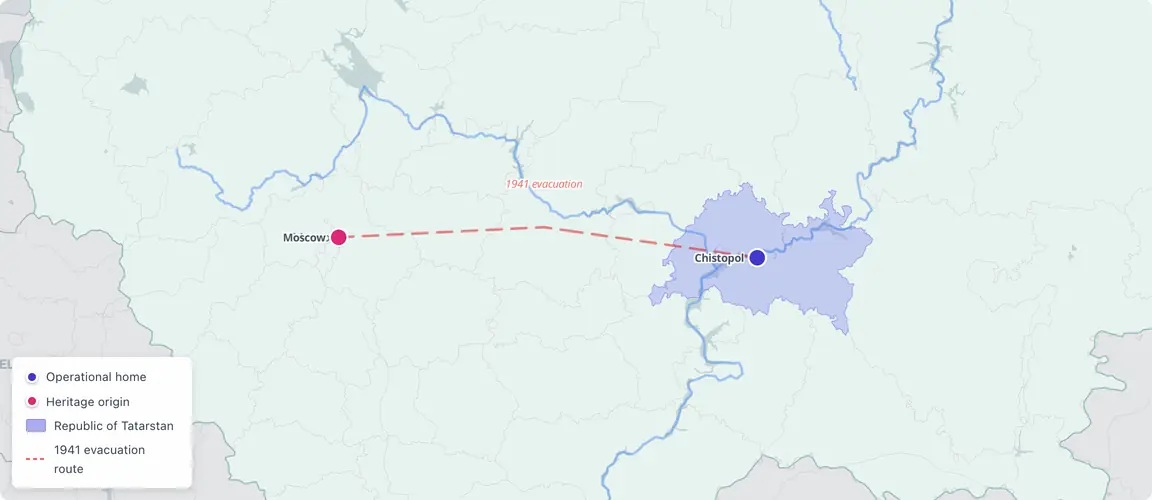
The factory that would become Vostok did not begin in Chistopol. It began in Moscow, as the 2nd Moscow Watch Factory, until October 1941 when Stalin’s State Defense Committee ordered it evacuated east as German forces approached the capital. Four hundred and eighty-eight workers and 170 railcars of equipment made the journey — by barge down the Kama River until it froze, then by horse-drawn wagon through temperatures below minus forty. Designated Factory No. 835, the evacuated plant reached full wartime production by July 1942, manufacturing tank watches, mine fuses, torpedo components, and parachute deployment mechanisms.
By February 1943, the first civilian wristwatches — the Kirovskie K-43 — rolled off the line, produced as awards for Red Army command staff. Watchmaking in Chistopol became permanent. The city, a modest settlement on the Kama in what is now Tatarstan, would build its entire civic infrastructure around the factory. By 1965, the plant had become the designated watch supplier to the USSR Ministry of Defense, and the Komandirskie (Командирские, “Commander’s”) line launched — sold exclusively through military Voentorg stores, with dial designs proliferating across every branch of the armed forces: tanks, submarines, aircraft, paratroopers, strategic missiles.
At its Soviet peak the factory is reported to have produced 4.5 million watches a year, according to Russian Wikipedia; Grachev, recalling the plant in 2016, put its output at 200,000 watches a month, about 2.4 million a year. Twelve thousand workers operated in three shifts. The factory had built 145,000 square metres of housing, a cultural centre, a school, and a hospital. Chistopol was not a city that happened to have a watch factory. It was a watch factory that had built itself a city. The Russian designation for this arrangement — градообразующее предприятие (city-forming enterprise) — would later earn Chistopol official monograd status, meaning the entire municipality’s economic survival depended on a single employer.
Then the Soviet Union ended, and everything that had sustained the factory ended with it.
Almost nothing left
The collapse was not sudden. It was a long erosion that lasted two decades. When the factory privatised as OAO in 1993, it signed a three-year exclusive sales agreement with the Swiss trading firm BN-Trading, which planned to take 500,000 watches a year under its own mark; according to Russian Wikipedia, the plant could not sell without that mark. But Chinese watches flooded the domestic market: by 2004, Chinese imports had captured approximately 80 percent of it, and the Chistopol factory was continuously unprofitable. Russia’s later accession to the World Trade Organization cut protective duties further: Grachev said in 2016 that the duty on imported watches, 10 euros until 2013, had fallen to between 1.50 and 4 euros.
The institutional response was fragmentation. In 2006, watch production transferred from the parent OAO to subsidiary LLC Russkie Chasy amid financial distress. By August 2009, production had moved again, to LLC Torgoviy Dom, while the parent carried debt it could not service. Grachev, recalling the 1990s in 2016, said the managers of the time had split each line of business into a separate, financially independent production to react faster to change. In 2009 the Ministry of Defense — historically the factory’s anchor customer — halved its watch orders. Credit repayment deadlines arrived simultaneously.
By February 2010, the factory’s accounts held 101,000 rubles, 693 euros, and $187. General Director Evgeny Pukhov informed creditors that the enterprise was not in a condition to conduct full economic activity. On April 22, the factory filed for its own bankruptcy. On September 29, 2010, the Arbitration Court of Tatarstan made it official. Bankruptcy manager Anatoly Khromov’s verdict was clinical: restoring solvency and production activities of the debtor is not possible. Total recognised creditor claims: 37.92 million rubles. The comedy show “Prozhektorperiskhilton” (Прожекторперисхилтон) mocked the news on national television, joking that Russian commanders would need to carry microwave ovens to tell time.
The state had declared the factory dead. But production never stopped. Through the subsidiary entities — the very corporate fragmentation that had been a symptom of decline — watches continued rolling off the line throughout the bankruptcy proceedings. The institutional knowledge, the tooling, the calibre designs, the skilled hands that knew how to assemble 218 components into a movement that kept time — none of it had been liquidated. It had merely lost its legal container.
Their own money
On February 21, 2013, three factory insiders registered a new joint-stock company: Ivan Grachev (Иван Грачёв) holding 34 percent, Sergey Tishchenko (Сергей Тищенко) holding 33 percent, and Vladimir Mosin (Владимир Мосин) holding 33 percent. All three were factory insiders. They pooled their own capital — not a bank’s, not the state’s — and consolidated scattered equipment from multiple buildings into a single 8,000 square metre facility housing over 1,000 pieces of production equipment.
By 2016 the company had a stated policy on credit. “We decided to be done with borrowing,” Grachev told BIZNES Online in January 2016. The reasons he gave were pragmatic: creditors demand repayment in a crisis, jobs depended on the enterprise, and he distrusted credit decisions taken by a bank in Kazan or Nizhny Novgorod. He said the company planned to buy equipment through subsidised leasing rather than bank loans.
By 2016 the factory was producing 15,000 to 18,000 watches per month — roughly 180,000 to 216,000 annually — with about 450 people, counting adjacent enterprises. The production line manufactured 93 percent of each watch’s 218 components in-house: movements from the 24xx calibre family, cases, dials, hands, crystals. Only artificial ruby bearings, straps, and Swiss watch oil came from external suppliers. In an industry where most manufacturers assemble sourced components, Vostok remained what it had been since 1942: a full-cycle manufacturer. By output it is Russia’s largest mechanical watchmaker: 180,000 to 240,000 watches a year against the 5,000 to 6,000 that Raketa, the other Russian factory known to make its own movements, produces, according to T-Journal’s 2026 ranking.
The global cult following that had sustained demand through the bankruptcy years continued to grow. On Reddit’s watch forums and WatchUSeek, the Amphibia became one of the most obsessively collected and modified mechanical watches in the world — a $70 entry point into serious horology that spawned more than fifteen aftermarket suppliers offering custom bezels, dials, hands, and case modifications. The Amphibia’s bezel insert dimensions happened to be compatible with the Seiko SKX, the other great affordable dive watch, creating a cross-pollination ecosystem that no marketing department could have engineered. The wobbly crown, the quirky Soviet-era dial art, the compression seal that tightened under pressure — these were not defects to be corrected but features that generated devotion.
When Western sanctions disrupted international payment processing and shipping after 2022, prices for Vostok watches roughly doubled on the global market. European intermediaries — Vostok-Watches24 and Poljot24, both based near Munich — became critical workaround channels. The sanctions did not kill international demand. They made the watches harder to obtain, which in collector markets is a distinction with a specific name: scarcity premium.
What survives, and what remains at risk
Revenue reached about 201 million rubles in 2024 — up 42 percent year-over-year. But cost of sales at 212.6 million rubles exceeded revenue, yielding a net loss of 24.2 million rubles. Vostok is growing and losing money simultaneously — a pattern that reflects the economics of manufacturing 180,000 or more mechanical watches per year at prices starting under $60, in a market where, by Grachev’s 2016 account, smuggled and counterfeit imports undercut domestic producers. Survival, not profit, remains the operating mode.
The factory entered a voluntary corporate consolidation in January 2025 — absorbing three subsidiary LLCs back into a unified entity, reversing the fragmentation that had spread operations across subsidiaries. The Bank of Russia suspended related share emissions for the merger process. This was not another bankruptcy. It was an efficiency play: one legal entity, one set of accounts, one management structure.
The equipment on the factory floor can support three to five times current production volumes. The bottleneck is not capacity. It is skilled labour — the machinists, movement assemblers, and quality inspectors who know how to produce a mechanical watch to tolerance in a city of 60,000 people where trained hands are scarce. Each watch passes through a 14-day quality testing regimen before shipment. The institutional knowledge required to maintain that standard is hard to hire from outside Chistopol; Grachev said in 2016 that the company required employees nearing retirement to train their replacements.
Grachev stepped back from the General Director role by January 2025 in favour of co-founder Tishchenko; the company’s site lists him as Director. The three co-founders remain the only documented shareholders. No next-generation involvement has been announced. No formal succession plan is visible. The factory that three insiders restarted with their own money has not yet answered the question of what happens when those three insiders are no longer there.
The Amphibia’s compression seal — the physics that defied logic in 1967 — remains the product identity that sustains the entire enterprise. A $70 watch with a wobbly crown, manufactured in a small Tatarstan city by a factory that a bankruptcy manager once judged beyond saving, continues to attract buyers in about a dozen countries, by Grachev’s 2016 count. The seal still tightens under pressure. So does the factory. Whether either can continue to do so without the hands that rebuilt them is the question that hangs over Chistopol like the Tatarstan winter.
Researched 23 sources in Russian, English.