 Skip to main content
USHATÁVA
Two women with no fashion credentials, a borrowed showroom in a Yekaterinburg beauty studio, and a stake of roughly ₽200,000–250,000. A decade later, USHATÁVA records ~₽786M in revenue, stages its jubilee show at the Garage Museum, and opens its first investor conversation — proof that federal fashion scale does not require a Moscow address.
From a Ural Beauty Studio to Federal Scale
From ₽200K and a beauty studio to a Garage Museum jubilee
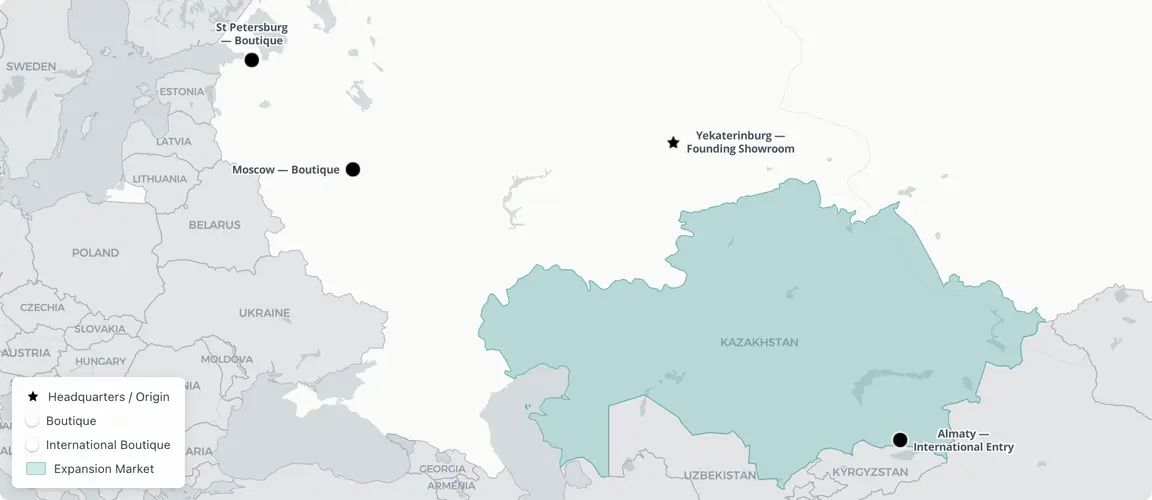
Russia’s premium fashion brands tend to carry a Moscow origin story. USHATÁVA does not. It was born in a Yekaterinburg beauty studio in 2015, financed by a friend’s food-delivery money, built by two women who had left formal fashion courses and taught themselves to cut and sew. A decade later, the brand records ~₽786M in annual revenue, stages its jubilee show at the Garage Museum, and — for the first time — sits across the table from investors. The journey between these two points runs through two consecutive crises that would have ended most businesses at half their size.
The bet that wasn’t supposed to work
USHATÁVA was founded in 2015 by Nino Shamatava (Нино Шаматава) and Alisa Ushakova (Алиса Ушакова) — creative director and CEO, respectively — in circumstances the Russian fashion industry did not regard as promising. The capital was a personal loan of roughly 200,000–250,000 rubles from a friend who ran a food-delivery operation. There was no fashion-industry background: both founders had enrolled in formal courses and left, concluding that the instruction did not match what they wanted to make. They taught themselves instead. The showroom was a space inside a Yekaterinburg beauty studio — a room borrowed from another trade, in a city four hours east of Moscow by plane.
The logic of the wager was not obvious. Russian designer fashion concentrated in Moscow, drew from European supply chains, sought investment early, and oriented itself toward the metropolitan consumer. USHATÁVA did none of these things. It operated in the Urals, sourced locally, used its own cash, and built from a regional audience outward. By the end of the first year, the founding stake had been recovered. The bet had not failed. Whether it had succeeded was still an open question.
2016 answered part of it. USHATÁVA opened boutiques in Yekaterinburg and Sochi and established a first Moscow showroom — not a sequential market-by-market expansion but a parallel strike across three distinct cities. The brand staged a 700-guest show with hay-bale seating, an aesthetic choice that announced it would not imitate Moscow fashion-week conventions. Then it nearly imploded: a ~1-million-ruble fur order that the market did not absorb came close to wiping out the cash buffer the first year had built. The survival was narrow. The lesson — about inventory risk and the difference between editorial ambition and commercial demand — proved structural.
The same year brought an addition that would define the brand’s identity for five years: menswear designer Dachi Zukhbaia joined as content and art director. His work built the recognisable visual language that USHATÁVA would come to own — an aesthetic that made the brand’s imagery immediately identifiable against the broader Russian fashion-media landscape. The Petra collection (FW2017/18), the St Petersburg opening in 2017, the Ushatáva x Moms hand-knitting community project in 2018 — these additions each extended the brand’s range and register. By 2020, USHATÁVA recorded ~₽435M in revenue. Ushakova appeared on Forbes Russia’s 30 Under 30 list. Sanan Gasanov joined as co-creative director. The brand was at its pre-pandemic peak.
Two crises, back to back
The first crisis arrived in March 2020. COVID lockdowns eliminated offline retail — USHATÁVA’s primary channel — without warning. Unlike 12 STOREEZ, which had begun building e-commerce infrastructure before the pandemic, USHATÁVA had no meaningful online channel and no credit line. The brand entered what its founders would later describe as survival mode. There was no capital to absorb a prolonged offline shutdown, no digital channel to catch the displaced revenue, and no external investor to bridge the gap. The question was not whether the brand would grow; it was whether it would continue to exist.
It did, though the margin is not documented in any public record in precise terms. What is clear is that USHATÁVA emerged from the first crisis — but without the runway to absorb a second one.
The second crisis arrived on 15 August 2021. Dachi Zukhbaia died at 33. His death was not only a personal loss but a structural one: the visual identity he had built over five years — the photography, the campaign aesthetic, the recognisable look that made USHATÁVA’s output distinct from other Russian designer brands — went with him. A business that had survived a revenue collapse now faced a different kind of crisis: the loss of the person most responsible for communicating what the brand was.
The scale of this loss is difficult to quantify but easy to describe. Fashion brands are, at their core, acts of communication — propositions about a way of seeing and being seen. USHATÁVA’s communication had been shaped substantially by Zukhbaia’s eye. Without it, the brand had to decide whether to find a replacement voice or to reframe the loss as a turning point. It chose the latter.
The Research pivot
On 1 September 2022, USHATÁVA staged a memorial show for Dachi Zukhbaia at Bounce in Moscow. The show was not simply a tribute; it marked a strategic reorientation. The brand announced a middle-up pivot — a deliberate move toward a higher price point and a more premium positioning — and launched Research, a new runway-oriented line that would carry the most ambitious design work. The line name was intentional: an acknowledgment that the brand’s next chapter would be built through investigation and experimentation rather than through the repetition of what had already worked.
The short-term numbers were painful. FY2022 revenue fell 36% to ~₽229M — a consequence of both the ongoing adjustment to Zukhbaia’s absence and the broader compression in Russian consumer spending that followed February 2022’s geopolitical rupture. The brand was smaller, more expensive, and operating in a market that was simultaneously contracting and reconfiguring. The Research pivot was a bet made under duress, on a thesis that had not yet been tested by the market.
The founders stated it simply: “We decided to make a fashion house.” The remark, made to SETTERS Media in 2023, carries the characteristic register of a decision taken when options are limited — not grandiose but precise. A fashion house is a specific thing: a multi-line organization with a defined aesthetic hierarchy, where each line serves a distinct customer purpose and price tier. Garderobe addresses everyday construction; Special handles capsule releases; Ushatáva x Moms extends the brand into artisan hand-knitting. Research sits at the top — the editorial and commercial flagship, the line that tests ideas the other lines will later absorb. The architecture was not assembled all at once; it was assembled under pressure, as each crisis eliminated one path and clarified another.
The architecture of a fashion house
The multi-line structure that emerged from the crisis years is not incidental to USHATÁVA’s commercial model — it is the model. Research occupies the premium tier: runway collections priced toward the top of the brand’s ₽5,000–₽150,000 range, with annual price increases of 25–27% since the 2022 repositioning, intended to function as the editorial flagship. Garderobe addresses the everyday wardrobe — the everyday-constructor register where the brand retains its broadest accessible customer base. Special handles capsule releases and limited-edition collaborations. Ushatáva x Moms sits outside the industrial production logic entirely: a community hand-knitting project, launched in 2018, that connects the brand to artisan labour and to a register that no competitor in the Russian designer segment has occupied.
Each line speaks to a different customer decision and a different price tolerance. The Research buyer is purchasing an editorial position — a vote for what Russian designer fashion can be at its most ambitious. The Garderobe buyer is purchasing practical clothing that carries the brand’s aesthetic without the premium Research price. The Moms buyer is purchasing something that is explicitly not industrial — a garment that is slow, local, and made by a specific person. The architecture means that USHATÁVA can hold multiple registers simultaneously without the incoherence that afflicts brands trying to be everything in a single line.
The pricing trajectory bears examination. A 25–27% annual price rise over three consecutive years is not a cost-pass-through; it is a deliberate repositioning signal. The brand was communicating to its market — and to the trade — that it intended to occupy a higher tier, and that the product quality and design ambition justified the move. Whether the Russian consumer of 2025 agrees, in a year of softening demand and late deliveries, is the test the brand is currently running.
The vindication
FY2023 delivered the answer to the Research pivot thesis. Operating-company revenue reached ~₽504.3M, a x2.2 rebound from the 2022 trough. Net profit came in at ~₽81.2M. The Color.Block and Paper Street collections reinforced the premium positioning that Research had established. The middle-up pivot was no longer a thesis; it was a result.
FY2024 extended it. Revenue reached ~₽786.4M, with net profit of ~₽141.8M. PROfashion recognised USHATÁVA specifically for what it had accomplished — scaling a designer brand outside Moscow — in an industry where the received wisdom held that federal scale required a metropolitan address and institutional capital. In October 2024, Anton Letushev, a former executive at LIMÉ — one of Russia’s largest mid-market fashion chains — joined the brand to lead boutique network expansion and the first moves toward international entry. The hire was a signal: USHATÁVA was preparing for a different phase of growth, one that would require operating knowledge it had never needed before.
In 2025 came a further confirmation of the brand’s cultural standing. The Garage Museum — Moscow’s most internationally visible contemporary art institution — staged USHATÁVA’s 10-year jubilee as its first-ever fashion show. A Collectible Pieces exhibition accompanied the event. New boutiques opened at Afimall in Moscow and Galeria in St Petersburg. The brand had, by any available measure, arrived at the kind of institutional legitimacy that its founding circumstances did not predict.
The open question
The founders call 2025 the hardest year in the brand’s history. Consumer demand has softened across Russia’s fashion sector; store traffic has fallen; collections have shipped late, disrupting the retail calendar the brand had built around seasonal launches. The structural question that the premium pivot answered in 2022 — can a founder-built regional brand reach federal scale without outside capital? — has now been answered affirmatively. The question USHATÁVA enters 2026 carrying is different: can it cross the threshold to institutional scale while retaining the identity that made it worth scaling?
The founders’ March 2026 signal of openness to outside investment — the first in ten years — is a marker. A decade of self-financing means the brand has never been shaped by an investor’s return horizon or portfolio logic. Whether that independence was a structural advantage (preserving identity, avoiding growth-for-growth’s sake) or a structural limit (constraining the capital needed for the next phase) is the question USHATÁVA now has to answer explicitly, rather than by default.
The ~₽9.72M raised at the March 2026 Oncologica charity auction — a cause Ushakova has championed through the foundation — is not a capital event. But the founders’ public framing of it, and their simultaneous statement about investor readiness, suggests a deliberate shift in posture. The next year will determine whether that shift produces a transaction or remains a declared intention. Either way, the brand that emerges from it will have been built on a foundation that no investor helped lay.
Researched 22 sources in Russian.