 Skip to main content
SOKOLOV
In 1993, Alexey Sokolov started a nine-person jewelry workshop in a Kostroma village that has never had gold in its soil. His son Artem inherited it young, survived a ₽300M tax attack and formal bankruptcy, pivoted from wholesale to retail, and scaled tenfold to ₽68B GMV and 1,000 stores. In 2025 he sold it all — deal price undisclosed, estimated ₽30–40bn.
Village With No Gold to 1,000 Stores
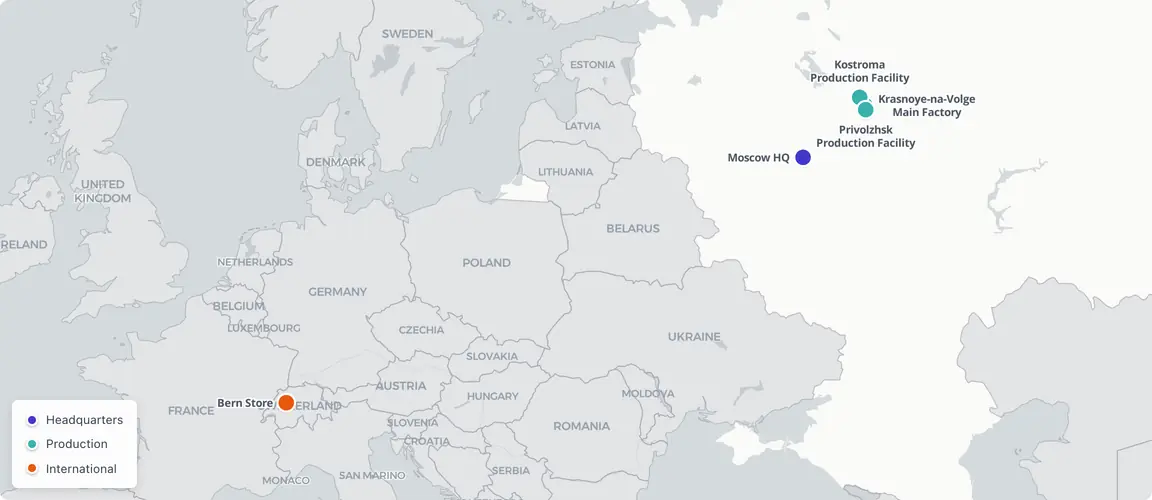
A nine-person Kostroma workshop scaled to ₽68B, then sold whole
Krasnoye-na-Volge is a settlement of 7,800 people on the Volga River, thirty-five kilometers from Kostroma. It has produced jewelry since the sixteenth century. It has never had a single gram of gold in its soil. Today, the village and its surrounding cluster account for over sixty percent of all jewelry sold in Russia — and the company that dominates that output, SOKOLOV (СОКОЛОВ), was started in 1993 with nine people and a kitchen table.
The machine behind the metal
The numbers alone make the case. In 2024, SOKOLOV reported ₽60.5 billion in IFRS revenue and ₽68.1 billion in gross merchandise value (~$792M USD) — a forty-one percent increase over the prior year. Net profit reached ₽6.0 billion. Adjusted EBITDA hit ₽13.1 billion, a thirty-three percent increase, with margins holding at twenty-two percent. The company operates roughly 1,000 mono-brand stores across 260 cities, employs 7,000 people, and produces more than 30 million pieces of jewelry annually from four factories spanning 50,000 square meters. Its in-house design bureau of forty people generates over 600 new models each month across a catalogue of 55,000 active SKUs. Brand awareness among Russian women aged eighteen to fifty-four reached ninety-six percent in a September 2024 NielsenIQ survey — the highest of any jewelry brand in the country, and an awareness figure that most consumer brands in any sector never achieve.
What separates SOKOLOV from every competitor is not scale but architecture. The company is Russia’s only major jeweler that controls the entire value chain: its own Kvart affinage plant processes 6.5 tonnes of gold and 11.5 tonnes of silver annually, with more than half sourced from recycled precious metals. Raw material flows from the refinery to four production plants, through a proprietary design pipeline, into both wholesale distribution to 4,500 business partners and an omnichannel retail network that generated ₽24.3 billion online in 2024 — thirty-six percent of total turnover. No competitor matches this vertical span. The nearest comparable player, 585*Zolotoy, operates a similar store count but manufactures nothing. The number-one retailer by revenue, multi-brand chain Sunlight, carries others’ products on its shelves. SOKOLOV is the only one that refines the gold, designs the ring, pours the mold, polishes the stone, and hands the box to the customer.
That architecture is not merely a competitive advantage. As SOKOLOV would discover, it is a survival mechanism.
Bricks before the default
The company’s founding story is inseparable from place. Alexey Sokolov grew up around the trade — his parents had spent their entire careers at the Soviet-era Krasnoselsky Jewelry Factory, one of several workshops that had clustered in Krasnoye-na-Volge since the reign of Ivan the Terrible. When the Soviet system collapsed, Alexey and his wife Elena, an economist by training, did what scores of other Krasnoye jewelers did: they started their own operation. In 1993, they launched a nine-person home workshop called Diamant. The growth was, by their son Artem’s later description, “spontaneous and chaotic” — a handful of artisans producing gold rings and chains with cubic zirconia for wholesale buyers who drove out from Moscow and paid in cash.
The first inflection came during the August 1998 ruble default. The crisis annihilated savings, shuttered businesses, and sent the ruble from six to the dollar to twenty-one overnight. While competitors froze, Alexey bought bricks and land at pre-crash prices. It was a contrarian bet that only a manufacturer embedded in a village — where land was cheap, labor was loyal, and the alternative to working was not working — could have made. Diamant’s first dedicated factory opened on that land in 2000, built with roughly thirty million rubles of the family’s own and borrowed money. By 2005, the production floor had expanded to 10,000 square meters. By 2008, revenue crossed one billion rubles with several dozen jewelers on the payroll.
Then came the second contrarian move. In 2009, during the global financial crisis, Alexey launched silver jewelry production — a category that established Russian jewelers had largely ignored as low-margin and unserious. His son would later call it “a 100% bullseye — father guessed the trend.” The reasoning was characteristically practical: gold prices were surging, consumers were trading down, and no domestic manufacturer had built a credible silver brand. Silver would eventually account for one-third of Russia’s jewelry market in monetary terms and two-thirds in physical volume. SOKOLOV had entered the category before anyone else took it seriously. The company that started with nine people making gold chains now had a mass-market product line that could reach customers who would never walk into a traditional jeweler.
The tax attack and the bankruptcy that saved the company
In 2011, the family opened an office in Bern and created the SOKOLOV brand name for European markets — a signal that the business had outgrown its factory-floor origins. At the JUNWEX trade exhibition in St. Petersburg in May 2014, all Diamant products were formally rebranded under the SOKOLOV identity. It was a decisive shift: Diamant was a manufacturer’s name, functional and forgettable. SOKOLOV was a consumer brand, carrying the family name into a market where brand recognition would soon matter more than wholesale relationships.
Months later, founders Alexey and Elena relocated to Switzerland. Their son Artem — at twenty-one, with no university degree — assumed operational control of a billion-ruble wholesale business.
He inherited a company. What he did not know was that a supplier’s fraud was about to detonate inside its tax history.
The broader context was brutal. Starting in autumn 2014, the Russian jewelry industry entered a prolonged contraction. National production crashed from 110 tonnes to 59 tonnes in a single year. The Federal Tax Service launched an aggressive crackdown on gray VAT schemes across the sector, initiating bankruptcy proceedings against approximately thirty companies, including major players like Adamas, which owed ₽2.5 billion to Sberbank, and TPK Yashma, facing roughly ₽10 billion in back-taxes. The cleanup was industry-wide. SOKOLOV was caught in the sweep.
In 2017, tax inspections began at Diamant’s parent entities — both legally founded by Elena Sokolova — covering the already-closed tax periods of 2012 to 2014. The claims traced through a VAT chain from the company’s then-largest supplier, Yuveliry Severnoy Stolitsy, which was separately under criminal investigation for ₽759 million in VAT fraud. Tax authorities assessed over ₽300 million in additional VAT against the Diamant entities. SOKOLOV was not the perpetrator of the fraud. It was the inheritor of the liability.
The company challenged the ruling in arbitration court and lost. In March 2018, formal bankruptcy proceedings were initiated. A bankruptcy trustee was appointed. The financial state at liquidation showed revenue of ₽570 million, losses of ₽760 million, and net asset value of negative ₽1.1 billion. SOKOLOV was, on paper, insolvent.
But Artem had already separated the production from the legal wreckage. Manufacturing transferred to a new entity, Yuvelit, ensuring that not a single day of factory output was lost. “We used the lawful bankruptcy procedure to make the process transparent, predictable, manageable,” he explained later. “Thanks to this, production did not stop.” The approach was surgical: contain the legal crisis in the legacy entities, protect the operating business, and keep 2,500 production workers employed while the courts decided.
This was not merely a legal maneuver. It was also the moment when SOKOLOV’s institutional architecture proved its worth. Because the company controlled its own refinery, its own factories, and its own supply chain, the bankruptcy of parent holding entities did not sever any critical external dependency. A less vertically integrated business — one reliant on outside suppliers, outside refiners, outside distributors — would have lost partners the moment bankruptcy was filed. SOKOLOV lost only the shell. The machine inside it kept running.
The court ultimately sided with the taxpayer, applying the rule against creating formal conditions for collecting taxes beyond what the law requires. All claims were resolved. The legacy Diamant entity was liquidated on October 7, 2019. SOKOLOV emerged operationally unscathed — and had already begun building something entirely new.
From factories to storefronts
The same year that bankruptcy proceedings began, Artem opened the first branded SOKOLOV retail store in Moscow. The timing was not coincidental. The bankruptcy had exposed the structural weakness of the wholesale-only model — dependence on intermediaries who could vanish at the first sign of legal trouble. Direct retail eliminated that vulnerability and placed SOKOLOV’s brand, pricing, and customer experience under its own control for the first time.
The pivot proved transformative. From a single Moscow store in 2018, the network grew to 226 locations by 2021 with ₽14 billion in revenue. When the pandemic struck in 2020, SOKOLOV launched a mobile app that reached four million users by year-end, pushing online channels to thirty percent of total revenue. The digital acceleration was not a pandemic afterthought — it was a structural commitment. By 2024, the company operated roughly 1,000 stores — 776 company-owned and 224 franchise — and online had grown to thirty-six percent of turnover, generating ₽24.3 billion, with marketplace sales on Wildberries and Ozon growing fifty-one percent year-on-year.
The vertical integration deepened in parallel with the retail expansion. In 2019, the company opened a second production facility in Kostroma, adding 19,000 square meters. In 2021, its own Kvart refinery entered the official Russian precious metals refiners list — the twelfth licensed refinery in the country, completing vertical integration from raw recycled metal to finished consumer product. A third plant opened in Privolzhsk in Ivanovo Oblast in 2022.
The brand portfolio expanded to match the infrastructure. SKLV launched in 2018 as a youth and streetwear line. SOKOLOV Diamonds debuted in 2021, targeting the premium segment with actress Renata Litvinova as brand ambassador. In August 2024, the SOKOLOV Premium retail format opened nine high-end stores. The original Diamant name was relaunched in 2022 as an affordable franchise concept — a deliberate reuse of heritage for a different market tier. Product categories extended beyond jewelry into watches, leather accessories, and cosmetics under SOKOLOV Beauty. The company was no longer a jeweler that happened to have stores. It was a consumer brand that happened to make jewelry.
The institutional milestones followed the commercial ones. In November 2022, SOKOLOV received the first credit rating ever awarded in Russia’s jewelry industry — BBB+(RU) from ACRA, later upgraded to A(RU) stable. The company issued a ₽3 billion bond on the Moscow Exchange. It was named most loved jewelry brand by Russians for five consecutive years running, and won Brand of the Year Russia 2024 in the jewelry category. The progression from kitchen workshop to rated credit issuer took thirty years.
The proof is in the price
On August 14, 2025, Artem Sokolov sold one hundred percent of SOKOLOV to private investor Anton Pak, brokered by Aspring Capital. The transaction price was not disclosed, but expert estimates ranged from ₽30 billion — based on a six-times EBITDA multiple with a Russian market discount — to ₽40 billion (Mikhail Burmistrov, CEO of Infoline-Аналитика, via Kommersant, 2025-08-14). A separate ₽65 billion estimate, once carried alongside these, is withdrawn — it sat close to Welvart Group’s unrelated FY2024 revenue and had no independent source. This makes the sale one of the largest Russian retail transactions in recent years regardless of the exact figure. Negotiations had lasted two years.
“In 10 years we grew 10 times,” Artem wrote in his farewell. He was thirty-two. His parents had started with nine people.
The logic of the exit was strategic, not sentimental. Artem had explained that continued growth outpacing the market would require additional investment — capital that could come from an IPO, from a strategic partner, or from a new owner willing to fund the next phase. He chose exit over dilution. Professional CEO Nikolay Polyakov, already in place, remained to ensure continuity. The founding family stepped away cleanly, with the charitable foundation they had registered in Krasnoye-na-Volge in February 2024 signaling where their attention would turn next.
The sale validated more than a family’s ambition. It demonstrated that vertically integrated, family-built consumer brands in emerging markets can achieve institutional scale, survive existential crises, and command premium valuations — provided the architecture is sound and the generational transfer happens when it should. The factories still run three shifts in Krasnoye-na-Volge. The village that has never had gold in its soil continues to turn recycled metal into Russia’s most recognized jewelry brand.
Ownership Transition
"Artem Sokolov sold 100% to private investor Anton Pak after two years of negotiations, brokered by Aspring Capital; professional CEO Nikolay Polyakov remains in place"
Researched 20 sources in Russian.