 Skip to main content
Shanshan Group
Shanshan turned an insolvent Ningbo factory into China's first listed apparel company, then reinvented itself twice — lithium-battery materials, then the world's largest LCD polarizer supplier. Its founder died in 2023 without a will. Within three years, RMB33.55bn in claims forced bankruptcy; creditors recovered ~2.3%.
Four China Footholds, One Anhui Takeover
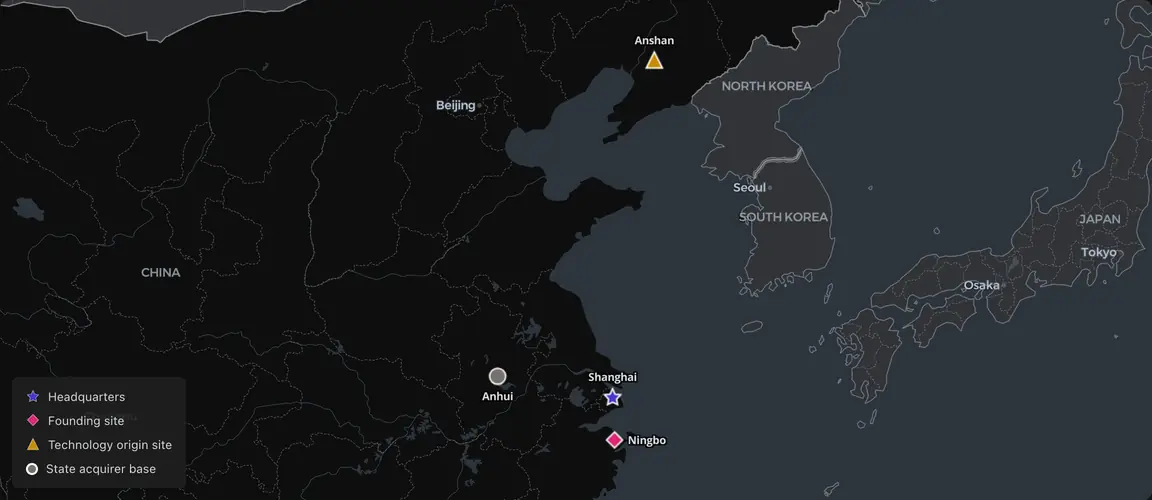
A menswear empire, twice rebuilt, undone by one missing document
Shanshan (杉杉) built China’s first listed apparel brand, then reinvented itself twice into a materials conglomerate the world had never heard of — lithium-battery anode materials, then LCD polarizers, the film that makes every flat screen work. By 2021, it was global No.1 in the latter. Its founder, Zheng Yonggang (郑永刚), took over an insolvent Ningbo garment factory in 1989 and spent 34 years proving he could see the next cycle before it arrived. What he never built was an instrument to transfer control when he could no longer see it himself. He died intestate in February 2023, aged 65. Three years later, Shanshan Group was in bankruptcy restructuring, ordinary creditors had recovered roughly 2.3 cents on the yuan against RMB33.55bn in confirmed claims, and control of the enterprise had passed to a state-owned consortium in a province Zheng never operated in.
Two companies wearing one name
Shanshan’s name conjures menswear to anyone who knew the brand in the 1990s — with reason. In 1989, Zheng took charge of the Ningbo Yonggang Garment Factory, an insolvent state enterprise that had burned through three managers in three years and carried debts exceeding RMB10 million. He saw what the previous managers had missed: sound equipment and export experience, just no brand and no market. He built both. The same year, Shanshan aired “Shanshan Suits — don’t be too dashing,” China’s first suit-brand television commercial, on borrowed money. Demand followed overnight. By 1996, Shanshan Shares had listed on the Shanghai Stock Exchange under code 600884 — the first listed company in China’s apparel industry. By 1998, Shanshan’s suit brand held roughly 37.4% of the national market, China’s undisputed No.1.
That is where most accounts of Shanshan stop, because that is where the recognizable brand stops. What happened next is a different company operating under the same listed entity. In 1999 — with the apparel business still comfortably profitable — Shanshan entered a joint venture with the Anshan Thermal Energy Research Institute on mesophase carbon microspheres (MCMB), an anode material for lithium batteries. It was a bet on a technology Zheng did not understand, made while the business that did understand him was still winning. By 2001, Shanshan’s MCMB mass production had ended Japan’s monopoly on lithium-battery anode materials. By 2013, battery-materials revenue had overtaken apparel inside the same company. The pivot was complete before most of Shanshan’s own customers noticed a pivot had happened.
The second reinvention came later and larger. Between 2020 and 2021, Shanshan acquired LG Chem’s LCD polarizer business for more than RMB5 billion (~$770 million), forming Shanjin Optoelectronics and becoming the world’s largest supplier of the polarizing film that sits inside every LCD screen. Zheng described the acquisition, in a 2021 interview, as a move he did not choose so much as one that was forced on him — “not something I proactively chose… it was forced on me” — and, separately in the same interview, called the polarizer business “my last battle. I will accomplish it, and I’m proud of that.” He was past 60 when he said it. Group revenue peaked at RMB20.7 billion in 2021, up 151.9% year-on-year; the share price peaked at RMB43.47; market capitalization reached roughly RMB72.5 billion in 2022. By any institutional measure, Shanshan Group in 2021 was one of Zhejiang’s genuine industrial success stories — a business that had escaped a commodity apparel category twice and landed, twice, on the right side of a global supply chain.
Sector-wise, the industrial-materials Shanshan of 2021 has no canonical parallel to the menswear Shanshan of 1989 — this profile documents both eras of one continuous listed entity, but the enterprise that built polarizers and the enterprise that sold suits are, in every operational sense, two companies wearing one name. Zheng himself framed the apparel exit in cyclical terms rather than as a retreat: “Every industry has cyclical laws; Shanshan’s apparel business had run its cycle… When the industry was good, I was already preparing for the next cycle.” That instinct — moving before decline rather than after it — is the single thread connecting the 1999 lithium bet and the 2020 polarizer acquisition. Both were made from a position of strength, not distress, which is precisely why the operating businesses survived what came next while the ownership structure around them did not.
The mechanism nobody built
None of that scale mattered for what came next, because the risk that ended Shanshan was never operational. Zheng chaired the group’s 2023 economic work conference on January 12 — a routine appearance, unremarkable at the time, that turned out to be his last public address. On February 10, 2023, he died suddenly of a heart attack while in Japan. He was 65. He had, by his own account in a 2018 interview, been grooming his son Zheng Ju to succeed him — “a son born into my family should inherit it,” he said at the time — but that intention was never converted into a will, a trust, or any formal governance instrument. When he died, Shanshan Group lost its controlling strategist and gained a vacuum.
The vacuum filled with conflict inside six weeks. On March 23, 2023, Zheng Ju was elected chairman by a full board vote; his mother, Zhou Ting, publicly contested the meeting’s legitimacy, asserting a claim to control by inheritance. Three days later, the Shanghai Stock Exchange issued a regulatory work letter urging orderly handling of the dispute — a listed company’s succession crisis had become a matter for the regulator, not just the family. By May 2023, a lawsuit and share freeze were resolved through a truce: both mother and son joined the board, with Zheng Ju remaining chairman. The truce did not hold. In November 2024, the SSE disciplined the company over controlling-shareholder fund occupation totaling RMB1.788 billion — Zheng Ju stepped down as chairman, and Zhou Ting took the seat.
By the time the company reached the Ningbo Yinzhou District Court in February 2025 to file for substantive-consolidation bankruptcy restructuring, the succession dispute and the balance-sheet crisis had become the same crisis. Two years of contested control meant two years without a strategist empowered to renegotiate terms, refinance short-dated obligations, or make the kind of forward-looking capital-allocation call that had defined Zheng’s tenure. A first restructuring plan, led by a shipbuilding-industry consortium, was rejected by creditors and shareholders in November 2025 over synergy concerns — the market’s verdict that an unrelated industrial buyer without a feedstock or supply-chain logic could not credibly run a materials business it did not understand. Confirmed bankruptcy-restructuring claims against the group reached RMB33.55 billion. As of the group’s disclosures around that period, 95% of its RMB12.621 billion in interest-bearing debt (excluding the listed company) was classified short-term — a company whose obligations had come due all at once, with no single decision-maker left who could restructure them.
The distinction between the two crises matters for how the collapse is read. Shanshan did not fail because its polarizer business stopped being competitive — Shanjin Optoelectronics remained the world’s largest supplier of the product throughout the restructuring. It failed because the entity that owned the polarizer business could not resolve who was allowed to make decisions on its behalf, for long enough that short-term creditors stopped waiting. A governance vacuum, left open for two years, did to a healthy operating business what no competitor or market shock had managed to do in three and a half decades.
What the state bought
In February 2026, an Anhui SASAC-linked consortium — Wanwei Group and Conch Group — was selected as the rescuer investor, with a clear industrial logic: Anhui Wanwei is a PVA feedstock producer, and PVA is a direct input to the polarizer film Shanshan’s Shanjin Optoelectronics unit makes. This was not a distressed-asset speculator; it was a vertically integrated buyer absorbing a supplier. Where the rejected shipbuilding consortium had offered capital without a coherent reason to hold the asset, Wanwei and Conch offered both capital and a supply-chain rationale a materials business could credibly operate under. The consortium’s total investment was capped at approximately RMB 7.16 billion; the direct share purchase, roughly RMB 4.99 billion for 13.5% of the company, sat within that cap, and a concert-party arrangement added a further 8.38%, bringing voting control to 21.88%. In April 2026, the restructuring plan cleared creditor and shareholder votes and the court’s approval. The operating business survives — Shanjin Optoelectronics keeps making polarizers, the plants keep running — now under Anhui SASAC control.
For ordinary creditors, the recovery rate on confirmed claims of RMB33.55 billion came to approximately 2.3%. For the founding family, the outcome was starker still: the control-chain equity that Zheng Yonggang spent 34 years building was reduced to economically worthless subordinate trust units. Zheng Ju’s own remaining personal shares — 1.81 million of them — were separately, judicially executed to zero in June 2025, wiping out what remained of his direct stake independent of the corporate restructuring. The son who was meant to inherit is reported in Chinese press as currently residing in Japan.
What survived is instructive in its own right. The physical enterprise — the anode-materials plants, the Shanjin Optoelectronics polarizer lines, the decades of accumulated engineering knowledge that broke Japan’s monopoly in 2001 and out-executed a Korean conglomerate’s asset sale in 2021 — needed none of the corporate restructuring to keep functioning. What needed rescuing was the ownership layer sitting above it: the holding structure, the equity claims, the RMB33.55 billion of obligations that had accumulated against a company nobody had full authority to run. The operating business Zheng built proved durable. The ownership vehicle he never protected did not.
The lesson the numbers carry
Shanshan’s collapse is not a story about a bad decade. Every strategic call the company made after 1989 — the television bet, the lithium pivot made while apparel still worked, the polarizer acquisition — proved right, sometimes spectacularly. Revenue quintupled between the anode pivot and its 2021 peak. The company beat Japanese incumbents in materials science and out-executed a Korean conglomerate in the LG Chem acquisition. None of that operational judgment transferred to the one decision that mattered most: what happens to a founder-controlled, listed industrial group when its founder is gone.
Zheng’s own words, given to a Zhejiang business publication in 2018, capture the irony precisely: “I am grooming my son to succeed me… a son born into my family should inherit it.” He meant it as a plan. It functioned as an intention with no legal form — no will, no trust, no governance firewall between the founder’s personal authority and the company’s institutional continuity. A 2024 survey of Chinese family businesses found that roughly 68% of private entrepreneurs have no formal will; Shanshan is what that statistic looks like at scale, in a company with a market cap that once reached RMB72.5 billion. The operational brilliance built a world-leading enterprise twice. The absence of a succession instrument dismantled it once, in under three years, and handed what remained to a province Zheng Yonggang never chose to do business with.
Ownership Transition
"Anhui SASAC-linked consortium selected as rescuer investor after creditors rejected a first restructuring plan; operating business survives under state control, founding family's equity reduced to economically worthless subordinate trust units."
Researched 26 sources in English, Chinese.