 Skip to main content
Raketa
From 8,000 workers to twenty pensioners in a freezing ruin — and back to 104 specialists and 477.8 million rubles in revenue. Raketa is one of a small number of watchmakers on earth making its own hairsprings, independent of the Nivarox supply chain most of the industry relies on.
Peter the Great's Factory at Geneva's Table
From imperial decree to Geneva Watch Days
When David Henderson-Stewart first walked into the Petrodvorets Watch Factory in 2009, he found roughly twenty elderly workers in a building with broken windows and sub-zero temperatures. They were making tick-tock sounds for tourist souvenirs. What they had preserved, against all logic, was the ability to make hairsprings — a capability shared by only a small number of watchmakers worldwide.
The last manufacture standing
The factory that Henderson-Stewart discovered in Peterhof (Петергоф) sits at the end of a three-century chain of improbable survival. Peter the Great founded the Imperial Peterhof Lapidary Factory in 1721 for hardstone carving, adjacent to the summer palace that draws three million visitors a year. By 1938 the factory was cutting precision ruby stones for watch mechanisms — the beginning of a transition from decorative arts to horology that would define its next century. In 1945, Stalin decreed it would manufacture complete watches; by 1949, the first Pobeda (Победа, “Victory”) timepieces left the production line. When Yuri Gagarin orbited the earth in 1961, the factory renamed its brand Raketa (Ракета, “Rocket”) — tying Soviet watchmaking permanently to the space programme. Four years later, the ultra-thin Caliber 2209, at just 2.7mm, won a Gold Medal at the International Leipzig Trade Fair, demonstrating that Soviet horology could compete with Swiss precision.
At its Soviet peak around 1980, the Petrodvorets factory employed 8,000 workers across fifty production lines, produced 4.5 to 5 million watches per year, and exported to 38 countries. Every third resident of Peterhof worked there. The factory was not merely a watchmaker but a self-contained manufacture — it produced movements, hairsprings, escapements, cases, dials, and hands under one roof. That vertical integration, unusual even among Soviet industrial enterprises, would prove to be the difference between extinction and revival.
Three decades of collapse
The Soviet Union’s dissolution in 1991 destroyed the state procurement system that sustained the factory overnight. Raketa had no experience with market economics, no brand strategy, no retail relationships, and no understanding of consumer demand. Production collapsed across the 1990s. Around 2000, factory director Oleg Tychkin died, much of the complex was converted into a shopping mall, and the workforce fell to roughly forty masters maintaining one production line out of fifty.
By the time Henderson-Stewart arrived in 2009, the headcount had dropped further to approximately fifteen to twenty. The survivors were pensioners who had worked there for decades — women like Ludmila Voinik, employed since 1957, who continued to assemble watches in freezing conditions for negligible wages. The factory’s archives held over 30,000 historical watch designs. Its machines, Soviet-era analog equipment built to tolerances that no longer existed in Western catalogues, sat idle on production floors designed for thousands. The institution was clinically dead by every business metric. But the capability — the knowledge encoded in those elderly hands, the machines that could still cut hairsprings from Soviet-era alloy — remained intact. No other post-Soviet watch factory had preserved this chain of competence. The handful that survived had become assembly operations, importing Swiss movements and stamping Russian dials onto foreign calibers. Raketa’s ruin was the only place left where a complete movement could be built from raw materials.
“It was like a diamond laying on the floor,” Henderson-Stewart would later say. Every Swiss watch expert told him to walk away. The factory was dead. What he lacked in horological knowledge he made up for in the kind of ignorance that occasionally builds empires.
The outsiders’ bet
Henderson-Stewart, a Franco-British lawyer practising in Moscow, and his partner Jacques von Polier acquired the factory in 2010 with funding from “friends, relatives, and acquaintances.” They retained every remaining worker. Three Swiss watchmakers — veterans of Rolex, Breguet, and Hautlence — were recruited to assess the manufacture’s capabilities. In 2012, Jean-Claude Quenet, former director of escapements at Rolex and production head at Franck Muller, joined the factory, bringing Swiss haute horlogerie expertise to a Soviet-era production floor. The Petrodvorets Watchmaking School opened on the factory premises — Russia’s only training programme for mechanical watchmakers.
The first new collection debuted at Baselworld in 2011. Back in Russia, the reception was brutal. By Henderson-Stewart’s own account, not a single retailer would stock Raketa watches, even on consignment. The brand name carried Soviet nostalgia but zero commercial credibility in a market where Russian consumers aspired to Swiss names. Revenue between 2012 and 2014 produced consecutive losses while the workforce grew from fifteen to roughly eighty people — each new hire increasing the burn rate of a company with no retail channel and no domestic market. The strategy that would eventually work — monobrand boutiques that told the manufacture story directly — had not yet been conceived. Henderson-Stewart was spending other people’s money to rebuild a factory that the market did not want.
The 2014 ruble crisis compounded the damage. The pivot to monobrand boutiques — which would eventually bypass the retail gatekeepers who refused to stock the watches — was still years away from proving viable. And then, in 2014, something happened that no Swiss consultant would have predicted: the factory launched the Raketa-Avtomat, the first new Russian automatic movement caliber in thirty years. The 242-component movement was designed and assembled entirely in-house. In Moscow, the Raketa Monumental Clock — a five-ton, 13-by-8-metre mechanism designed by von Polier — was installed at the Central Children’s Store and inaugurated by Mayor Sobyanin. The technical proof-of-concept was established. The commercial proof remained absent.
August 2016 was the binary moment. Von Polier described it bluntly: “We were faced with a choice: go all-in, or close the factory.” The company nearly shut down entirely. A last-minute investor — whose identity Henderson-Stewart has never disclosed — saved the project. The year ended with Raketa’s first profitable result: 54.2 million rubles in revenue. The factory had survived, but barely.
The hairspring advantage
What makes Raketa strategically significant, beyond its heritage narrative, is a technical capability that most watch enthusiasts overlook: the factory produces its own hairsprings. The hairspring — the oscillating spring that regulates a mechanical watch’s accuracy — is the single most difficult component to manufacture, and most of the industry buys finished hairsprings from the Swatch Group’s Nivarox subsidiary rather than making its own. Raketa is one of a small number of watchmakers that do not: Monochrome Watches (February 2026) names Rolex, Patek Philippe, Bovet, Ulysse Nardin, Schwarz Etienne, Raketa, and A. Lange & Söhne among the manufactures with in-house hairspring production — the first third-party source, independent of the company itself, to place Raketa in that group.
Raketa’s own account is that the alloy’s composition is a closely guarded formula developed during the Soviet era for temperature-compensating balance springs — a secrecy claim the public GOST 10994-74 standard contradicts. When Western sanctions hit in 2014 and again in 2022, the factory’s dependence on Soviet-era equipment, which every consultant had identified as a liability, became a decisive advantage. “If we had modern Swiss machines, they would have stopped; we couldn’t repair them,” Henderson-Stewart told Kommersant in October 2024. The old machines required no Western servicing, no imported spare parts, no software updates from sanctioned jurisdictions.
Today, each Raketa watch contains 242 components, of which 95% are Russian-made. Each watch passes through 8,201 manual operations. The factory employs 104 specialists working in ISO 7 clean rooms — down from 8,000 at the Soviet peak, but producing watches at price points that Soviet production never attempted. The core Raketa line retails at 85,000 to 170,000 rubles (roughly 750 to 2,500 euros). The IPF (Imperial Peterhof Factory) ultra-premium collection — hand-finished movements in gold cases with semi-precious stone bezels — produces approximately forty pieces per year at around 1.5 million rubles each. The accessible Pobeda brand, maintained as a heritage entry point, sells quartz watches at roughly 10,000 rubles.
Sanctions paradox and the Geneva seat
The 2022 sanctions regime produced a result that Henderson-Stewart himself could not have planned. When Swiss luxury watch brands — Rolex, Omega, Patek Philippe, Cartier — exited the Russian market, domestic demand for premium Russian alternatives surged. Raketa’s revenue rose by nearly two-thirds, from 134.2 million rubles in 2021 to 222.0 million in 2022. The brand expanded into Middle East markets — Saudi Arabia, Qatar, Bahrain, Kuwait, Jordan — and India, while losing the UK market entirely to direct sanctions on Russian watches.
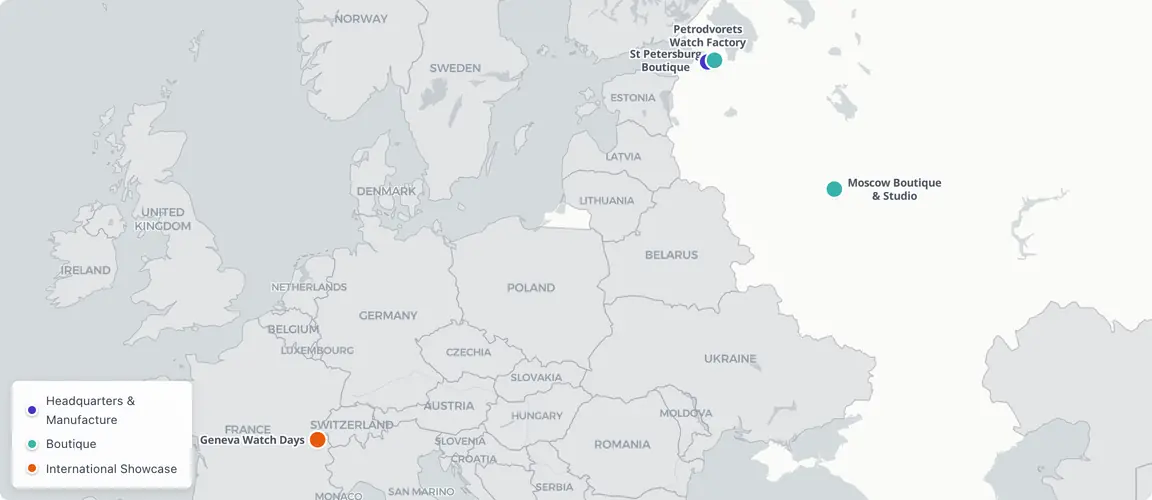
The same year, Raketa joined Geneva Watch Days as an associate brand alongside Breitling, Bulgari, and Ulysse Nardin — a debut in August 2022, continuing every year since. The Swiss watch experts who had told Henderson-Stewart to give up a decade earlier now shared a showcase venue with the factory they had declared dead. Its Geneva presence has drawn attention from collectors who value manufacture independence over finishing precision.
In 2026, the brand launched the Baikonur, a cosmonaut tool watch co-designed with legendary cosmonaut Sergei Krikalev and featuring the Cal. 2624CA with zero-gravity decoupler. Priced at 2,400 euros and reviewed by SJX Watches — one of the most influential independent watch publications — the Baikonur reconnected Raketa’s space programme heritage to contemporary horology. The reviewer acknowledged the movement’s technical limitations compared to Swiss standards (18,000 beats per hour versus the Swiss 28,800; 40-hour power reserve versus modern 60–80 hours) but called the value proposition compelling. For a fraction of the price of a Swiss manufacture watch, a buyer gets something that most Swiss brands cannot offer: a movement produced entirely in-house, including the hairspring.
Revenue reached 452.6 million rubles in 2024 with net profit of 93.9 million — an eightfold increase from the 54.2 million that marked the company’s first profitable year in 2016. The workforce stands at 104 specialists producing approximately 6,000 watches per year against a target of 10,000. Demand outstrips capacity. Total assets reached 606 million rubles, though the balance sheet still carries negative net assets of 28 million from accumulated historical losses — the financial scar tissue of a decade of capital starvation.
“None of Raketa’s watchmakers really consider the Raketa Watch Factory as a ‘business,’” Henderson-Stewart has said. “To us it is a priceless national heritage that we saved from destruction.” The statement is not false — it is incomplete. Raketa is a priceless national heritage that also holds a rare combination of assets in global watchmaking: a hairspring capability that no amount of capital can quickly replicate, independence from the Nivarox supply chain most of the industry depends on, and machines that no Western supplier needs to service. “If we had adopted the same codes as all the foreign brands, we would have lost,” Henderson-Stewart told Europa Star. “We have to be proud of our uniqueness.” The experts who knew why it was impossible never attempted it. The amateur who did not know succeeded precisely because he never learned to quit.
Researched 20 sources in English, Russian.