 Skip to main content
Pista House
A newspaper's false report of 11 food-poisoning deaths nearly ended the business in the 1990s. Three decades later, that same kitchen's haleem became the first meat dish in India to win a Geographical Indication tag — then beat Rasgulla in a national vote for India's most popular GI product.
From an Old City kitchen to the US and the Gulf
How a Ramzan staple earned the legal right to its own name
Every Ramzan, dozens of Hyderabad kitchens sell haleem — the same slow-cooked wheat-and-meat dish, made the same seasonal way, sold from the same kind of stall. For decades it was a commodity. Pista House changed that: it gave the dish a name no rival could legally use, then turned the naming into a legal designation a court would defend.
A bakery that nearly didn’t survive
Mohammad Abdul Majeed did not open Pista House as a haleem business. Soon after he moved from the family textile trade into food, he opened it as a bakery and sweets shop in Shalibanda, in Hyderabad’s Old City — and a false newspaper report alleging deaths from food poisoning nearly destroyed it before it found its footing. The business survived that collapse, and within a year or two, the shop added haleem to its menu under its own name: Pista House Haleem. That single branding decision — taking a dish every Ramzan stall in the city already sold and attaching a proprietary name to it — is the hinge the rest of the company’s history turns on.
The stakes of that decision were not obvious in 1997. Haleem had no owner. It was a recipe, not a brand — passed between families, cooked to house standards, sold under whatever name a stall happened to use that season. A customer walking through Old City during Ramzan could choose from dozens of vendors selling what was, in any meaningful commercial sense, the identical product: the same slow-cooked pounded wheat and meat, the same seasonal window, the same neighborhood price. Branding it meant betting that a name could hold value the recipe alone couldn’t — that customers would seek out “Pista House Haleem” specifically, rather than accepting whichever haleem was closest and cheapest, and that the bet would still make sense once the novelty of a branded dish wore off and competitors started copying the idea, if not the name.
The report that nearly ended the business
Before that bet could pay off, the business it was built on nearly didn’t survive. Soon after Majeed opened it, a newspaper falsely reported that eleven people had died of food poisoning there — both principal sources on the record independently name the business as Pista House itself, with no distinct earlier venture named. There was no truth to the report. It did not matter. Trade collapsed overnight. Customers who had eaten there for years stopped coming; the daily takings that had supported the business evaporated within days. It remains, on the record, the single most existential threat the business has faced — worse than any regulatory action or supply shock that followed it, because it threatened the business’s right to exist at all, not merely its margins.
Rebuilding from a reputational collapse with no wrongdoing to correct and no regulator to appeal to is slower than rebuilding from a financial one. There was no ruling to overturn — only years of quietly re-earning trust, one order at a time, in a city where word of mouth had just proven it could end a business overnight. The scale of what recovery cost is a matter of record: the family’s houses, inherited assets liquidated to keep the business solvent through the years the reputation took to rebuild. By Majeed’s own account, that recovery took the better part of a decade — years spent proving, transaction by transaction, that the business behind the falsely reported name was still standing and still trustworthy.
That the business survived at all, under its own name, in the same neighborhood, is itself the first evidence that the brand’s core asset — trust in the Pista House name — could be rebuilt once it had been shaken, which is exactly what made betting the business further on that same name a defensible risk rather than a reckless one. A business that had just watched a false story erase years of goodwill in days had every reason to stay anonymous, to let the product speak without a name attached to it that a future rumor could target again. Pista House did the opposite: it built its whole subsequent growth on making the name more prominent, not less — first on the shopfront, then on the haleem, and eventually on a certificate the Indian government would issue in that name alone.
From a stall’s name to a national designation
The 1997-1998 haleem branding decision was the opening move. The next thirteen years built the infrastructure a food brand needs to scale a single seasonal product past a single city. In 2004, the Indian postal department began carrying Pista House haleem to customers outside Hyderabad — Majeed’s own estimate at the time was five tonnes of daily demand, an early signal that a dish tied to one city’s Ramzan tradition could travel. By 2009, a courier partnership with Gati had extended that reach further, into Gulf and Saudi markets — haleem shipped, for the first time, to a diaspora that remembered the taste from home.
None of that distribution infrastructure, on its own, prevented a rival haleem maker from copying the recipe and the name. What changed that calculus was legal, not logistical: in August 2010, Hyderabadi Haleem became the first non-vegetarian dish in India to receive a Geographical Indication tag — certificate number 193, presented to Majeed by the Controller General of Patents and Registrar of GIs. A GI tag does something a trademark on a single company’s name cannot: it protects a regional product’s name for producers who meet its defined criteria, which for Hyderabadi Haleem specify goat meat, pure ghee, and roughly twelve hours of slow, wood-fired cooking. Pista House, as the brand most associated with the dish and with Majeed serving as president of the Hyderabad Haleem Makers Association, had effectively helped write the legal definition of the product category it competed in.
The GI registration lapsed briefly in December 2019 before renewal — a regulatory gap, not a market one — and was confirmed renewed for a further ten years, valid through December 2029. The clearest evidence that the legal designation had become a genuine competitive asset, not just a certificate, came in October 2022: Hyderabadi Haleem won India’s national “Most Popular GI” award, a public vote in which it beat Rasgulla, Bikaneri Bhujiya and Ratlami Sev — sweets and snacks with far broader national name recognition than a Ramzan-season meat dish from one city. Union Minister Piyush Goyal presented the award to Majeed directly, a public validation of the same craft standard Majeed himself described when the original GI tag was awarded: “It is the cooking that we had applied as the criterion for being recognised as Hyderabadi haleem. Haleem preparation is a lengthy process, which begins at dawn and goes on till dusk. The timing of mixing the ingredients is the key that determines the taste.”
That framing — cooking method, not just recipe, as the thing worth protecting — is what separates a GI tag from an ordinary trademark. A trademark protects a name; the Hyderabadi Haleem GI protects a process, one that any producer using the required goat meat, pure ghee, and roughly twelve-hour wood-fired cooking method can legitimately claim. Pista House’s advantage was never exclusive legal ownership of the dish — dozens of other Hyderabad haleem makers can and do use the GI designation too. Its advantage was arriving first, at scale, with the brand recognition and distribution already built to make “Pista House Haleem” the name most consumers reach for when they want the GI-standard product specifically.
Scale, tested by both crisis and success
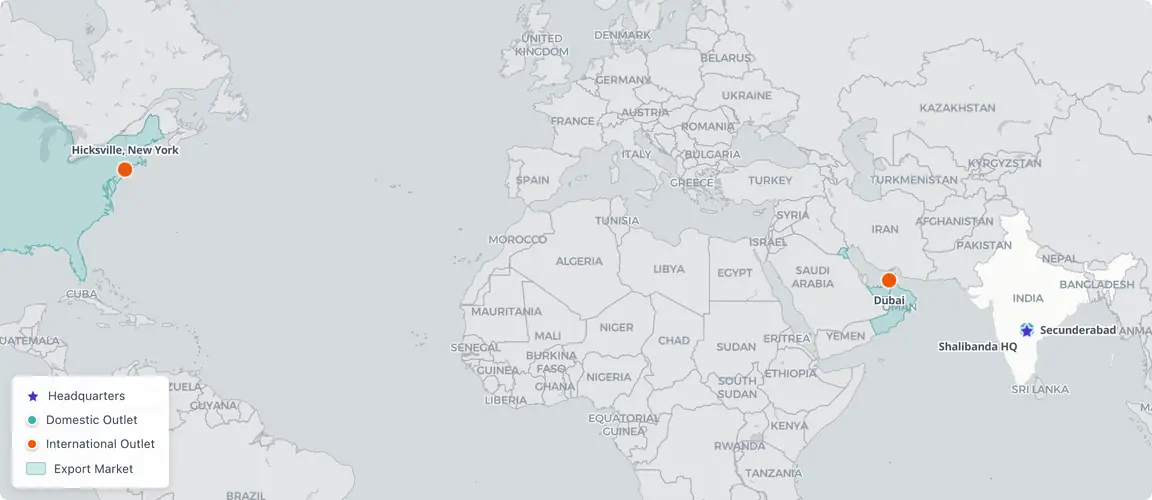
By the 2020s, the infrastructure built on that legal foundation had scaled to roughly 44 outlets — sources place the figure anywhere from 40 to 46 — spanning India, the United States, the UAE, Oman and Kuwait, run substantially as a franchise. The company’s own account of its Ramzan-season operation, self-reported and not independently audited, claims 10,000 kilograms of haleem produced daily across more than 40 outlets during the 2024 season, backed by a core Hyderabad workforce of roughly 3,500 employees supplemented by an additional 5,000 or so seasonal workers — couriers, students, and short-term hires — during Ramzan itself.
Scale of that kind draws scrutiny scale alone cannot buy off. When COVID-19 hit in 2020, the Haleem Makers Association under Majeed’s leadership voted unanimously to suspend haleem production entirely for that Ramzan — a voluntary, industry-wide sacrifice of a season’s revenue, and a markedly different kind of crisis leadership than the one Majeed had faced three decades earlier, when the choice to stop wasn’t his to make. Choosing not to sell, in other words, when the earlier crisis had been about not being allowed to sell at all.
In November 2025, India’s Income Tax Investigation Wing raided Pista House alongside two other Hyderabad haleem chains, Shah Ghouse and Mehfil, across 30 premises over two days — roughly 50 IT teams were deployed, and Majeed’s own residence was searched as the business’s owner. The reported cash seizure figures conflict across outlets and remain preliminary; the most credible breakdown attributes roughly ₹2 crore combined to Pista House and Mehfil, of a roughly ₹6 crore total across all three chains, with Shah Ghouse accounting for the larger share. A separate, lower-credibility report claims a much larger figure; it is not independently corroborated and is not treated as reliable here. Whatever the precise number, the raid is a reminder of something the false-report crisis established thirty years earlier and never really stopped being true: Majeed’s personal and business standing remain inseparable, for better and for worse, in a way that scale and legal recognition have not changed.
Even operational continuity has required adaptation under pressure. A commercial LPG shortage in 2026 forced the company back to wood-fired cooking to keep haleem production running — an outcome that, measured against the GI tag’s own criteria for traditional method, arguably moved the brand closer to its legally defined standard rather than away from it. What reads, on the surface, as a supply-chain setback is also a reminder of how tightly the brand’s operations are bound to the same standard it helped write into law: a shortage that would be a routine inconvenience for most food businesses instead pushed Pista House back toward the exact cooking method its own GI certification specifies. That same year, Pista House won Best No. 1 Haleem at the Times Food and Nightlife Awards in Hyderabad — the most recent entry in an unbroken run of public recognition dating back to the 2010 GI tag, arriving in the same year regulatory and supply-chain pressure both tested the business directly.
What the name protects
Three decades separate the newspaper report that nearly ended the business and the tax raid that searched its founder’s home as a matter of routine regulatory process rather than existential threat. The distance between those two events is the measure of what branding a commodity dish actually built: not just a chain of roughly 44 outlets across five countries, but a legal claim to a name that a false headline once could have destroyed for good, and that a Union Minister now hands an award for in a nationally televised public vote. Competitors can still cook haleem. They cannot call it Pista House Haleem, and — within the geographic and methodological bounds of the GI registration — they cannot easily call anything they make simply “Hyderabadi Haleem” either, without meeting the standard Pista House helped define.
What began as one shop’s decision to put its own name on a dish every stall in the neighborhood already sold has become the reference standard the entire category is measured against — proof that in a market where the product itself can’t be patented, the name attached to it can still be worth defending.