 Skip to main content
Marrybrown
When Marrybrown opened in a Johor Bahru shoplot in 1981, KFC had ruled Malaysia for eight years and McDonald's was about to arrive — the banks had already said no, and nearly everyone predicted the local chain would not last the decade. Forty-four years and ~500 outlets across 16 countries later, the verdict reads very differently.
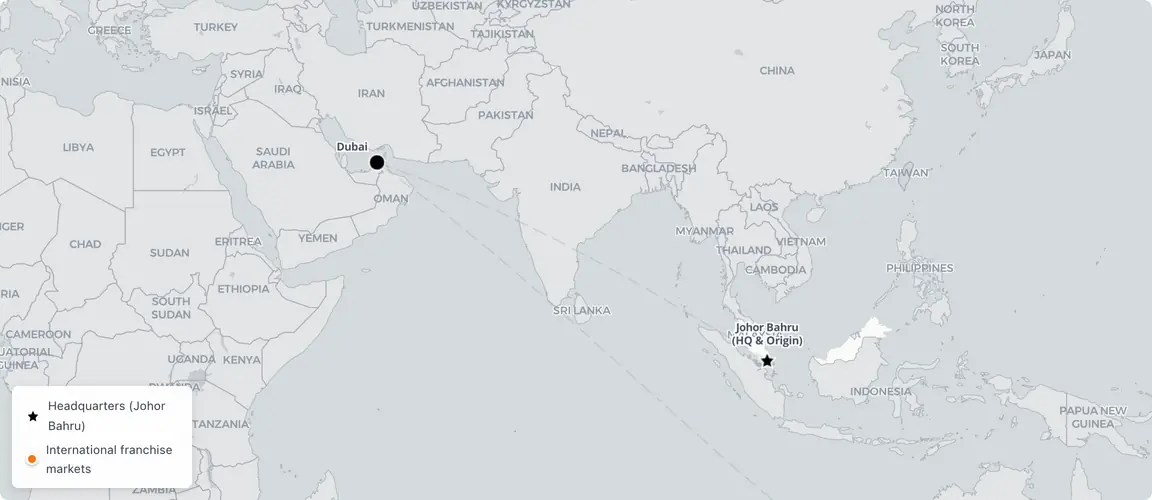
16 Countries from Johor Bahru
The local chain that outlasted the giants
When Marrybrown opened in a Johor Bahru shoplot in 1981, KFC had ruled Malaysia for eight years and McDonald’s was about to arrive; the banks had already said no, and nearly everyone said the little local chain would not last the decade. Forty-four years and ~500 outlets across 16 countries later, the verdict reads differently.
The wrong side of every prediction
The founders of Malaysia’s first homegrown QSR launched with RM120,000 scraped together from personal savings and family loans — the banks were not interested. The brand name was Nancy Liew’s, chosen for phonetic accessibility and a deliberately international feel — a positioning decision made before the first outlet had proven anything.
One year after the first outlet opened on Jalan Wong Ah Fook in Johor Bahru, McDonald’s arrived in Malaysia. Pizza Hut arrived the same year. The American giants carried decades of franchising expertise, proven supply chains, advertising budgets, and institutional credibility that the little Johor Bahru chain could not have matched in any conventional sense. The rational expectation was consolidation: the Americans would take the market, and Marrybrown would become a regional footnote.
That expectation had one structural flaw. The American QSR model — standardised menus built around beef and pork derivatives, designed for Western consumer habits — sat awkwardly in a Muslim-majority country. Malaysia’s population is approximately 60% Malay-Muslim, with large Chinese and Indian minorities. A chain that could credibly claim halal certification and local menu authenticity had a structural position the Americans could not occupy, regardless of capital advantage.
The five years that followed were the hardest. Operating in the same market as KFC and McDonald’s, with suppliers demanding cash payment and no bank credit available, Marrybrown was undercapitalised in a way that would have ended most businesses. The Liews’ approach was not to compete dollar-for-dollar with the Americans on their own terms — that path was closed. Instead, the business ran lean, stayed in Johor Bahru, and kept operating. Survival was the strategy, and survival was the competitive asset: every year that passed without the chain closing was a year of accumulated institutional knowledge about Malaysian consumers that the American chains’ standardised playbooks were not designed to capture.
Three moves the giants could not copy
Marrybrown’s survival and eventual expansion came through three decisions made between 1985 and 1989, each of which made the business harder to compete with rather than opening it up to more rivals.
The first was the franchise model. Unable to fund owned expansion from operating cash or bank credit, the Liews shifted to franchising in 1985 — finding a structure that transferred capital requirements to franchisees while Marrybrown retained brand control. In 1986, a Mahathir-era national franchise initiative certified Marrybrown as the first Malaysian F&B franchise, providing government recognition that carried commercial credibility in an era when Malaysian institutional endorsement mattered. The certification was not merely symbolic: it gave the brand a government-backed legitimacy signal that helped recruit early franchisees and positioned Marrybrown within the national development agenda that Mahathir’s government was advancing in the mid-1980s. Capital constraints became, in retrospect, a strategic input — the franchise model that bank rejection forced upon the Liews turned out to be better suited to rapid geographic expansion than owned outlets would have been.
The second was Nasi Marrybrown, also launched in 1986: the first rice dish on any Malaysian fast-food menu. Rice is the staple starch across the three main ethnic communities; no American QSR had put rice at the centre of its format. The move was not imitation — it was category creation. A consumer who wanted a halal meal built around rice now had one fast-food option, and that option was Marrybrown. The decision also reflected something deeper about the structure of the local QSR market: the American chains’ menus assumed a Western consumer whose staple protein was wheat-based bread. A QSR built on rice had a different structural relationship with the Malaysian palate, one that could not be acquired by adding a rice side dish. The format itself was different.
The third was Nasi Lemak in 1989: Malaysia’s most nationally recognised dish, added to a menu that already included fried chicken and rice. The combination — fried chicken from the American QSR playbook, rice and Nasi Lemak from the Malaysian street-food tradition — produced a menu that the American chains could not replicate without contradicting their own brand identity. Serving Nasi Lemak requires more than adding an item to a menu: it requires sourcing pandan leaf, sambal belacan, and coconut rice at QSR volume and consistency, which demands supply chain relationships and product development capability that the American chains’ standardised procurement systems were not designed to build. KFC’s halal certification in Malaysia came later and did not extend to a localised rice format. McDonald’s McRice was introduced to Southeast Asia in the 2000s — two decades after Marrybrown had established the category. By then, Marrybrown’s menu was not the novelty; it was the benchmark.
The franchise architecture that travels
The master-franchise model that Marrybrown built in its early years became the mechanism of international expansion. By the mid-1990s, Marrybrown opened its first overseas outlet in China — making it the first Malaysian-owned QSR to franchise internationally. (The company cites 1992; independent sources indicate 1996; “mid-1990s” is the accurate framing.) The Asian Financial Crisis of 1997 and the GFC of 2008 compressed competitors and disrupted supply chains; Marrybrown weathered both, its value positioning and franchise infrastructure providing structural resilience that company-owned networks lacked.
The Gulf entry in 2000 was the most strategically significant international move. Dubai became the hub for a regional network that now covers OIC markets where Malaysian halal certification carries institutional weight that other certifications do not. For a Gulf consumer or a Sudanese franchise operator, “Malaysian halal” is a specific trust signal — not just compliance with Islamic dietary law, but compliance certified by an institution from a Muslim-majority country with decades of halal infrastructure development. The American QSR chains operating in the same markets offer halal certification, but they cannot offer Malaysian halal provenance.
The distinction matters commercially. Halal certification has become a contested category in international QSR — multiple certification bodies, varying standards, and growing consumer awareness about the difference between pro-forma compliance and institutional credibility. Marrybrown’s certification history predates most of its international competitors’ by two decades, and that history is verifiable by any OIC-market customer or franchise partner who examines it. The trust cannot be purchased at speed; it was built through years of domestic operation in a Muslim-majority market before any international franchise partner was signed.
Today approximately 82% of Marrybrown’s network is franchised via master-franchise agreements. The model shifts capital requirements to the franchise partner, allows market-specific menu adaptation within the halal framework, and scales in markets where Marrybrown’s brand recognition grows primarily through the franchise network rather than owned marketing investment. The Africa entry (Tanzania) during the GFC period demonstrated the model’s adaptability: a market with limited consumer purchasing power required a different price architecture than the Gulf, and the master-franchise structure allowed the local operator to calibrate it without requiring Marrybrown to fund owned operations in a new continent.
The government endorsement that confirmed it
In 2020, the Malaysian government faced a question of national representation: which food operator would run the Malaysia Pavilion at World Expo 2020 Dubai? The choice was Marrybrown — not KFC Malaysia, not McDonald’s Malaysia, not any multinational with deeper pockets. A Chinese-Malaysian-founded chain, built on a RM120,000 investment rejected by every bank, operating in a Muslim-majority country with halal certification at its core, was selected to represent the nation at the Gulf’s most prominent international forum.
The context matters. World Expo 2020 Dubai drew 192 participating nations and 24.1 million visits over six months. The Malaysia Pavilion was Malaysia’s face to an audience that included Gulf investors, OIC trade delegations, and regional franchise operators looking for established QSR models. Selecting Marrybrown to operate the food service at that pavilion was a statement about what “Malaysian food” means to an international audience — and specifically to the Muslim-majority markets that the Gulf Expo drew in outsized numbers.
The appointment was a form of institutional recognition that advertising cannot purchase: the government’s implicit endorsement that Marrybrown carried the “Malaysian halal” credential more authentically than any American licensee operating in the country. It was also a commercial amplifier: operating the Malaysia Pavilion at Expo Dubai put Marrybrown in direct contact with potential franchise partners across the OIC world at the moment when the brand was actively expanding its master-franchise footprint.
Scale confirmed, succession underway
By 2025, Marrybrown operates ~500 outlets across 16+ countries, with ~250 in Malaysia and the remainder distributed across Asia, the Middle East, Africa, and Oceania. The 2023 opening in Burwood, Melbourne — the first Malaysian halal QSR in Australia — extended the network into a developed market, where the proposition shifts from pure price competition to cultural specificity for the Malaysian diaspora and OIC-aware consumers.
In April 2024, Daniel Lek Seong Chan — a professional operator with McDonald’s experience — was appointed CEO, the first non-family chief executive in Marrybrown’s history. The move signals governance maturity: a founding family retaining board-level control (Lawrence Liew as Chairman, Nancy Liew as Group Managing Director, Dato’ Joshua Liew as Group Executive Director) while installing professional operational leadership for the scale phase. CEO Chan’s 2025 announcement of 40+ new Malaysian outlets and 1,000+ new jobs operates from a base of 10,000+ employees — a brand that the banks refused to fund in 1981.
The governance structure now separates ownership from operations in a way that family-only leadership could not sustain at this scale. Lawrence Liew as Chairman holds the institutional authority and the brand’s founding identity. Nancy Liew as Group Managing Director carries the operational history and the halal positioning decisions that defined the brand’s competitive position. Dato’ Joshua Liew as Group Executive Director represents the second generation’s stake in governance. CEO Daniel Chan brings the operational systems and McDonald’s-trained discipline that professional QSR scaling requires. The four-layer structure — founding couple at governance level, founding-family heir in senior operations, professional CEO in execution — is the model that regional franchise brands graduate to when the founding generation cannot alone carry the management burden of a 16-country network.
The Iconic Franchise Award from the Malaysia Franchise Association in 2024 and the Cambodia and Uzbekistan entries the same year point in the same direction: Marrybrown is not consolidating. It is extending its OIC-market franchise into Central Asia, a region where halal-certified QSR infrastructure is limited and Malaysian brand recognition has the headroom to grow.
The counter-intuitive fact at the centre of the Marrybrown story is this: a Chinese-Malaysian couple built the halal empire. What made it hard to replicate was not ethnic origin or religious affiliation — it was institutional credibility, built through certification, menu localisation, and four decades of operational presence in Muslim-majority markets. The American giants who arrived in 1982 with superior capital did not have four decades to wait. Marrybrown did.
Researched 24 sources in English, Malay, Chinese.