 Skip to main content
Liza Borzaya
A swallow bracelet made for a friend's French wedding in 2010 ignited demand that forced a brand into existence. A ruble crash in 2014 forced that brand into Russian production — and into the hands of Russia's best enameler. When Western luxury maisons exited Moscow in 2022, the bootstrapped result occupied their boutiques and tripled its revenue.
From Krylatskoe Workshop to Dubai's Luxury Quarter
A swallow bracelet that the 2022 exodus turned into Moscow boutiques
When the ruble collapsed in December 2014, Elizaveta Borzunova faced a choice that would define Liza Borzaya: absorb unsustainable losses on her Italian and Hong Kong production, or build something Russian. She had no workshop, no employees, and no brand name. She had personal savings her husband told her were crazy to spend — and she spent them.
The accidental luxury brand that beat a vacuum
The post-2022 luxury retail landscape in Moscow tells its own story. In October 2023, Liza Borzaya opened its Petrovka 5 flagship in the space Roger Dubuis had vacated after Richemont pulled out of Russia. The 113-square-metre boutique occupies a prime address in one of Moscow’s most storied commercial thoroughfares. In December 2025, the brand expanded into GUM — the historic department store on Red Square that has anchored Moscow retail since the nineteenth century. Revenue nearly tripled between 2023 and 2024, reaching ₽95 million (~$1.3M USD).
The simple reading is that Western departures opened space for a local brand to move in. The more precise version: Liza Borzaya had already built the credibility to occupy those spaces before they became available. When Richemont, LVMH, and a dozen other Western luxury houses withdrew from Moscow after February 2022, they left a vacuum in premium retail real estate and a much deeper vacuum in client relationships. High-net-worth Russian clients — who had been the primary consumers of international luxury for twenty years — did not stop buying. They simply needed different brands.
Liza Borzaya was ready because it had been building toward precisely this client for a decade. The brand’s distinctive character — transformable haute joaillerie executed in hot enamel with motifs drawn from Russian childhood (borzoi dogs, Buratino the wooden boy, school-notebook paper airplanes) — was not adapted for the domestic market after 2022. It had been developed for it through a decade of word-of-mouth sales to high-net-worth Muscovites. The Western exit accelerated a trajectory already in motion.
A bracelet made for a French wedding
The founding piece was not a commercial calculation. Around 2010, Borzunova — then operating as an intermediary placing jewelry orders with factories in Italy, Hong Kong, and New York — designed a swallow-shaped palm bracelet for a friend’s wedding in France. The necklace she had in mind wouldn’t work for the bride’s dress. She redesigned it as a piece that wraps around the hand, with the swallow’s body resting across the knuckles and its wings extending toward the wrist: the Ласточки (Swallows) palm bracelet.
The reaction was immediate. The piece attracted attention at the wedding, then orders from guests, then the kind of sustained demand that forces a decision. Borzunova had spent years in finance before entering jewelry — she had served as a tax consultant for Renova, Troika Dialog, and A Group before a German colleague’s proposal in 2007 pulled her into the jewelry trade. She spent years attending Baselworld, Vicenzaoro, and the Hong Kong Jewellery & Gem World Fair, placing bespoke orders with craftsmen across three continents. She knew supply chains, understood margins, and recognized when a market was signaling something real.
Operating informally was no longer tenable. The demand the Swallows bracelet had generated was not casual interest — it was the kind of specific, returning inquiry that marks a genuine product-market fit. “We developed the brand absolutely not by the rules, spontaneously and chaotically,” she later told Forbes Woman Russia. “Without a launch calendar, without collections, just by mood and inspiration.” The brand she didn’t intend to create was taking shape regardless of her intentions.
The ruble crisis that built a workshop
In December 2014, the ruble crashed from 49 to 72 per dollar — a 47% devaluation in weeks. For a business whose production was priced in euros and dollars while its clients paid in rubles, this was not a bump. Every piece Borzunova placed at her Italian, Hong Kong, and New York suppliers suddenly cost substantially more to produce than she could charge without destroying the client relationship. The cost-revenue gap was unsustainable within months.
Three options presented themselves. She could pass currency losses to clients and lose them. She could absorb margins until capital ran out. Or she could find Russian craftsmen and rebuild the supply chain from scratch — with money her husband explicitly told her was being wasted.
She chose the third option.
Borzunova walked jewelry markets asking who the best craftsmen were. Every conversation pointed to the same name for enamel work: Evgeny Baranov, a master whose jeweled eggs are held in the Kremlin collection. “You can’t just ride up to him casually,” she later recalled. She found him on social media and wrote: “I’m Liza, I’m in love with hot enamel, I want to meet you so you can make an order for us.” They met and talked for five hours. Baranov agreed. His influence — the painted enamel technique, the standards of firing, the visual vocabulary of pre-revolutionary Russian decorative arts — would define Liza Borzaya’s most distinctive work.
By February 2015, she had a workshop in Krylatskoe — Moscow’s western district near the Tatarovo Lake — with her first five jewelers. The Russian Assay Office required a hallmark registration, which required an official brand name and logo. The childhood nickname she’d accumulated — “borzaya,” the Russian sighthound, swift and elegant — became the brand. The Buratino figure became the logo: the wooden puppet from a beloved Soviet-era story, enterprising, fearless, a carved boy in pursuit of something real. The brand was born from necessity rather than ambition, and its name encodes the founder’s spirit rather than a market positioning.
Collections, mechanisms, and a business model built for conviction
What set Liza Borzaya apart from the outset was not just the aesthetic, but the technical ambition. The brand developed a proprietary mechanism for transformable jewelry: pieces that convert via a “key” system between necklace, brooch, bracelet, and earring configurations. A single Swallows palm bracelet can become a brooch. Paper Airplanes pendants detach and reconfigure as modular stud sets. Bumblebee earrings separate from their ring-and-honeycomb settings to wear as standalone pieces. The Sixxy high-jewelry suite — anchored by a 12.05-carat hexagonal Colombian emerald — transforms between sautoir necklace and tiered pendant configurations. Up to ten configuration variants per piece in some collections.
The hot enamel work — for which Baranov trained the workshop team — requires up to 100 firings per piece, with each firing setting a thin layer of powdered glass permanently onto the gold. Complex originals take up to six months to complete. The studio’s entry-level pieces start at approximately $3,000 for enamel brooches and studs. Palm bracelets, which require custom fitting to each client’s hand measurements, range from $26,000 to over $44,000. Bespoke commissions begin at $20,000.
The collections themselves reflect a design sensibility that resists the usual luxury vocabulary. Бумажные самолётики (Paper Airplanes) translates school-notebook doodles — the margin art of Soviet childhood — into painted hot enamel canvases in 18-karat white gold with laboratory-grown and natural diamonds. Тату / Get Inked draws on the founder’s father’s biker tattoos for motifs that mix old-school flash with gemstone execution. Сказочные герои (Fairytale Heroes) places the Cheshire Cat, the Nutcracker, the Mouse King, and Buratino in gold and spessartine. The Шмели (Bumblebees) collection articulates the naturalistic bumblebee with enough precision to render the difference between species. Humor is not decoration — it is structural.
In 2017, jewelry blogger Katerina Perez visited the Moscow showroom and published the first international English-language feature on the brand. That coverage led, in 2019, to an invitation to debut at Couture Show Las Vegas — where the inaugural Tattoo/Get Inked collection nearly sold out in the first run. American buyers, accustomed to the conventions of either fine jewelry restraint or maximalist novelty, responded to something they hadn’t seen before. The same year, the brand participated in The Protagonist, a Vogue Italia curated exhibition at Salon Art + Design in New York. A Luxury Lifestyle Awards recognition as Best Luxury Local Jewelry Brand in Moscow followed.
The brand twice considered and twice rejected launching a mid-price line. The decision preserved the haute joaillerie positioning and the client base that values it. Operating expenses are significant: the 2024 net profit of ₽639,000 on ₽95 million in revenue reflects a deliberate reinvestment strategy prioritizing boutique openings and production capacity over profit extraction.
The ownership structure reinforces this orientation. Borzunova holds a 33.3% stake and serves as creative director; Igor Egorov, her husband and business partner, holds the majority 66.7% stake as managing director and CFO — responsible for the financial discipline that channels revenue back into production and boutique openings. The brand has accepted no external investment at any stage. The workshop was funded from personal savings, the Petrovka boutique from operating revenue, the GUM expansion from the same source. A co-founder structure that Egorov once called financially reckless became, in retrospect, the mechanism that kept the brand coherent through a decade of crisis. There is no investor to pressure toward volume metrics, no board to satisfy with margin targets, no debt service to manage by compromising design standards. The thin 2024 net margin is the profit of a brand that opened its second boutique at GUM, trained a new cohort of craftspeople in the Krylatskoe workshop, and reinvested every available ruble into the infrastructure for the following decade.
From Krylatskoe to Red Square
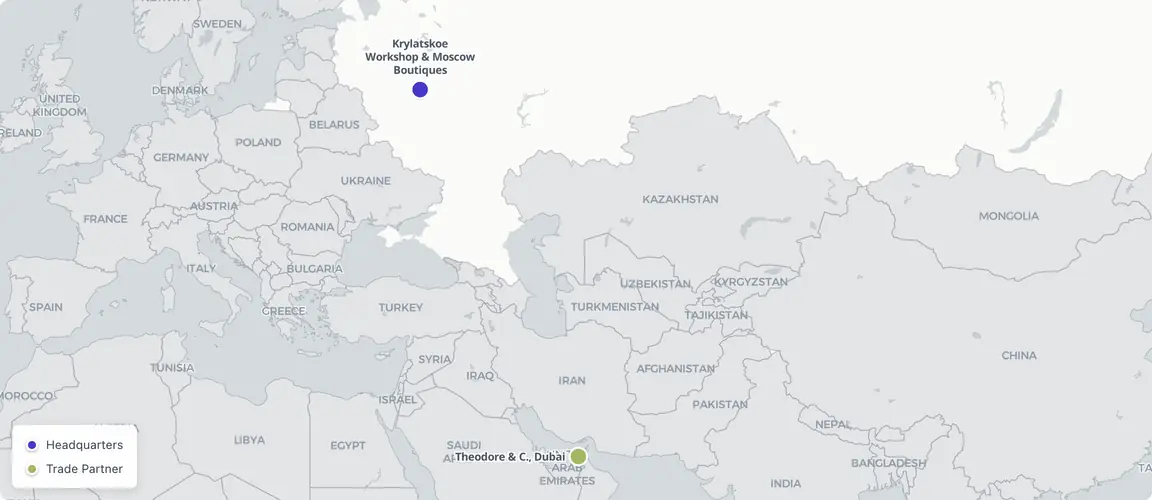
Liza Borzaya’s two Moscow boutiques — Petrovka 5 and GUM — represent the brand’s most visible institutional declaration. Both occupy former Western luxury addresses. The Petrovka 5 flagship, which opened in October 2023 in the former Roger Dubuis boutique inside Berlinsky Dom, spans 113 square metres on one of Moscow’s premier shopping streets, open daily until 21:00. The GUM location, which opened in December 2025 to mark the brand’s tenth anniversary, places it in the historic department store that has served as both a retail destination and a cultural landmark since the nineteenth century.
International presence continues through Theodore & C. in Dubai, which carries 83 Liza Borzaya products with AED pricing. The brand’s bilingual English-Russian website ships worldwide. The founder has identified China as a market with genuine appetite for what the brand offers: “They love art, understand and pay for it.” The aspiration she has stated publicly is TEFAF — the European Fine Art Foundation fair — a credential that would position Liza Borzaya alongside the world’s most rigorously vetted dealers in decorative arts and jewelry.
The Swallows bracelet that started as a wedding gift for a friend in France remains the brand’s origin piece and clearest statement of intent: not a product designed for a market, but a design that found its own demand. In the decade since, the brand has passed through a ruble collapse, a pandemic, and a geopolitical rupture — each time rebuilding its supply chain or client base from the resources on hand rather than outside capital.
Researched 28 sources in Russian, English.