 Skip to main content

Krasny Vostok
Krasny Vostok lost its founder, Airat Khayrullin, in February 2020, as state support was falling: by his son's figures, from ₽1.2B in 2019 to ₽587M in 2023. The son, Adel, sold the Tambov farms and kept the holding close to home. Milk output rose from 90,000 tonnes in 2022 to about 109,200 in 2025, the most in Tatarstan.
Tatarstan's districts and one site beyond
Krasny Vostok made more milk on a smaller footprint after 2020
In February 2020 Ilshat Khayrullin presented his nephew Adel to the workforce of Krasny Vostok (Красный Восток, “Red East”), and to Tatarstan’s president, Rustam Minnikhanov, as the holding’s new head. Earlier that month Adel’s father, Airat, who had built the agroholding with Ilshat, had died in a helicopter crash in Tatarstan. A new generation took over at the start of the holding’s hardest stretch.
A holding that outlived its builder
Krasny Vostok is a farming business before it is a name. It grows its own feed crops and stores grain in its own elevators, breeds its own pedigree stock, runs dairy mega-farms across the districts of Tatarstan and keeps a beef feedlot, Russky Mramor, in Rybnaya Sloboda district. Its head office is in Kazan, on Tikhoretskaya Street. It sells raw milk to processors and grain through traders and elevators.
The scale is in the herd. In 2025 Krasny Vostok produced about 109,200 tonnes of milk, about 305 tonnes a day, from about 40,000 head of cattle, 17,000 of them cows. That made it Tatarstan’s largest milk producer, a position it also held in 2024. The herd is the asset the rest of the holding is built around: its own crops feed it, and it is renewed with 100 heifers bought a month since December 2023.
What makes the holding worth a closer look is when that output was reached. Its founder died in February 2020. The state subsidies the holding received were falling, and they kept falling until 2023. A drought arrived the year after his death. Krasny Vostok came through that stretch with a smaller footprint and a larger milk output, under a son who had not founded it and who has explained, in his own words, why he chose to keep it.
From a brewery to the land
The name comes from beer. In 1996 Airat Khayrullin became general director, and later board chair, of the Krasny Vostok brewery in Kazan, the business whose name the agroholding still carries.
The farming came in March 2003. The Khayrullin family, Airat with his brother Ilshat, assembled an agroholding out of collective farms that had gone bankrupt. About 20,000 former kolkhoz members contributed their land shares, so the holding began as a patchwork of village land rather than a single estate. In July 2004 the milk operating company, Krasny Vostok Agro, was registered in Kazan and absorbed the district farming companies beneath it.
For three years the family ran a brewery and a farming holding side by side. The decisive step came in January 2006, when it sold the brewing business to Turkey’s Efes and concentrated on agriculture. From then on the land was the business, and the name of a Kazan beer became the name of a dairy holding. A year later the Levashovo mega-farm opened in Alekseevsky district; it later became the holding’s test site for new technology.
A patchwork of districts
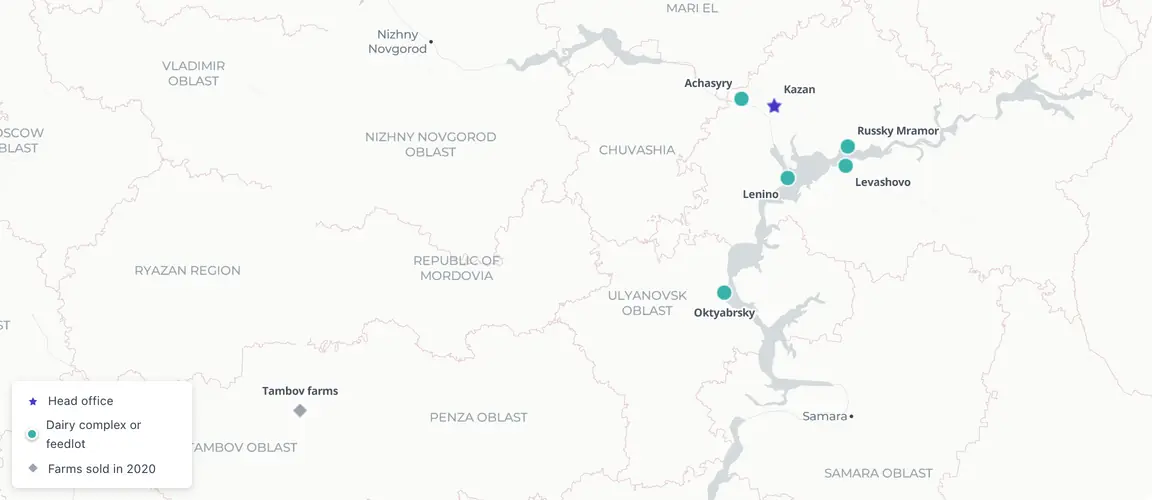
The holding is spread across the republic rather than gathered in one place. Alkeevsky district, around the village of Bazarnye Mataki, was among the first districts it entered in 2003. Alekseevsky district holds two of its dairy complexes: Levashovo, the test site, and Lebyazhye, which keeps a high-yield herd and a calving unit. The Lenino dairy complex in Kamsko-Ustyinsky district stands on a former collective-farm base, a reminder of how the holding was put together.
The Achasyry dairy complex in Zelenodolsky district opened in 2020. Russky Mramor, the beef feedlot and meat plant, is in Rybnaya Sloboda district. Taken together, the Tatarstan sites run from Zelenodolsky district, west of Kazan, to Alekseevsky and Alkeevsky districts to the south-east.
The grain side sits closer to the city. The holding’s grain elevator is on Portovaya Street in Kazan and is slated to move out to the districts, where the crops are grown.
Beyond Tatarstan, Krasny Vostok runs a dairy and crop complex in Ulyanovsk oblast, at Oktyabrsky, on a former agrarian-university farm. Further west it owned two dairy farms in Tambov oblast, Sheremetyevo and Pichaevo-Niva. Those were the outer edge of the holding’s map, and they were sold in 2020.
The founder’s death and the narrowing
Airat Khayrullin died in a helicopter crash in Tatarstan on 7 February 2020. That month his son Adel took charge. His uncle Ilshat, the founder’s partner since 2003, presented him to the workforce. In March 2020 Krasny Vostok Group was registered with Adel as general director, and the other heirs renounced their shares in his favour; he inherited his father’s stake and heads the holding.
He inherited it as its conditions worsened. By his own figures, the state subsidies the holding received fell from ₽1.2B in 2019, in steps of ₽930M, ₽900M and ₽680M, to ₽587M in 2023. The support fell in every year of the series, and by 2023 it was less than half of what it had been in the founder’s last full year.
The holding then contracted. In September 2020 the competition regulator approved the sale of the holding’s two dairy farms in Tambov oblast, and Krasny Vostok narrowed to Tatarstan and Ulyanovsk oblast. The farthest part of the founder’s map was given up within eight months of his death.
Then the weather turned. In 2021 a drought cut the holding’s grain yields to 10.6 centners a hectare. Its average milk yields stood at 15 kg a cow a day against 32–38 kg at the leading farms, and bulls were culled. Looking back on his first five years in charge, in an interview with Business Online in November 2025, Adel Khayrullin listed the period’s trials, Covid, three droughts and two waterlogged years among them, and said they had tried to make the holding stronger.
The output did not collapse. Milk production stood at 90,000 tonnes in 2022 and rose to 105,700 tonnes in 2023, the year subsidies reached the bottom of the series at ₽587M. By 2024 Krasny Vostok was Tatarstan’s largest milk producer, and in 2025 it produced about 109,200 tonnes. The holding that had lost its founder, its Tambov farms and more than half of its state support made more milk in 2025 than in either 2022 or 2023.
How the holding is put together
Krasny Vostok is a group of companies rather than a single one. The milk is produced by the operating company, Krasny Vostok Agro, registered in Kazan in 2004. A separate head-office company manages the holding from Kazan. Crops sit in another company. In March 2020 a group company, Krasny Vostok Group, was registered, with Adel Khayrullin as its general director.
Each of these companies files its own accounts, and no consolidated group figure is published. The structure is one inherited from the founder’s years, when the operating company absorbed the district farming companies of a holding assembled from former collective farms. It explains why the holding’s size is best read in tonnes of milk and head of cattle rather than in a single financial total.
It also explains how the succession was carried out. Adel inherited his father’s stake, the other heirs renounced their shares in his favour, and within weeks of the founder’s death a group company was registered with Adel as its general director.
Improving the herd it already owns
The way back ran through the herd rather than through new territory. From December 2023 the holding bought 100 heifers a month, improving the herd it already had step by step rather than culling it wholesale and importing a new one.
Yields moved in the same direction. In 2021 the holding’s cows averaged 15 kg of milk a day. In 2025 they averaged 24 to 25 litres a day, and those at the Lebyazhye complex 32 to 34 litres. The two years are reported in different units, kilograms in 2021 and litres in 2025, so they are best read side by side rather than as a single measured rise.
The chain around the herd stayed whole. Krasny Vostok still grows its own feed, stores its own grain, breeds its own pedigree stock and fattens beef cattle at Russky Mramor. A new dairy complex at Achasyry opened in 2020, the year of the handover. The narrowing took away a distant region, not a stage of production: the holding gave up Tambov and kept every link from the field to the milk.
State money out, interest in
The money around the business changed shape after 2020. State subsidies, by Adel Khayrullin’s own figures, fell from ₽1.2B in 2019 to ₽587M in 2023. Interest on the holding’s loans, by his account, cost ₽600–700M in the year to November 2025, at times as much as ₽100M a month against what he called a standard ₽44–50M. He described the burden as phenomenally large. Both figures are his own, given in interviews with Business Online in February 2024 and November 2025.
Set side by side, the two figures show the holding’s position. The interest bill for the year to November 2025 was larger than the whole of the state support the holding received in 2023. In its heaviest months, interest ran at roughly twice the level he regarded as normal.
Paying down debt is now a stated policy, set out by Adel Khayrullin in 2026 alongside a long-term goal of 800 tonnes of milk a day, against about 305 tonnes a day in 2025. A business that kept its land, its herd and its chain from feed to milk has also kept the cost of financing all three.
Staying within Tatarstan
The strategy is explicit, and it is a choice of depth over reach. In February 2024, at an internet conference held by Business Online, Adel Khayrullin set out why the holding would stay where it is: expansion might come in a decade, he said, but for now the aim is the maximum level of efficiency inside Tatarstan. He said it after the Tambov sale, as the holding’s strategy for what it had kept. The phrasing matters: expansion is not ruled out, only deferred, and the measure he chose for the years in between is efficiency, not size.
The holding he runs is not the one his father left. It covers less ground and receives far less state money, and it produces more milk than it did in 2022 or 2023. Its one complex outside Tatarstan is in Ulyanovsk oblast. The Tatarstan farms carry the weight. The planned move of the Kazan grain elevator out to the districts points the same way, towards the fields the holding already works.
The clearest measure of how much room is left inside that footprint is in the holding’s own numbers. The average Krasny Vostok cow gave 24 to 25 litres a day in 2025; the herd at Lebyazhye gave 32 to 34. The distance between the two is the growth the holding has chosen to look for at home.
Researched 32 sources in Russian.