 Skip to main content
Konstantin Chaykin Manufacture
When its Baselworld 2017 exhibition movement failed, a 14-person Moscow manufacture had four months to conceive something new. What emerged was the Joker — a dial whose expression changes every minute. The 99-piece debut sold out in weeks. Originals now trade above $25,000, and a prototype fetched CHF 508,000 at Phillips.
From Moscow to 17 Countries
A failed Baselworld movement that birthed the half-million-franc Joker
In November 2016, four months before the most important trade fair in watchmaking, Konstantin Chaykin (Константин Чайкин) discovered that his exhibition watch was dead. The movement he had spent months developing for Baselworld 2017 would not work. For a manufacture that had nearly been shut down two years earlier — fourteen employees, five to seven orders a year, post-crisis finances held together by stubbornness — the failure was not an inconvenience. It was a threat to survival.
What Chaykin conceived in the weeks that followed was not a replacement. It was a reinvention. An anthropomorphic face dial whose rotating discs formed mechanical “eyes” displaying hours and minutes, with a moonphase indicator that shifted into a grin. He called it the Joker. Produced as a 99-piece series at EUR 6,990, it sold out within weeks at Basel. Original pieces now trade at $14,000 to $25,000. The watch that was never supposed to exist became the entire identity of Russia’s only haute horlogerie manufacture.
The workshop that shouldn’t have worked
The manufacture that produced the Joker began in 2003 as a one-man operation in a St. Petersburg apartment. Konstantin Chaykin, a radio engineering graduate who had spent the previous years selling knives door to door and reselling watches with a partner named Ruslan Nikiforov, decided to build a tourbillon — the most demanding complication in watchmaking. He had no formal horological training, no mentor, and no access to the Swiss ecosystem that produces virtually every serious mechanical watch on earth. His tools were Soviet-era textbooks, a design drafted in CorelDRAW, and parts cannibalized from a table clock.
The Foundation tourbillon, completed in early 2004, was the first produced in Russia in 175 years. It established a pattern that would define the manufacture: building things that the industry believed only the Swiss could build, then proving the industry wrong.
The first commercial sale came in 2006 — a Muslim calendar module on a Buben and Zorweg mechanism, sold for $10,000. A commission followed for an astronomical Easter clock for Patriarch Alexius II of the Russian Orthodox Church: 750 parts, one year of labor, $50,000. Chaykin later acknowledged the price was far below the work invested. But the Resurrection Computus Clock, now in the collection of Patriarch Kirill, accomplished something no amount of revenue could: it demonstrated that the manufacture’s ambitions extended to the most complex horological territory.
When Chaykin showed the Easter Computus Clock at Baselworld in 2007, the Académie Horlogère des Créateurs Indépendants — the world’s most exclusive body of independent watchmakers — refused to believe an unknown Russian had built it alone. AHCI President Peter Uibmer flew to St. Petersburg to inspect the workshop in person. What he found was sufficient. The AHCI accepted Chaykin as a candidate at ViennaTime 2008, and by 2010 he was a full member — the first and only Russian in the academy’s history.
The investor’s bargain
International recognition opened doors that nearly closed the manufacture. In 2010, Moscow jewelry-watch company Nika invested for a 70% stake, eventually committing approximately $3 million. The capital enabled staff expansion from a handful of artisans to thirty employees, a relocation from St. Petersburg to Moscow in 2012, and the development of increasingly ambitious complications: the Lunokhod with its 12mm spherical moonphase — the world’s largest — and the Levitas, whose transparent sapphire disc created a “mysterious” time display that seemed to float above the dial.
But Nika’s investment came with Nika’s managers. Professional administrators were installed. Payroll consumed 70% of production costs. Chaykin found himself gradually sidelined toward a purely creative role, removed from the business decisions that determined whether his watches would ever reach collectors. The manufacture was producing more, staffing more, spending more — and generating no commercial breakthrough.
Russia’s 2014 economic crisis settled the question. The ruble collapsed. Western sanctions tightened. Nika’s owners proposed shutting the manufacture entirely. Investments ceased. Thirty employees needed salaries the business could not support.
Chaykin’s response was a single sentence that contained his entire philosophy: “For you we are only a business, but for me this is life.”
He cut staff from 30 to 14. He removed the investor-installed managers. He took back operational control — marketing, sales, social media, everything. The manufacture reverted to accepting five to seven orders per year. Many of the Nika-era employees, he later reflected, had been unnecessary. The business was stripped to its minimum viable core: one inventor, a small team of craftspeople he had trained himself over five years, and the technical credibility that no amount of corporate restructuring could take away.
When the movement failed
For three years, the lean operation survived. Production was minimal. Finances were fragile. The AHCI membership and a growing reputation among collectors who followed independent watchmaking kept the manufacture visible, but visibility without a commercial product is just an expensive form of patience.
Then came November 2016 and the failed movement.
The timeline that followed would have been aggressive for an established Swiss house with hundreds of employees. For a post-crisis manufacture of fourteen people in Moscow, it was borderline reckless. Four months to conceive a new watch, design the complication, prototype the mechanism, produce the dials and cases, assemble the pieces, and deliver them to Basel.
What emerged was not a conventional watch. The Joker’s face changes expression every minute — disc-based “eyes” rotating to display hours and minutes, a moonphase indicator forming a smile that waxes and wanes with the lunar cycle. The effect is simultaneously playful and technically demanding, a watchmaking complication dressed in the visual language of commedia dell’arte. Chaykin described the Joker’s effect on his business as a “hyper-leap” — a word that captures both the magnitude and the unexpectedness of what happened next.
The 99-piece debut at EUR 6,990 sold out within weeks at Baselworld 2017. Collectors who had tracked Chaykin’s career through astronomical clocks and religious calendar complications discovered that the manufacture could do something no Swiss independent was attempting: make haute horlogerie that made you smile.
Monsters on every wrist
The Joker was not a product launch. It was a creative philosophy made physical. Within months, Chaykin had begun developing what would become the Wristmons collection — “wrist monsters” whose faces change expression through the same mechanical disc indicators. Dracula, whose fangs appear at night. The Mouse King, with a crowned complication. Harley Quinn, the first women’s Wristmon. Calavera, for Day of the Dead. A licensed Minions collaboration that brought haute horlogerie into contact with popular culture in a way that would have horrified traditional Swiss houses.
By 2025, the collection had grown to more than thirty characters, each carrying its own philosophical, artistic, and technical content. The deliberate whimsy is the point. In an industry defined by solemn tradition, Chaykin had found a lane where no competitor could follow — not because the technical barriers were insurmountable, but because no other serious watchmaker was willing to build a face that grins.
The commercial architecture that grew around the Wristmons proved as distinctive as the watches themselves. Retail prices range from CHF 16,900 for a Joker Classic to over $158,000 for high complications — tourbillons, skeleton movements, GMT functions. Grand complications like the 17-complication Stargazer, with its 664 parts making it the most complicated wristwatch ever produced in Russia, are available only on request. Custom unique pieces start at EUR 30,000 with a twelve-month lead time and full prepayment. A waiting list numbers in the thousands.
The secondary market tells its own story. Original Jokers from the 2017 debut trade at two to three times retail. The Martian Tourbillon fetched CHF 290,000 at Only Watch 2021. A White Rabbit prototype sold for CHF 420,000 at Ineichen in December 2025. And in May 2025, the ThinKing and PalanKing prototype — the world’s thinnest mechanical watch at 1.65mm, featuring a split double balance wheel — sold for CHF 508,000 at Phillips Geneva. The 100th invention patent was registered the same year, a world record for any individual watchmaker.
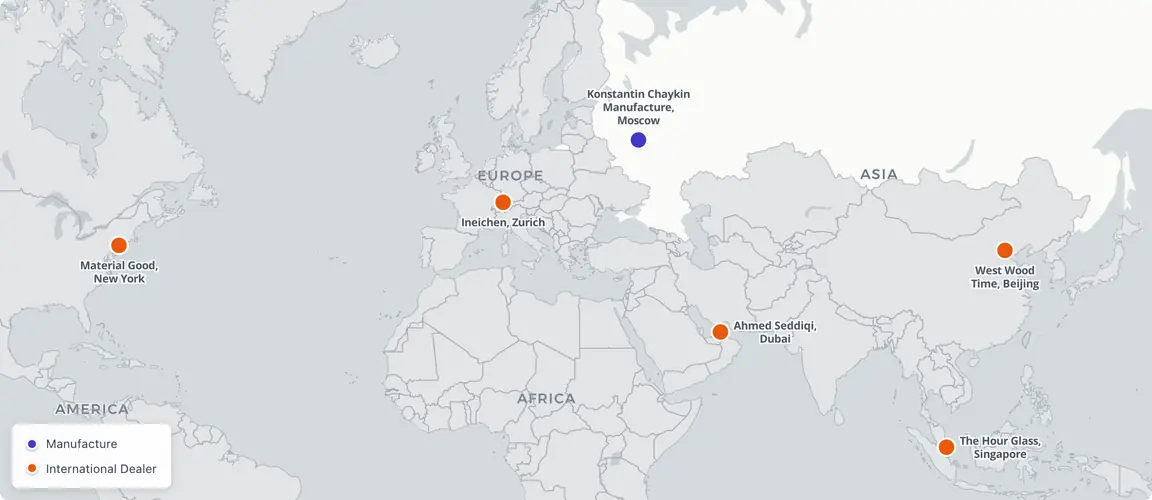
The manufacture now employs approximately sixty people, more than forty of them in manufacturing. Production runs at 200 to 300 pieces annually. Eighty percent is exported through twenty-two authorized dealers across seventeen countries — from Ahmed Seddiqi and Sons in Dubai to The Hour Glass in Singapore, from Material Good in New York to West Wood Time in Beijing. The Swiss hub through Ineichen in Zurich provides after-sales service and operational continuity for European and global collectors. Revenue was reported at 55 million rubles in 2018; the current figure is undisclosed but, given the price increases and volume growth since the Joker’s launch, is understood to be several multiples higher.
The recognition that sanctions cannot contain
The industry’s validation arrived in stages, each one more emphatic than the last. The GPHG Audacity Prize on November 9, 2018 — awarded to the Clown, a Wristmons sibling — made Chaykin the first Russian watchmaker ever recognized at watchmaking’s equivalent of the Academy Awards. The WIPO Gold Medal for Inventors followed in 2020, placing him in company with Nicolas G. Hayek as only the second horologist to receive the honor. Induction into the Temporis Hall of Fame in 2022, alongside Philippe Dufour and Kari Voutilainen — two of the greatest living watchmakers — confirmed that the manufacture’s position was not a novelty but a permanent feature of the industry’s upper tier. The same year, Chaykin received the title Distinguished Inventor of the Russian Federation.
The recognition has continued to arrive even as post-2022 sanctions have tightened the operational space around the manufacture. Component sourcing from Swiss movement makers like La Joux-Perret and Vaucher has become more complex. Financial transactions cross more regulatory boundaries. Logistics for a business that exports four out of every five watches it produces require careful navigation. Watches have reportedly been seized at international exhibitions. The 35% import tariffs that Russian goods face in EU and US markets compound the challenge.
Yet the manufacture exhibits at Geneva Watch Days, participates in Only Watch charity auctions, and in 2025 Chaykin became the first Russian invited to serve on the GPHG jury — the outsider becoming an arbiter. The dealer network has expanded, not contracted. Collector demand, measured by waiting lists and auction premiums, has intensified. The operational constraints are real, but they have not prevented the manufacture from reaching every major collecting market on earth.
“If you want to earn a lot quickly, then forget about the path of an independent watchmaker,” Chaykin has said, “because this is far from the most profitable business, for which on the contrary you need to devote an incredible amount of energy, time and yourself.” The sentence is as close to a business plan as the manufacture has ever published. What it describes — total commitment to a category that rewards conviction over efficiency — is precisely what produced the Joker in four frantic months, the Wristmons collection in the years that followed, and the half-million-franc auction results that prove the market agrees.
The watch that was never supposed to exist now defines a manufacture that was never supposed to survive. From a one-man workshop in St. Petersburg to sixty employees producing 300 watches a year for seventeen countries, Konstantin Chaykin Manufacture has built something the Swiss ecosystem did not anticipate and cannot replicate: haute horlogerie with a sense of humor, made in Moscow, collected worldwide.
Researched 25 sources in English, Russian.