 Skip to main content
Inka Crops
For 30 years Inka Crops shipped Andean ingredients to Whole Foods and 24 other export markets. Then Peru's Ley de Octógonos threatened to flag every fried-snack bag with black warning labels — a category-killer for premium positioning. The company had already reformulated for Chile's stricter rules. Alicorp noticed: USD 72.2 million for 60%.
Sacred Valley Corn to Lima — Peru's Integrated Supply Chain
Thirty years of export compliance became domestic regulatory standing
Andrés Abusada’s grandparents grew Giant White Corn in Cusco’s Sacred Valley before Peru exported it to anyone. In 1995 he built Inka Crops to ship the family grain in retail-ready bags instead of bulk sacks. Thirty years later, Alicorp paid USD 72.2 million for 60% of what that decision became — and the Sumar family kept the other 40%.
The question behind the acquisition
The question at the centre of Inka Crops’ story is not how a Peruvian snack maker reached 25 export markets in 30 years. It is how a company built for export accidentally became, within three years of a single regulatory decision, the only major brand in Lima’s snack aisle that did not need to relabel.
The mechanism was regulatory arbitrage by accident. Peru’s Ley de Alimentos Saludables, and its successive octagonal warning-label enforcement phases from 2019 to 2022, required food manufacturers to display black octagonal labels on products exceeding sugar, sodium, or saturated-fat thresholds. The design was borrowed from Chile, which had imposed equivalent rules earlier. For Inka Chips, the timing was not coincidence. The company had spent years reformulating its recipes for the Chilean export market. When Peru activated the stricter label-enforcement phase in September 2022, Inka Crops had nothing to relabel. Every major competitor in the fried-snack category did.
The outcome was swift. Ignacio Garaycochea, then gerente comercial, told Perú Retail that the company had gained 16% in modern-channel market share within a year of the octógono-free positioning. Between 2022 and 2024, the company grew at more than 25% annually, against a category that was contracting under the compliance burden. Effie Oro 2025 in the Golosinas/Postres/Snacks category confirmed the brand had crossed from niche exporter to mainstream domestic standard.
Gonzalo Uribe, CEO of Alicorp, was explicit in the acquisition press release of March 2026: “una empresa con marcas sólidas, una cadena agrícola integrada y un posicionamiento relevante en mercados internacionales” (“a company with solid brands, an integrated agricultural chain, and relevant positioning in international markets”). The USD 72.2 million for 60% — implying a total enterprise value of approximately USD 120 million — was not a payment for snack volumes. It was a payment for what 30 years of compliance patience had compounded into.
Corn, family, and the decision to brand
The Sumar family’s history with Cusco’s Giant White Corn predates the company by decades. Andrés Abusada’s maternal relatives supplied cancha-grade corn — the large-kernel toasted variety cultivated in Peru’s Sacred Valley under a Denominación de Origen designation — to agricultural cooperatives and bulk exporters before the modern snack category existed in Peru. The knowledge was agricultural: which communities grew which kernel sizes, how to manage the DO certification chain, and which growing seasons produced the profile that worked in roasted form. When Inka Crops S.A. was incorporated on 1 September 1995, the founding logic was direct: instead of selling the corn in bulk sacks at commodity prices, sell it in retail bags at a category premium.
The first market was the United States, not Peru. Around 2000, the Inka Corn brand — branded Giant White Corn cancha, repositioned as a snack for the North American natural-foods channel — arrived in Whole Foods alongside the nascent Latin American specialty-foods category. That market selection proved formative in ways the company could not have planned. Selling into Whole Foods required sourcing documentation, provenance transparency, and nutritional labelling that would, a decade later, transfer directly to regulatory compliance. The same audit culture that earned a Whole Foods shelf placement trained the organisation for what Peruvian food regulation would eventually demand.
The 2007 opening of a modern processing facility in San Juan de Lurigancho changed the company’s operational ceiling. Diversification into chifles, yuca crisps, and camote became possible at scale. Seven production lines, eventually capable of 13,000 tonnes per year, created the capacity to serve 150-plus SKUs across five sub-brands. By 2010, the ADEX trade association confirmed Inka Crops held 50.4% of Peru’s snack export value, the top-ranked position in its category. The UPC Premio a la Creatividad Empresarial in the Impacto Internacional category that year was the first formal external validation that an Andean food heritage could be systematised into a modern branded export operation.
Regulation, reformulation, and an accidental head start
The 2015 decision to launch Inka Chips into Peruvian domestic retail arrived at a particular structural moment. Chile had already introduced its own food-labelling regime earlier, applying octagonal black labels to products exceeding defined thresholds on saturated fat, sodium, and sugar. If Inka Chips intended to hold its Chilean supermarket placements, reformulation was not optional. Palm oil — then the dominant frying oil in Peruvian snacks, used industry-wide for cost and stability reasons — was saturated fat’s primary source. The oil would have to change.
The reformulation programme that began as export compliance work took six years to complete. The technical challenge was significant: high-oleic sunflower oil behaves differently under frying conditions from RSPO palm oil, and the product texture, colour, and shelf life required iteration across the portfolio. Management completed the migration in January 2021. Saturated fat in the chip line dropped from approximately 50% of fats to approximately 10%. The team launched the positioning simultaneously: “el primer snack peruano libre de octógonos” — the first Peruvian snack brand free of the warning labels that would become mandatory across the category.
Peru activated the stricter phase of its own Ley de Octógonos in September 2022. Competitors who had not reformulated now faced mandatory black warning labels at retail, which, in the Lima modern channel — Wong, Metro, Plaza Vea, Tottus — signalled a negative nutritional attribute to a consumer segment that had become sensitive to the designation. Inka Chips’ label-free status moved from positioning claim to structural advantage. Share gains in the modern channel accelerated.
The second test arrived at speed. On 8 February 2024, a fatal wastewater-tank collapse at PepsiCo’s Santa Anita plant in Lima pulled the Frito-Lay Peru portfolio — Lay’s, Karinto, and related lines — from retail shelves. Inka Crops’ San Juan de Lurigancho facility was already running at approximately 85% utilisation, with demand for its own Inka Chips and Amazon Chips lines growing at double-digit rates. The dilemma was precise: the shelf space Frito-Lay’s absence had vacated was open for Inka Chips to claim, but claiming it required production capacity the company was already stretching.
Management chose both paths simultaneously. Lay’s and Karinto white-label production contracts were accepted — Inka Crops had the formulation capability and the regulatory-compliant lines to produce them. To protect the identity of the branded portfolio during the same period, the team launched co-branded products: a Bembos flavour collaboration and a Cusqueña beer variant that positioned Inka Chips as a culturally embedded local product, not a capacity contractor. Christian Matos, gerente de marca, told Perú21 that the first half of 2024 delivered 50% growth: “nos sentimos con la confianza de que el consumidor está haciendo suya la marca” (“we feel confident that the consumer is making the brand their own”). By November 2025, Alicorp had signed the acquisition agreement.
A supply chain that is the product
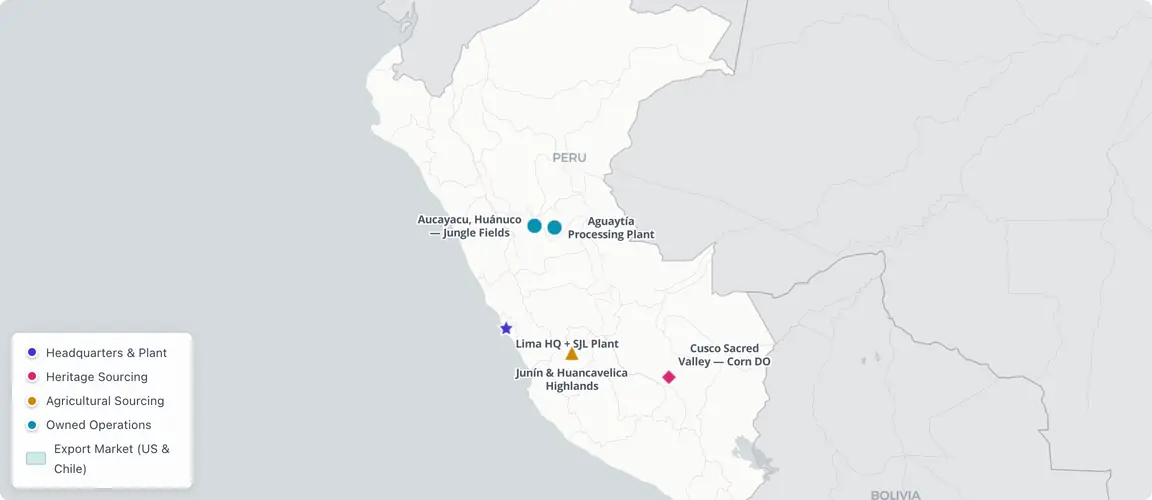
The sourcing architecture that supports Inka Crops is not incidental to the brand — it is the brand’s primary intellectual property, and the reason the “natural Andean ingredients” positioning is not easily replicated. Cusco Giant White Corn remains the heritage anchor. Sourced through APROMAIZ-linked cooperatives from growing communities in the Sacred Valley with Denominación de Origen certification, the corn carries provenance that can be traced to specific communities and harvests. The 83 tonnes of native-potato chips exported to the US in 2019 — sourced from 27 farming communities in Junín and Huancavelica through development NGOs Fovida and Cedinco — required a supply chain that Whole Foods could audit and a brand team could narrate. Both had been built in the decade before the chips existed.
Procesadora Tropical, the sister entity co-acquired by Alicorp alongside Inka Crops, extends the model into the Peruvian jungle. Two hundred hectares of plantain and yuca production near Aucayacu in Huánuco feed a separate processing facility in Aguaytía, Ucayali. The chifles, yuca crisps, cacao, ginger, and malanga products in the Inka Crops portfolio flow through this supply chain — a vertically integrated sourcing structure that spans coast, sierra, and selva — Peru’s three ecological zones from Pacific desert to Andean highlands to Amazon rainforest. When Alicorp’s transaction team evaluated what they were acquiring, Procesadora Tropical was not an add-on. It was a material component of the investment thesis, and the acquisition agreement covered both entities at a single price.
The 2,000-plus farming families across the three supply chains — the Cusco corn cooperatives, the Andean native-potato communities, and the Amazonian tropical-ingredient producers — represent a sourcing network that took three decades to develop and cannot be replicated quickly. Competitors can acquire a processing plant. They cannot acquire the agronomic trust, the traceability certification, and the community relationships that let the “natural Andean ingredients” positioning hold up under audit. That distinction, more than any single brand or award, is what justified the acquisition premium.
The 100,000-plus bodega distribution footprint — bodegas are the small family-run neighborhood grocery shops that form Peru’s traditional retail backbone — is the domestic commercial layer. Inka Crops’ penetration of Peru’s traditional trade channel — which dominates FMCG reach outside Lima’s modern supermarkets — was built in parallel to the modern-channel premium positioning. Smaller packaging formats, lower price points, and consistent quality thresholds applied at both ends: Whole Foods and the neighbourhood bodega in Villa El Salvador received product made to the same recipe.
Under the Alicorp umbrella
Alicorp brings to Inka Crops the one resource the company could not build as a founder-owned independent: the national distribution infrastructure to move a 150-SKU portfolio through the full breadth of Peru’s modern and traditional trade network. The Grupo Romero-controlled buyer — Peru’s largest consumer-goods company, with annual revenue exceeding USD 3 billion — did not acquire the brand to reposition it. Gonzalo Uribe’s language at the close — “nueva etapa de crecimiento conjunto” (“new phase of joint growth”) — signals an integration model that preserves brand equity while adding distribution reach and export logistics that a company at USD 40–55 million in revenue could not replicate independently.
The Sumar family’s residual 40% position is structured for a defined exit. Alicorp’s Q1 2026 financial accounts recognised a S/172 million (Peruvian soles, ~USD 46M) non-controlling interest put liability — the option mechanism that will, when exercised, transfer the remaining equity at a contractually determined price. The timeline is not publicly disclosed; comparable structures in Peru suggest a 3–7 year horizon from closing date.
Inka Crops’s 30-year arc shows a pattern: the discipline to absorb upfront compliance or reformulation cost produced regulatory standing that mattered once the regulatory environment caught up. The Chilean export reformulation and the Peruvian domestic regulatory compliance were responses to the same deadline, seen from different sides of the border.
Ownership Transition
"Grupo Romero-controlled Alicorp acquires 60% of Inka Crops and Procesadora Tropical; family retains 40% with contractual NCI put/call for eventual full transfer"
Researched 17 sources in Spanish, English.