 Skip to main content
Hairstory International
Every other Malaysian salon chain that wanted to scale picked franchising. Hairstory International picked its own stylists — and gave them equity. That structural bet, made over two decades in Penang, was the reason the chain posted record revenue in both 2020 and 2021 while every one of its 17 outlets sat closed.
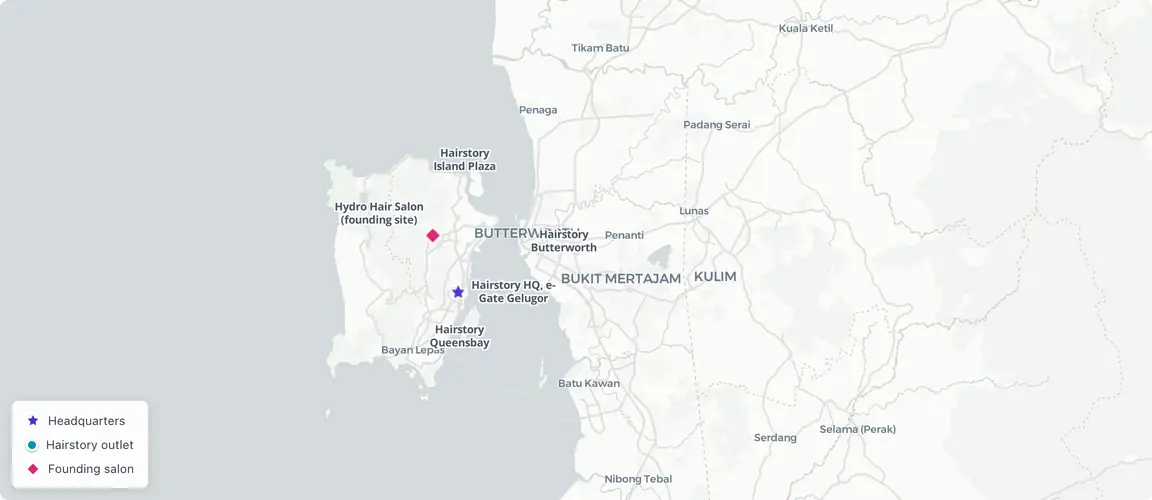
17 Outlets Across Penang and the Klang Valley
The stylists-as-owners bet that beat franchising through three lockdowns
Every other Malaysian salon chain that wanted to scale picked franchising. Hairstory International picked its own stylists — and gave them equity. Twenty-one years after Derick Ooi opened a three-chair Hydro Hair Salon in Bandar Baru Ayer Itam, the model still hasn’t lost a partner to a competitor.
The founding bet
Hairstory’s story begins as an apprentice story — briefly. Derick Ooi spent four years in Penang salons learning the craft from the bottom of the hierarchy, the way the trade worked. In 2004, he opened Hydro Hair Salon in Bandar Baru Ayer Itam with three chairs and no outside backing. The founder profile covers those years in full. What matters for the brand arc is what came next: the structural decision that would define Hairstory’s growth model for two decades.
By 2010, the salon had enough momentum to attract a business co-founder. Leon Lee (Lee Toong Leon) joined to take on commercial operations — the division of roles that most durable founder-led businesses eventually require. The entity was rebranded Hairstory International. Hydro was a single-salon name; Hairstory was built to carry a network. The question was what kind of network.
The prevailing answer in Malaysian beauty services was franchising. It offered faster capital accumulation and geographic reach without the complexity of managing a growing employed workforce. Hairstory rejected it entirely.
“This is much better than opening up new outlets with external shareholders, who may not be aligned with our work culture,” Derick Ooi told Asia Connects in July 2022. The franchise model solved the capital problem by creating a different problem: misaligned partners. Hairstory’s answer was the Employee Entrepreneurship Programme — the structural innovation that the entire subsequent history of the chain turns on.
How the EEP works
The Employee Entrepreneurship Programme is not a management training scheme. It is an equity pathway. A junior stylist who rises through Hairstory’s ranks and demonstrates the capability to manage an outlet is offered the opportunity to incorporate their own Sdn Bhd and take a partner stake in a new location. They are an owner-operator, not a franchisee — they are accountable for the outlet’s performance, and they benefit directly from its success.
The practical effect is that every Hairstory expansion is backed by a tested internal candidate with established client loyalty and a demonstrated understanding of the chain’s operating culture. There are no external shareholders from the franchise market, no investors whose incentives may diverge from the brand’s quality commitments, and no tension between the royalty payments a franchisee must cover and the service standards the brand needs to maintain.
The Hairstory Capital Sdn Bhd corporate structure, incorporated in 2012, is the legal mechanism that makes EEP viable. Each outlet operates as a separate corporate entity, ring-fencing the risk of any single location from the broader group. A partner-stylist who co-owns an outlet is exposed to the performance of that outlet, not the consolidated group — a structure that concentrates incentives precisely where the client interaction happens. It is architecturally different from a franchisor collecting royalties across a flat network.
By 2022, the EEP had produced 25 partner-stylists and 50 artistic directors. These figures are the business’s most important metrics — more diagnostic than the outlet count. They are also the binding constraint on future growth: no new outlet opens without a qualified EEP candidate ready to own it.
The Starbucks question
Derick Ooi’s account of how he thought about positioning is worth quoting directly: “I asked myself, why are people willing to spend so much on coffee at Starbucks? And if a can of Coke is priced at RM1.80 in the supermarket, how could it fetch up to RM18 at a hotel? It’s all about unrivalled service and creating an exceptional experience in a relaxed environment.”
The Chinese-language business press had already arrived at an answer. A 2021 profile in Shanghai Business Media described Hairstory as 美发界的星巴克 (“the Starbucks of hair salons”) — a characterisation that captured both the premium positioning and the service-experience ambition. Hairstory was not competing on price. It was competing on what a client’s hour in a salon should feel like.
This positioning is inseparable from the EEP. A franchise model built on royalty extraction cannot maintain the service culture that premium positioning requires. The partner-owner at each Hairstory outlet has a direct stake in the client experience because their equity value depends on it. The alignment between owner incentive and service standard is structural, not aspirational.
The training infrastructure
By 2017, Hairstory had formalised its training operations through Globalstory Academy Sdn Bhd (1250266-M), incorporated at All Seasons Place Penang. The academy holds TQUK certification and SKM Levels 2 and 3 — the industry qualifications that give graduates credentialled pathways into the sector. By 2019, more than 500 stylists had passed through the programme.
The academy serves two functions simultaneously. It trains external candidates for the broader industry — Hairstory’s answer to the sector-wide professionalisation challenge that every Malaysian salon chain faces. And it provides the EEP’s internal talent pipeline: the pool of trained, assessed stylists from which the next generation of partner-owner candidates will emerge.
In 2014, even before the academy was formally incorporated, Hairstory launched a zero-fee hairdressing training programme specifically for school-leavers from households earning under RM5,000 per month. More than 80 young people had enrolled by 2019. The programme was supported in collaboration with elected representatives — a public acknowledgment that professional training in the trades is as much a civic obligation as a commercial one.
The training investment also shapes what a new entrant to the Penang salon market would be competing against. It would not be a chain that simply has more outlets. It would be a chain whose leadership bench has been trained, certified, and promoted from within over years — stylists who have been absorbing Hairstory’s service culture since they first held a pair of scissors professionally. That institutional depth does not appear on a balance sheet, but it is why the EEP’s target of 30 outlets by 2027 is a management question rather than a capital one.
The pandemic as proof of concept
On 18 March 2020, Malaysia’s Movement Control Order came into effect. Every Hairstory outlet closed. Seventeen locations, 120 employees, and zero service revenue. The question was whether the model would hold.
The Penang dimension made it harder. Penang Chief Minister Chow Kon Yeow declined the federal government’s green-light to reopen salons, citing 95% public concern. Of the 1,645 hair salons and barbers across Penang, none were permitted to operate — a regional restriction stricter than the national baseline. When MCO 2.0 arrived on 13 January 2021 and FMCO from 1 June 2021, the same pattern repeated.
Hairstory’s response was four-pronged. First, no pay cuts for any of the 120 employees. Second, stylists began conducting Facebook Live haircut tutorials — maintaining client relationships and demonstrating the craft while salons were closed. Third, online sales of treatment products gave the chain a revenue channel that did not depend on physical service. Fourth, Hairstory offered prepaid voucher packages with one-year validity, converting client loyalty into advance revenue during the closure period.
The financial outcome was not what the model’s critics would have predicted. Both 2020 and 2021 closed as record-high revenue years — “tens of millions of Ringgit,” in Derick Ooi’s phrasing. “I believe the stellar financial results are one of the best among those in the fraternity in the northern region,” he told Asia Connects.
The EEP explains the paradox. A franchise model under pandemic conditions creates misalignment: the franchisor has royalty-revenue pressure; the franchisee has survival pressure; neither has the same stakes as an owner-operator who built the location from within. Hairstory’s partner-stylists had every reason to drive the voucher and online-product strategies — the business they part-owned depended on it. The four-pronged pandemic strategy was not a corporate directive imposed from above. It was the output of an ownership structure designed to make every team member’s incentives converge.
Seventeen outlets, thirty as the target
The 2019 opening of Hairstory Uptown Damansara in Petaling Jaya was a milestone the chain had approached carefully. It was the seventeenth outlet and the first outside Penang state. Leon Lee’s comment at the opening set the tone: “Only when we had 100% confidence of succeeding in our project then we made the great step forward.”
That caution is the EEP in action. The Klang Valley outlet required the same architecture as every other Hairstory location — a qualified partner-candidate, an established client base to transfer, and operational protocols that had been tested across sixteen Penang iterations. Two years of planning preceded the opening. The chain moved to a new market when the model was ready, not when the capital was available.
By the time the Asia Connects profile ran in July 2022, Hairstory was operating at 17 outlets, 120 employees, and a declared target of 30 outlets by 2027. The route to 30 runs through the EEP pipeline: 25 active partner-stylists, 50 artistic directors, and an academy that has now trained more than 500 certified stylists. These numbers determine the pace.
In October 2023, Derick Ooi received the Pingat Kelakuan Terpuji (PKT) on the Penang Governor’s Birthday Honours List — a state honour that placed Hairstory’s founder among Penang’s civic and business leadership. The same year, the Nanyang Siang Pau awarded the Phoenix Covid-19 Excellent Business Award, the third-party Chinese-press confirmation of what the record revenue figures had already established.
What the model demonstrates
The strategic argument for franchising in service industries rests on capital efficiency: it lets an owner replicate their model without hiring all the staff, managing all the operations, or absorbing all the risk. Hairstory’s counter-argument is that franchising solves the capital problem by creating a culture problem. The franchise fee structure rewards territory, not quality. The EEP structure rewards performance.
Twenty-one years of data supports the counter-argument. Hairstory has scaled to 17 outlets without a franchise fee paid or collected. It has retained its partner-stylists through three lockdown cycles. It has posted record revenue during the period that destroyed the business models of chain salons built on foot traffic and lease economics. And it has a credentialled training academy that produces its own replacement candidates.
The 30-outlet target is aggressive for a Penang-based chain — it implies nearly doubling the network in five years. But the constraint is not capital. It is the time required to produce the next generation of EEP partner-candidates from within. That constraint, unlike a franchise pipeline, cannot be accelerated by writing a cheque. It requires, as it always has, time in the chair.
What the outlet count does not show is the pipeline behind it: how many EEP-qualified candidates exist, and whether the Globalstory Academy’s certified output rate has kept pace with the chain’s stated growth target. On those questions the record already has numbers — 25 active partners, 50 artistic directors, 500-plus certified graduates — a level of documented detail that most service-chain expansion stories do not offer at this stage.
Researched 12 sources in English, Chinese.