 Skip to main content
Ghee Hiang
In 1999, four founding families went to war over Malaysia's oldest confectionery. Seven years of litigation nearly killed a 168-year-old brand. The reluctant heirs who inherited the wreckage discovered the turnaround wasn't in pastries—it was in sesame oil that now reaches 400+ Hong Kong supermarkets.
168 Years on Beach Street, 6,000 Bottles to Hong Kong
Seven years of family war, then sesame oil saved everything
When Dato Ch’ng Huck Theng and Datuk Ooi Sian Hian inherited Ghee Hiang in 2006, they weren’t receiving a cherished family legacy—they were accepting custody of wreckage. Seven years of litigation had paralyzed Malaysia’s oldest confectionery. Four founding families had torn themselves apart in court. Heavy machinery, intended to modernize production, had ruined the pastries. Customer service had deteriorated to the point where frustrated customers left empty-handed after being chided for not ordering in advance. It was, as Sian Hian later put it, one of the toughest challenges the family business had to deal with — a feud that “nearly spelt its doom.”
The crisis that mechanization created
The previous management’s strategic failure was ironically an attempt at modernization. In the late 1990s, heavy machinery was introduced to cope with increasing demand for tau sar pneah. The result: harder pastries that customers rejected. This violated Ghee Hiang’s foundational promise. Since 1856, when Fujian migrant Teng Tou Ku established the business at Beach Street, the brand had built its reputation on fresh-baked, hot-from-the-oven pastries. Customers would queue for biscuits barely cooled—the experience of eating tau sar pneah warm was inseparable from the product itself. The machines broke that sensory experience, producing pastries that lacked the delicate texture that generations of Penang families had come to expect.
Compounding the quality decline was a customer service culture so hostile that, according to local food histories, frustrated customers used to leave the shop empty-handed after being chided for not making their orders early. Staff attitudes reflected management dysfunction. Training deteriorated. The warmth that should accompany a heritage brand visiting experience was replaced with impatience and dismissiveness. Brand reputation deteriorated at the same moment the product itself was failing. As Chng Huck Theng later reflected: “It was between my grandfather and father. It mainly started with disagreements on strategy and one thing led to another. They were just at odds with each other.”
Seven years in court
The flashpoint came in 1999. An extraordinary general meeting resulted in the forced removal of several directors—granduncles and uncles from the other families. They sued. The litigation consumed approximately seven years.
For 73 years, four families—Ch’ng, Ooi, Yeap, and Yeoh—had governed Ghee Hiang under the 1926 arrangement established when founder Teng Tou Ku died and his widow sold the business. Generational tensions accumulated across decades until they erupted into open warfare. Ooi Sian Hian offered the starkest assessment: “We did not face many problems during economic downturns. Our biggest setback came in the form of trouble between the families… it was one of the toughest challenges the family business had to deal with as the feud nearly spelt its doom.”
The stakes were existential. The 143-year-old company faced potential dissolution under litigation costs and operational paralysis. Product quality had already declined. Customer trust had evaporated. Without intervention, one of Asia’s oldest food manufacturers would have collapsed into irrelevance.
The court ordered a mutual buyout. The Ch’ng and Ooi families acquired the Yeoh and Yeap stakes, simplifying ownership from four families to two. Sian Hian—an architect by profession, not a food industry veteran—found himself leading a heritage confectionery. They inherited a damaged brand—but they also inherited clarity. The governance paralysis that had nearly destroyed the company was eliminated. Now came the harder task: restoration.
The turnaround nobody expected
The turnaround strategy that saved Ghee Hiang wasn’t obvious. The new leadership could have focused entirely on rehabilitating the tau sar pneah pastries that had defined the brand since 1856. Instead, they recognized that a product with a two-week shelf life and tourism-dependent sales couldn’t sustain a heritage brand through crises. The answer had been on the shelf the whole time: Ghee Hiang Baby Brand Pure Sesame Oil, introduced in the early 1900s using traditional Fujian extraction methods and largely overlooked in pastry-focused narratives about the company.
Production returned to handmade methods. The machinery that had compromised pastry quality was abandoned. Sian Hian articulated the philosophy: “I don’t want to be a supermarket, I don’t want to be selling anything and everything like a sundry shop. We are a traditional biscuit maker, that’s our core strength so we will stick to it.” But the sesame oil operation—which didn’t require the same artisanal touch as pastries—could scale without betraying heritage.
The breakthrough came from serendipity. Sometime between 2008 and 2010, Hong Kong celebrity chef So Sze Wong walked into a Ghee Hiang outlet as an anonymous tourist. She purchased sesame oil without the company’s knowledge. Then, on her TVB cooking show “So Good,” she proclaimed it “the best sesame seed oil in the world”—adding that she treasured it so much she used it only for special dishes. This was not a paid advertisement.
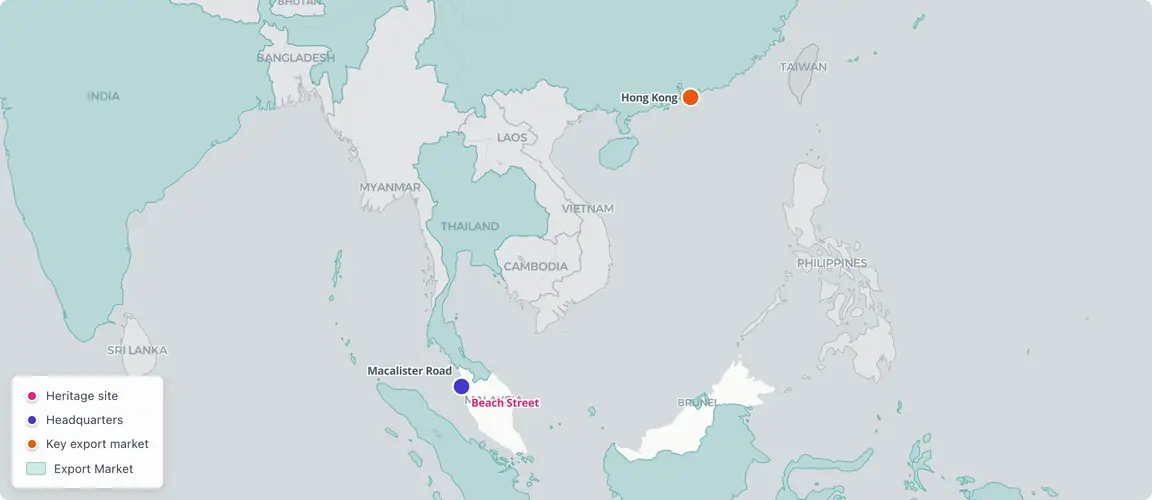
“All of a sudden, we had an influx of calls asking for our product,” Sian Hian recalled. The organic endorsement opened Hong Kong’s market in a way no marketing budget could have purchased. Today, Ghee Hiang sesame oil sits in 400+ supermarkets across Hong Kong, including the entire PARKnSHOP chain of 300+ stores. The Jelutong factory produces 6,000 bottles of 700ml sesame oil daily—a production scale that requires 110 employees (roughly half local, half foreign workers) to maintain. Sesame oil now generates 70% of Ghee Hiang’s revenue—a complete inversion of the traditional pastry-first business model. The product that founders’ families had treated as a side offering for over a century became the company’s salvation.
When the tourists disappeared
The diversification strategy’s value became unmistakable during COVID-19. George Town’s tourism industry collapsed—international passenger movement dropped 99.9% by Q2 2020. Domestic visitors to Penang declined 42.2%. The UNESCO World Heritage Zone where Ghee Hiang’s Beach Street headquarters has stood since 1856 became, as one report noted, “the sun-scorched colonial backwater it was before its inscription on the 2008 UNESCO World Heritage list.”
Ghee Hiang never disclosed specific revenue impacts. But the company’s response demonstrated the diversification thesis. Sesame oil exports—35% of production shipped to Singapore, China, Japan, India, and Indonesia, alongside the Hong Kong channel—continued while pastry-dependent competitors struggled. E-commerce platforms were activated. Delivery services launched. The revenue engine that most observers still associated with pastries proved to be the business’s true stability mechanism.
Huck Theng leveraged his position as Chairman of the Association of Tourism Attractions Penang (ATAP) to advocate for industry reopening and support for heritage businesses struggling through the lockdowns. By September 2021, he was calling for travel bubble expansion from Langkawi to Penang. The recovery proved robust. Penang tourism reached 8.24 million visitors in 2024, exceeding pre-pandemic levels. Ghee Hiang emerged not just surviving but expanding, with momentum that competitors who had retrenched during the pandemic could not match.
A city without a soul
Huck Theng articulates the philosophy that now guides the heritage brand: “Some things have to evolve and some things have to stay. While we have to evolve to survive, we also need to preserve and promote what we are known for. We must not change totally everything; there must be something that our forefathers had done right that gave us an opportunity to grow further.”
This evolution-without-erasure approach extends beyond business decisions into civic engagement. His concurrent roles as ATAP Chairman and President of the Penang Art Society position Ghee Hiang’s survival as cultural stewardship: “If the government does not take the initiative to do something with the heritage, the culture, and the arts scene, no one is going to bother… Without the history, the culture and the heritage, then it will be a state without a soul. You can build a nice and big building with good infrastructure, but you just have a nice body; you don’t have a soul.”
The Beach Street boutique—which survived Japanese bombing during World War II—has been restored to late 19th/early 20th century aesthetic. Chief Minister Chow Kon Yeow unveiled the major renovation in January 2023. The space now includes viewing decks and museum elements, transforming heritage retail into experiential tourism. A four-acre factory at Penang Science Park North, operational in 2024, provides expansion capacity without compromising the artisanal character of the original production.
The brand launched contemporary products—DarkChoc, WhiteChoc, and ChilliChoc cookies—alongside the traditional tau sar pneah. Most significantly, Tau Sar Pneah Kurma became the first halal-friendly dates variant in the brand’s 168-year history, expanding addressable markets while maintaining core offerings. In October 2025, a research collaboration with Hong Kong Baptist University on the neuroprotective effects of sesame oil bioactive compounds signaled ambitions beyond mere food production.
Forty rivals and one edge
The competitive landscape remains fragmented. Sian Hian estimates approximately 40 tau sar pneah makers operate in Malaysia. Him Heang, founded 1948 by a former Ghee Hiang baker, maintains only one outlet with deliberately limited daily output, commanding intense local loyalty on perceived superior taste. Ban Heang, established 1997, dominates mass-market distribution, including a Penang International Airport outlet, with a broader product range at lower prices. Tean Ean serves tourists with competitive pricing and full halal certification.
Ghee Hiang differentiates through heritage pedigree (168 years), product diversification (pastries plus sesame oil), traditional authenticity (lard-based recipes maintaining original taste), and experiential retail (factory tours, Teels Heritage Cafe, museum-style Beach Street outlet). The non-halal pastry positioning limits appeal to Malaysia’s Muslim-majority population but preserves the authenticity that distinguishes the brand from competitors who have compromised recipes for broader reach.
Meanwhile, halal-certified sesame oil and coffee products expand addressable markets without diluting the core offering. This dual approach—tradition where it matters, adaptation where it enables growth—defines how heritage brands survive not just market disruptions but internal implosions.
The afterlife of a side product
In October 2025, Ghee Hiang announced a research collaboration with Hong Kong Baptist University to study the neuroprotective effects of sesame oil bioactive compounds. For a brand whose primary narrative has always centered on pastries, the announcement marked something quietly significant: the product that four families spent 73 years overlooking is now a subject of nutritional neuroscience.
The arc of Ghee Hiang Baby Brand Pure Sesame Oil traces the entire history of the company. Introduced in 1900 as a complement to tau sar pneah. Ignored while the founding families argued about biscuit recipes and board control. Elevated by a celebrity chef who walked in as a tourist and proclaimed it the best in the world. Scaled to 6,000 bottles daily and 70% of company revenue. And now: a research partnership with a Hong Kong university examining what the oil’s bioactive compounds do to the human brain.
None of that trajectory was planned. The sesame oil operation survived the family feud not because anyone recognized its potential, but because it was small enough to escape the litigation. Its export shelf life—months, compared to tau sar pneah’s two weeks—made it immune to tourism volatility. Its halal certification opened markets the lard-based pastries could not reach. Each advantage was structural, waiting for conditions that the family feud paradoxically created.
What heritage brands ultimately learn from crisis is not strategy. It is attention. The Ch’ng and Ooi families, inheriting wreckage in 2006, were forced to look at everything. The side product they looked at turned out to be the company.
Researched 17 sources in English, Chinese.