 Skip to main content
Fabergé
In 1951, the family of the man who made the Tsar's Easter eggs lost their name for $25,000. Over six decades, it appeared on drugstore cologne and toilet cleaner. Recovery cost $38 million. Profitability has never been achieved. Yet one egg sells for $30.2 million — nearly matching the entire brand's $50 million sale price.
183 Years, Four Continents
The Tsar's jeweller's name, lost for $25,000, recovered for $38M
In 1951, the descendants of the man who made the Tsar’s Easter eggs settled a trademark dispute for $25,000. Over the next fifty-six years, they watched their family name appear on drugstore cologne, toilet cleaner, and Barbie dolls. How Fabergé (Фаберже) got its name back is the most improbable rescue in luxury history — and one that, by any financial measure, has not yet succeeded.
The jeweler who outranked Cartier
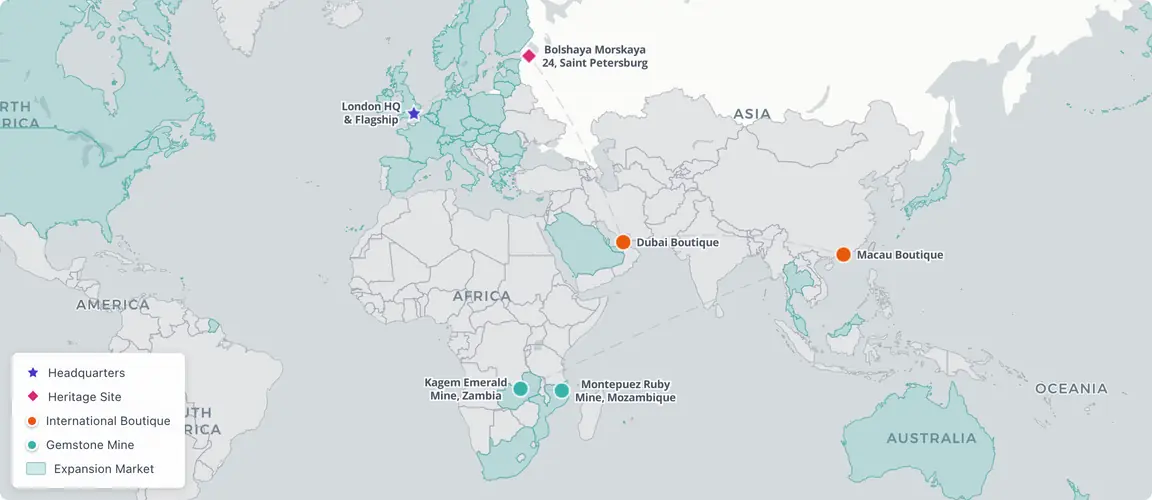
Gustav Fabergé, a Baltic German jeweler of Huguenot descent, opened a modest workshop at 24 Bolshaya Morskaya Street in Saint Petersburg in 1842. It was his son Peter Carl who transformed the family business into something without precedent. Assuming control in 1872 at the age of twenty-four, Peter Carl shifted from conventional jewelry toward art objects that synthesized goldsmithing, gemology, and mechanical engineering. In 1885, Tsar Alexander III commissioned the first Imperial Easter Egg — a gold hen nested inside a white enamel shell — as a gift for Tsarina Maria Feodorovna. The commission launched a tradition that would produce fifty Imperial Eggs over thirty-one years, each more intricate than the last, each containing a miniature surprise that only the recipient would see.
At its peak before the First World War, the House of Fabergé employed more than 500 craftsmen across workshops in Saint Petersburg, Moscow, Odessa, Kiev, and London, producing an estimated 150,000 objects for clients including two Tsars, the King of England, and the Rothschilds. At the 1900 Paris Exposition Universelle, Imperial Eggs were shown publicly for the first time. Peter Carl Fabergé received a gold medal and was made Chevalier de la Légion d’Honneur. The firm held the title “Goldsmith by Special Appointment to the Imperial Crown.” No other jeweler in history — not Cartier, not Boucheron, not Tiffany — had achieved the same concentration of institutional prestige and artisan output under a single roof.
Ten minutes to leave
The October Revolution of 1917 ended everything in a single season. Bolshevik forces nationalized the workshops at Bolshaya Morskaya 24 and every branch office. The firm’s entire inventory — precious metals, gemstones, finished objects — was confiscated without compensation. The business was handed to a “Committee of Employees” before full state seizure in 1918. Peter Carl Fabergé reportedly had minutes to collect personal belongings before leaving the premises. He disguised himself as a diplomatic courier attached to the British Embassy and escaped on the last diplomatic train through Riga, then traveled through Latvia and Germany before settling in Lausanne. He died at the Hôtel Bellevue on September 24, 1920, aged seventy-four, a stateless refugee who had lost his life’s work.
The Imperial Eggs, however, proved indestructible. Kremlin curators heroically preserved ten by registering them as museum inventory in 1927, shielding them from Stalin’s foreign-currency sales program that dispersed dozens of masterworks to Western collectors. Peter Carl’s sons Eugène and Alexander established Fabergé & Cie at 281 Rue du Faubourg Saint-Honoré in Paris in 1924, maintaining the jewelry-making tradition and the family’s claim to the name. German workmaster Victor Mayer in Pforzheim produced Fabergé eggs and jewelry for the Paris firm from the 1920s through the 1980s. The family maintained continuous use of the Fabergé name for seventy-seven years — a thread that would prove essential when the moment came to recover what had been stolen.
The $25,000 settlement
In 1937, an American entrepreneur named Samuel Rubin — acting on a suggestion from the Soviet-connected businessman Armand Hammer — incorporated Fabergé Inc. to sell perfume. He did so without the Fabergé family’s knowledge or consent. The family discovered the unauthorized use after the Second World War and, unable to afford protracted American litigation, settled in 1951 for $25,000. It was the most consequential trademark concession in luxury history.
Rubin built Fabergé Inc. into a cosmetics powerhouse. George Barrie acquired the company for $26 million in 1964 and launched Brut cologne — which became the world’s best-selling men’s fragrance — with Cary Grant as creative consultant and board member. Israeli financier Meshulam Riklis purchased it in 1984 for approximately $180 million. Then, in 1989, Unilever acquired Fabergé Inc. for $1.55 billion and proceeded to destroy what remained of the name’s luxury associations.
Under Unilever, the Fabergé name was systematically degraded beyond anything the family could have imagined. The company renamed its cleaning-products subsidiary “Lever Fabergé,” placing the brand that had made the Tsar’s Easter eggs on Domestos toilet cleaner, Cif kitchen cleaner, and Surf laundry detergent. It granted third-party licenses with abandon: Fabergé-branded spectacles, Barbie dolls, Franklin Mint collectibles, and Limoges porcelain. The Brut cologne line, once the company’s crown jewel, was transferred to a separate entity. By the early 2000s, the Fabergé name appeared on no Unilever consumer products at all — the company had extracted the trademark’s commercial utility, discarded the brand, and moved on. By 2006, the name that had defined the pinnacle of Imperial Russian decorative arts was a dormant cleaning-products label with no luxury association left to destroy. As Tatiana Fabergé, Peter Carl’s great-granddaughter, noted with bitter irony, her visit to Unilever’s offices to explain the name’s heritage significance may have actually encouraged the company to register the trademark more broadly.
Recovery at 2.5 cents on the dollar
On January 3, 2007, Brian Gilbertson — the former CEO of BHP Billiton, operating through Pallinghurst Resources — acquired Unilever’s entire global Fabergé trademark portfolio for approximately $38 million. The price represented 2.5% of what Unilever had paid eighteen years earlier. Gilbertson immediately reconstituted the brand as Fabergé Limited and invited descendants Tatiana and Sarah Fabergé to join a Heritage Council, reuniting the family with its name for the first time since 1951.
The relaunch came with a haute joaillerie debut at Goodwood House in September 2009. Boutiques opened in Geneva, London, and New York. But the cost of rebuilding luxury credibility from scratch was staggering: $58 million in losses from 2009 to 2012 alone. In January 2013, Gemfields plc acquired Fabergé for $142 million in shares and launched the most intellectually coherent attempt to commercialize the heritage: a “mine-to-market” strategy integrating the brand with Gemfields’ Kagem emerald mine in Zambia — which produced 25% of the world’s emeralds — and its Montepuez ruby operation in Mozambique, which supplied roughly half the global market.
The concept was sound. Ethically sourced colored gemstones, traced from mine to finished jewel, sold under the world’s most recognizable heritage jewelry name. The Colours of Love collection showcased Zambian emeralds and Mozambican rubies in settings that connected African provenance to Russian heritage — a vertical integration narrative no competitor could replicate. A bespoke Game of Thrones egg reportedly sold for $2.2 million and drove the first half of 2022’s revenue. The 007 collaboration with EON Productions produced Octopussy and Goldfinger capsule collections that generated press coverage wildly disproportionate to their commercial scale.
None of it was enough. Fabergé peaked at $17.6 million in revenue in 2022, then declined to $15.7 million in 2023 and $13.4 million in 2024. In its best year, the brand recorded a $3.1 million loss. In 2024, the net loss widened to $11.3 million on net assets of $50.3 million. Meanwhile, Gemfields itself entered financial distress — revenue down 19%, a $103.6 million pretax loss, $91.3 million in impairment charges — forcing a strategic review. The fundamental problem was structural: $13 million in annual revenue could not support the marketing infrastructure required to compete with Cartier, Bulgari, or Van Cleef & Arpels, houses backed by the combined spending power of LVMH and Richemont. Cartier alone spent more on marketing annually than Fabergé’s entire revenue. Cumulative losses under every modern owner exceeded $100 million.
One egg, one brand, and a $20 million gap
In August 2025, Gemfields sold Fabergé to SMG Capital LLC for $50 million — $45 million at close, with the remaining $5 million structured as quarterly royalty payments at 8% of revenue — a 65% markdown from the acquisition price, with zero brand goodwill. Sergei Mosunov, a Russian-born, Stanford-educated tech entrepreneur based in London, became the first Russian-origin owner since Peter Carl’s exile in 1918. The Kyiv boutique closed within weeks after Ukrainian partner Zarina terminated its relationship, citing the new ownership’s origins.
Four months later, in December 2025, a single historic Fabergé egg sold at Christie’s London for $30.2 million — setting the world auction record for any Fabergé object. The Winter Egg’s price trajectory crystallizes a century of value creation: sold by Stalin’s government for approximately £450 in the early 1930s, it fetched $5.6 million in 1994, $9.6 million in 2002, and $30.2 million in 2025 — a compound annual return exceeding 12% over nine decades, sustained through world wars, the Cold War, and sanctions. One antique egg, made by craftsmen who had been dead for a century, commanded nearly the same price as the entire operating brand. The gap between heritage value and commercial value — between what the market will pay for a single authenticated Fabergé object and what it values the working business at — had been crystallized in a single lot number.
The flea market egg reinforced the paradox from the other direction. In 2014, a scrap metal dealer in the American Midwest purchased a gold object at a flea market for $14,000, intending to melt it for its gold value. Research led him to Wartski, the London dealers, who authenticated it as the lost Third Imperial Egg — one of only eight Imperial Eggs not in museum or known private collections. It sold privately for an estimated $33 million. The heritage asset continues to appreciate independently of the commercial brand: only seven Imperial Eggs remain in private hands, and each museum acquisition further concentrates the scarcity value of those that remain.
That paradox defines the brand today. Fabergé’s guilloché enamel tradition, executed in 140 proprietary color shades by fourth-generation German workmasters, remains unmatched. Its GPHG-winning timepieces, powered by exclusive Agenhor movements from Geneva, compete credibly in haute horlogerie. Its egg objets — like the 007 Octopussy Egg that required seven months, twelve specialists, and nine distinct crafts — represent the living continuation of a tradition that dates to 1885. Entry-level pieces start at approximately $2,700; haute joaillerie commands six-figure prices. The brand ships to more than forty-five countries from boutiques in London, Dubai, and Macau.
The brand’s current product architecture spans five categories. Fine jewelry — rings, earrings, necklaces, bracelets, brooches, and charms — ranges from approximately $2,700 for a simple pendant to six-figure bespoke commissions. The Heritage collection features guilloché enamel egg pendants in proprietary color shades. Egg objets, handcrafted in Pforzheim by fourth-generation enamel workmasters descended from the Victor Mayer workshop tradition, continue the Imperial surprise-mechanism tradition. Swiss timepieces — the Compliquée, Visionnaire, Altruist, Dalliance, and Eggsistence collections — are powered by exclusive movements from Agenhor, the Geneva atelier founded by Jean-Marc Wiederrecht. The Eggsistence collection, which translates the egg motif into wristwatch form, was shortlisted for the 2024 GPHG Ladies’ category; the Compliquée Peacock and Visionnaire DTZ had already won at the world’s most prestigious watchmaking competition.
The customer base, however, remains vanishingly small. Revenue of $13 million implies hundreds of annual purchasers, not thousands. The target demographic — heritage-conscious high-net-worth individuals aged thirty-five and above who value provenance over brand signaling — overlaps with but is far narrower than the addressable market for Cartier or Bulgari. The Fabergé Inventory Partner Programme, which allowed external investors to co-finance high-value inventory at cost in exchange for 50% of sale profits, was a novel acknowledgment that the brand lacked the balance sheet to self-finance its own product pipeline.
What Fabergé has not done, across ten ownership transfers and 183 years, is prove that heritage and profitability can coexist in the same balance sheet. The proof remains the province of the next owner — or the next egg that surfaces at a flea market.
Ownership Transition
"Gemfields Group sold to SMG Capital (Sergei Mosunov) for $50M — 65% markdown on acquisition cost; Mosunov becomes first Russian owner since 1918"
Researched 22 sources in English, Russian.