 Skip to main content
Dragonfly Therapeutic Retreat
Shanghai 2003: ¥30 street parlors or ¥1,500 hotel spas—nothing between. A Hong Kong hairdresser launched during SARS when crisis compressed competition. Academy training solved what salons couldn't: service quality that transfers to brand, not therapist. By 2009, China's first service brand exported abroad.
From Shanghai to three continents
A hairdresser's SARS-era bet on China's first exported service brand
You could pay thirty yuan for a dubious rubdown in a backstreet parlor, or fifteen hundred yuan at a five-star hotel spa. For Shanghai’s growing class of international professionals in 2003, that was it. Georgie Yam saw the vacuum in the middle and built a company to fill it.
Yam never planned to be an entrepreneur. A Hong Kong-born celebrity hairdresser who had spent twenty-three years building a salon business in Singapore, he arrived in Shanghai in 2001 on a consulting contract for a German hair-care company. He didn’t speak Mandarin, had never started a business in China, and knew nothing about spas. But his reconnaissance of Shanghai’s wellness market revealed something the incumbents at either end couldn’t see: the sophisticated urban professional seeking quality relaxation without extravagance had nowhere to go. Hotel spas charged eight hundred to fifteen hundred yuan per session. Street parlors charged thirty to forty. Nobody occupied the space between.
Yam’s hairdressing career had taught him one uncomfortable truth about personal service businesses: customers pledged loyalty to their hairdresser, not the salon. The business couldn’t scale beyond the individual practitioner’s hands. Massage, he realized, was different. If technique could be standardized, the brand — not the therapist — would own the customer relationship. He drafted a business plan with Eve Zhuo (卓文芳), a local colleague from the German company, and opened Dragonfly Therapeutic Retreat (悠庭保健会所) in February 2003 — a 140-square-metre shopfront on Donghu Road in Shanghai’s French Concession.
The timing seemed catastrophic. SARS was spreading from Guangdong through Hong Kong and Shanghai. The epidemic would ultimately infect over 8,000 people globally, with 87% of cases in China and Hong Kong. Tourism revenue dropped an estimated 50–60%. For a startup in the touch-dependent massage business, the crisis threatened extinction before the company found its footing. Customer flow dropped precipitously as foreigners — Dragonfly’s target market — fled or stayed home.
But crisis compressed competition. Lower commercial rents and reduced market activity created space for a well-capitalised entrant to establish itself. While competitors retreated, Dragonfly partnered with Shanghai Sunrise to educate customers about SARS prevention — demonstrating community commitment that became a brand hallmark. By the time WHO declared SARS contained in July 2003, Dragonfly had survived its trial by fire with its hygiene standards and reputation intact.
Three months chasing bureaucrats
SARS was acute and finite. The Chinese massage industry’s reputation crisis was neither. The beauty and wellness sector was widely perceived as shady, unregulated, and associated with illicit services. Massage parlours frequently served as fronts, triggering police crackdowns and creating consumer confusion that tarred legitimate operators alongside fraudulent ones.
Yam and Zhuo spent three months following government officials through a regulatory maze to obtain business certification. Once licensed, they faced ongoing snap checks from authorities scrutinising even legal establishments. The regulatory burden was substantial — but it also served as a barrier that weaker competitors could not clear.
The company deliberately designed every operational detail to signal legitimacy: English-speaking staff, transparent pricing menus, couples-friendly VIP suites, professional lighting, and consistently immaculate facilities. The strategy worked. By 2005, Dragonfly had built its reputation on the basis of its ambiance, products, and environment — a place where the absence of questionable activities was itself a competitive advantage. That year, the first customer to tattoo the Dragonfly logo on their body appeared — a small data point that said more about brand loyalty than any industry award.
Five-star service at three-star prices
The French Concession location was not incidental. Donghu Road — and later the Xinle Road flagship — sat in Shanghai’s densest expatriate district, where the target customer lived, socialised, and walked past the door. The positioning married location to price point: walk-in rates at roughly a third of hotel spa prices, with membership cards for additional discounts. No pools, no saunas, no expensive wet infrastructure — just boutique urban retreats of 140 to 500 square metres focused on manual treatments with what Yam described as a “mystical oriental touch.”
The formula cracked a market gap that existed well beyond Shanghai. The missing middle between luxury and low-end persisted because incumbents at each extreme had no incentive to serve it. Hotel spas competed on exclusivity; street parlours competed on price. Neither could pursue the value-conscious professional without cannibalising their core proposition. Dragonfly could, because it was building a category rather than extending an existing one.
Scaling soul
The Academy was Yam’s answer to the question that had haunted his hairdressing career: how do you scale a business that depends on individual human touch?
“I believe all those on the spa team should share the same technique, so that if a customer’s favourite therapist is not available, they can still experience a massage that’s at least 95 per cent what they expect,” Yam told the South China Morning Post in 2006.
Staff were recruited from across China — often through referrals from existing team members — then trained in proprietary techniques blending Chinese, Japanese, Indonesian, and Thai massage traditions. The company minimised turnover through professional treatment, competitive compensation, and genuine career progression. In a distinctive innovation, several staff became part owners of the shops in which they worked.
This staff development model created what Yam described as “soul” — the intangible feeling of warmth that differentiated Dragonfly from clinical hotel spas. Counter-intuitively, standardisation didn’t diminish the human element. It amplified it by freeing therapists to focus on genuine hospitality rather than technique variation. The Academy created baseline quality; personality delivered on top of it.
Competitors could copy décor and pricing. They couldn’t replicate an institutional culture built over years. The Academy was the mechanism: each cohort of therapists trained added to a body of institutional knowledge that no rival’s opening-week menu or renovation budget could match.
Three continents in six years
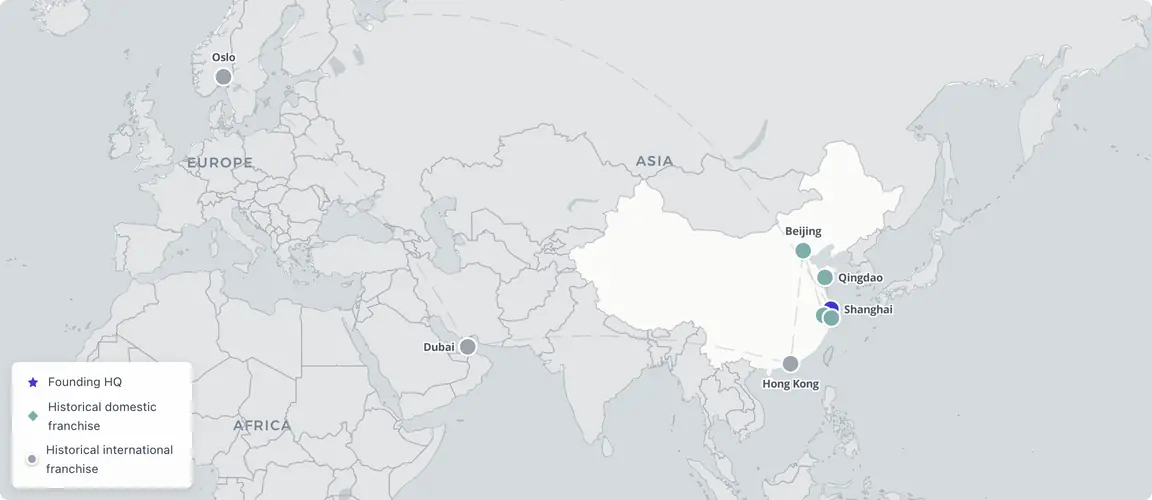
Within two years of launch, Dragonfly operated three stores. The company used 40-60 partnership arrangements to fund expansion — partners contributed capital while Dragonfly provided the brand, training, and operational systems. By March 2009, the network had grown to twenty local branches plus three overseas franchises.
The international expansion began with Oslo in December 2005 and extended to Dubai in 2008, followed by Hong Kong in 2010. Dragonfly claimed to be “the first service brand from China to be exported abroad” — proving that China could export intangible quality, not just manufactured goods. The Academy-trained consistency that worked in Shanghai transferred across cultures and continents. A therapist in Oslo delivered the same experience as one in Pudong.
But rapid growth through partnership arrangements created tension. As the HKU case study identified, the growing number of stores was diluting the span of control and threatening the quality standards the Academy had built. Misaligned operators could damage the brand faster than marketing could repair it. The international franchises proved the thesis — Chinese service quality could travel — but they also revealed its limits. Daily operational supervision did not transfer as cleanly as the training manual.
SpaChina awarded Dragonfly Best Franchise Spa of the Year three consecutive times between 2010 and 2012 — recognition of the Academy system’s industry-leading approach to quality scaling. That’s Shanghai named it Best Spa in the city in 2009. The awards validated a model that, at its peak, employed roughly a thousand people across three continents.
Defending the brand abroad
The first sign that Dragonfly had become worth stealing came from Munich. In 2006 a German lawyer named Jürgen Madl had visited the Beijing spa, admired the treatments, and written to Yam’s team about helping bring the brand to Germany. The conversation was friendly; Dragonfly put him in touch with its franchise consultant. Then, in January 2007, Madl quietly filed the word mark “DRAGONFLY” with the German Patent and Trade Mark Office (DPMA) — in his own name, in Class 44, the exact category covering massage and beauty services. It registered that May.
When the manoeuvre surfaced, its logic became clear. Madl was willing to hand the mark over — for a price. By late 2007 he was offering to transfer it “for payment,” eventually naming a figure of at least €5,000, and suggesting Dragonfly also let him register the name across the rest of Europe. A company planning its European entry now found a stranger holding the front door and asking for a key fee.
Dragonfly refused to pay. Through the Düsseldorf firm Tigges Rechtsanwälte, it filed to cancel the registration on the grounds of bad faith — that Madl, knowing Dragonfly intended to enter Germany, had registered the mark to block that entry or extract a payment. German trademark law has long recognised the offence: the lawyers cited the Federal Court of Justice’s Recrin and EQUI 2000 precedents, which hold that registering a foreign brand’s mark to fence it out of the domestic market is unlawful. Madl’s own written offer to sell became the evidence against him.
In 2008 the DPMA cancelled the registration. The mark returned to the company that had built it.
Oslo tested the other half of the export thesis. Defending the name was one thing; defending the franchise contract was another. The Norwegian franchisee rebranded the shop mid-contract — operating under a different name while the agreement still ran — and stopped honouring its terms. Dragonfly took the case to court in Oslo, suing for the payments owed through the end of the five-year franchise agreement. Eastman led the fight and retained a Norwegian lawyer who had once been a Dragonfly member in Shanghai, a customer turned counsel. Dragonfly won.
For a Shanghai spa barely five years old, the two victories were quietly remarkable: a Chinese-origin service brand had defended both its name and its contracts on European legal turf — and prevailed on each. The export experiment had proved the brand was valuable enough to be worth taking, and solid enough to be worth defending.
The training manual outlives the architect
Yam stepped back from day-to-day operations in 2010. In 2012, Grace Zhuo (卓盛) — Eve’s cousin, who had entered the business in 2005 as partner in the first Beijing location — acquired a majority of Yam’s shares. Yam and his business partner Randal Eastman exited simultaneously in 2021. Three members of the Zhuo family assumed full control: Grace and Eve as equal shareholders, and Eve’s sister Zhuo Wenjun (卓文俊) as legal representative.
Today Dragonfly operates roughly eleven locations — nine in Shanghai, two in Beijing — with between two and five hundred employees. New locations continue to open. The governance structure reflects a textbook Chinese family-business pattern: controlling owners invisible in public records, operations managed through trusted family members. None of the three Zhuo relatives has appeared in any Chinese-language publication across the brand’s twenty-two-year history.
Looking back in 2024, Yam reflected on what he built: “I’m proud of creating jobs for around 1,000 employees and helping 30 of them work overseas, improving their lives and their families’ well-being.” He appeared on a SpaChina panel that October discussing the evolution of China’s spa industry — still recognised as a pioneer, two decades after opening a shopfront during an epidemic.
The arc of Dragonfly traces a question that most service businesses never answer: can institutional quality outlive its architect? Yam’s hairdressing career in Singapore proved it couldn’t — customers followed the stylist, not the salon. The Academy proved it could — by transferring skill into system, personality into process, and individual excellence into institutional culture. The brand’s survival under three successive ownership configurations is the evidence. The training manual outlived the architect who wrote it.
Researched 20 sources in English, Chinese.