 Skip to main content


Dorsa
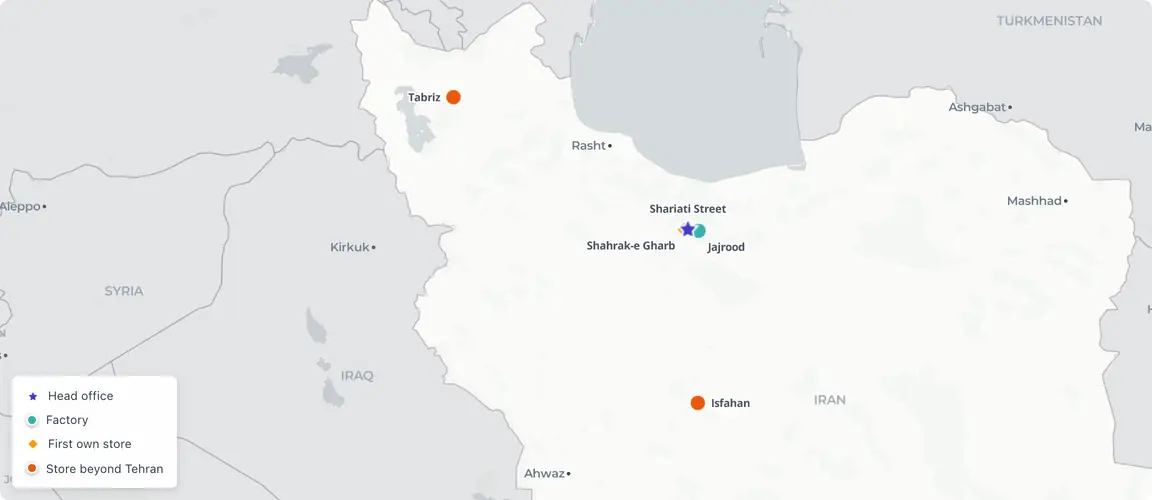
In 1995–96 Amirkazem Nourmohammadi and Shahin Fatemi put a name chosen by chance, Dorsa, on the leather goods they had been shipping unbranded. Customers left. A factory built soon after made goods no retailer would stock under an Iranian brand. The way out, in 2002, was Dorsa's first store of its own, and it restored the company's liquidity.
Made, Run and First Sold in Tehran
An unnamed supplier that had to build its own shops to keep its name
Full timeline available in report (10 more events)
In 1374–75 in the Iranian calendar (1995–96), Dorsa’s two founders were shipping unbranded leather goods wholesale to about 400 agencies. On a friend’s suggestion they decided to put a name on them, though, Amirkazem Nourmohammadi recalls, many around them said “what you want to do will fail”. They could have stayed an unnamed supplier. Customers left, and a crisis followed.
A name ordinary people cannot buy from
By 2019 the name carried a meaning of its own in Iranian fashion. Interviewing the head of another fashion business that April, the fashion desk of the Iranian online publication Honaronline framed one question around Dorsa (درسا): “Do you, in the future, want to be like the leather brand ‘Dorsa’, whose goods ordinary people can never buy”. It was an aside inside someone else’s interview, not a survey. But it takes for granted that a reader knows the brand, and knows it as beyond an ordinary budget.
The company’s own figures describe what stands behind that standing. It counts nearly 30 branches, in Tehran, Isfahan, Ahvaz, Mashhad, Shiraz, Rasht, Kerman and other cities. In February 2017 its chairman counted 20 stores built to one uniform standard. Its concept store, Dorsa House, stands on Shariati Street in Tehran, with a café inside.
None of that was there at the start. For its first years, the goods carried no name at all.
Four hundred agencies
The business began in 1992 (1371 in the Iranian calendar) as a leather workshop run by two partners, Shahin Fatemi (شاهین فاطمی) and Amirkazem Nourmohammadi (امیرکاظم نورمحمدی). Even its size depends on who tells it. Nourmohammadi remembers 30 square metres; Fatemi remembers a rented room of 15 on a rooftop. The host of a podcast on which Fatemi appeared in 2019 dated the start a year earlier, to 1370, with the two men making leather accessories, keychains and belts among them, in a 15-metre workshop.
What the workshop made, others sold. By the mid-1990s about 400 agencies were taking its goods, by Nourmohammadi’s count, and the goods reached buyers on those agencies’ counters with no maker’s name attached. A wholesale book of that size was the business. It was also the reason a name was a risk: every agency that wanted unbranded stock could take its custom elsewhere.
The suggestion to change it came from a friend, Nourmohammadi told a newspaper in 2017, two decades on, and the name itself from nowhere in particular. “The name Dorsa was chosen entirely by chance.” The two partners decided to sell under it, against the advice of many around them; how Fatemi remembers that decision, and when he dates it, is told on his own page.
Goods nobody would stock
Naming the goods cost Dorsa much of the trade it had been built on: once the products carried a name, many wholesale customers fell away. “We hit a period of crisis,” Nourmohammadi said in the same interview.
Then came the factory. In 1377 in the Iranian calendar (1998–99), by his account, the company built 2,000 square metres of production at Jajrood, in Tehran Province; other sources date it a year later. Output rose. The shelves did not follow: no retailer would stock a product sold under an Iranian brand. A business that had lost wholesale buyers by naming its goods now had a factory making more of them.
His partner, Shahin Fatemi, has said that he came to the edge of bankruptcy at least two or three times. His account gives no dates, and places none of those episodes in this crisis or in any other.
The way out was a shop of its own. In 1381 in the Iranian calendar (2002; another source gives 1380) the first Dorsa store opened in Shahrak-e Gharb, Tehran, and it restored the company’s liquidity. More stores followed, and with them, by Nourmohammadi’s account, a second reckoning: “the company hit crisis again”. About 40 stores, of 20 to 100 square metres each, had opened with no coordination between them and no shared infrastructure. A contract to rebuild the company’s software, signed in 1384 or 1385 (2005–07), was part of the work of bringing them to one standard. The counts do not agree: a shopping-centre profile of the brand has Dorsa opening only its twentieth chain store in 1386 (2007–08).
Fatemi has described a crisis of the late 1380s in the Iranian calendar (about 2007 to 2011) on the company’s blog. The company “fell into a severe financial crisis”, he wrote, and for several months it could not pay its staff. He gives the staff the credit for what followed: “unlike the 1370s, because we had loyal and informed staff, we managed to bring Dorsa to its rightful place.”
By February 2017 the chairman counted 20 Dorsa stores built to one uniform standard.
Crystals, a café and a line of script
By one online platform’s account, Dorsa House opened on Shariati Street in Tehran on 4 March 2016: a concept store of more than 2,000 square metres, with the Dorsa Cafe inside it. The brand that had once needed other people’s counters now had a building of its own in which to show what it made.
On 9 March 2018 Dorsa unveiled collections set with Swarovski crystals there, with Andrew Mojica of Swarovski Middle East in attendance. The cooperation had begun “nearly a year ago”, Mojica said in an interview around the launch. Fatemi described it twice that month, in different terms. At the launch he called Dorsa “the first brand to have obtained the Swarovski licence in the Middle East for the leather industry”. Later in March he called it “the only Middle East brand in jewellery and leather that has been able to obtain the Swarovski brand licence”. Each claim is his, and each holds only in its own scope. Twenty years after no retailer would stock goods under an Iranian brand, the Dorsa name was the one the crystals were set beside.
The same year, from 1397 in the Iranian calendar, Iran banned order registration for clothing and footwear imports, a rule that applied across the sector. In October 2020 (Mehr 1399), after 18 months of work, Dorsa unveiled a new identity for the name chosen by chance a quarter of a century earlier, and a philosophy it calls Khat-e Dal. The next announcement reached further than design.
A plan to put leather aside
On 11 June 2021 Fatemi told an audience that the company had “plans in hand so that within the next three years Dorsa can put aside the production and use of natural leather”. The plan, as announced, also turned the company toward a digital lifestyle operating system. For a business that began making keychains and belts, it named its own raw material as the thing to leave behind; what the plan kept was the name.
In August 2025 Fatemi counted more than a thousand colleagues. By then the business the two partners had risked their wholesale trade to name, nearly three decades earlier, had a chief executive who was not one of them: by 26 January 2024 Alireza Saffary (علیرضا صفاری) headed Dorsa Group, and he still held the post in June 2025. The two men who made that choice still sit on its board, Nourmohammadi as chairman and Fatemi as vice-chairman and, by February 2024, Chief Creative Officer.
Researched 49 sources in Persian, English.