 Skip to main content
Dezan Shira & Associates
A clerical error misspelled his surname. He kept the name. In 1992, that $500 bet on Shenzhen became Dezan Shira—40+ offices across 23 countries by 2024, 27 per its 2026 acquisition announcement. The secret to surviving the Asian Financial Crisis, SARS, two recessions, COVID, and the US-China trade war? Staying when Big 4 competitors fly in.
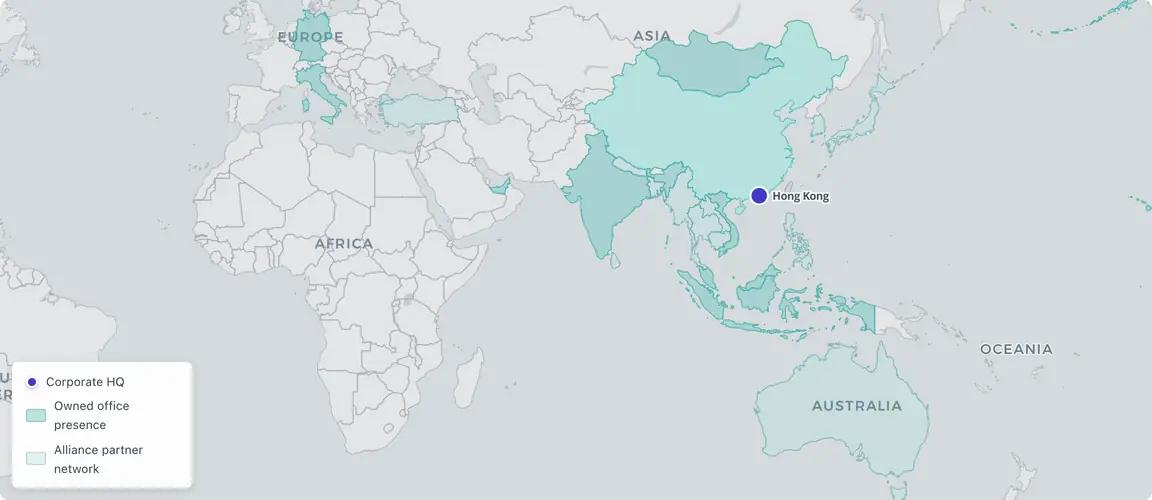
23 countries — where Dezan Shira serves clients
$500 to eight figures across six crises
In 1992, Chris Devonshire-Ellis watched Deng Xiaoping’s Southern Tour on television and saw what Hong Kong insiders missed: Shenzhen’s 15% tax rate and emerging oil industry created an arbitrage opportunity for professional services. He incorporated Dezan Shira & Associates in Hong Kong with $500—the company name born from a clerical misspelling of his surname. Thirty-two years later, the firm spanned 40+ offices across 23 countries and employed 600+ professionals by 2024, a footprint its own 2026 acquisition announcement put at 27 offices and 300+ professionals; it generated $40–50 million annually and had survived the 1997 Asian Financial Crisis, SARS, two global recessions, COVID-19, and the US-China trade war. The competitive advantage isn’t credentials (the founder has no formal accounting qualifications) but continuous presence: staying when others fly in.
The accidental foundation
What separates Dezan Shira from Big 4 competitors isn’t scale or pedigree—it’s operational philosophy. Where global firms deploy credentialed consultants who fly into Asian markets, the firm committed to continuous presence—building relationships so deep that partners were “ashamed to do bad work for me personally.” The cultural immersion wasn’t tourism. It was strategic positioning.
The absence of formal credentials shaped the firm’s competitive approach. Without the qualification track that structured competitors’ careers, the firm built expertise through market immersion rather than methodological frameworks. Early clients—foreign companies entering South China’s oil sector—needed practical regulatory guidance that standard professional services training didn’t provide. Dezan Shira responded with practitioners who lived the environments they advised on. Where Big 4 competitors deployed credentialed staff in rotating Asian assignments, the firm accumulated practitioners who understood the gap between how regulations read on paper and how authorities applied them in practice—particularly in early-1990s China, where foreign investment rules were evolving faster than any framework could capture.
The 1992 founding exploited a specific moment. Deng’s Southern Tour signaled China’s renewed commitment to economic opening after post-Tiananmen retrenchment. Shenzhen’s special economic zone offered 15% corporate tax rates versus 25% elsewhere. Foreign investment in South China Sea oil exploration created demand for professional services that established Western firms were too cautious to pursue.
The firm’s name itself reflects the accidental origins. “Dezan Shira” came from a clerical error—his surname misspelled during registration. Rather than correct it, he kept the name. The linguistic confusion worked: the ambiguity about origins avoided the skepticism Western professional services firms faced in early-1990s China.
The crisis that built the disciplines
The 1997 Asian Financial Crisis tested whether the five-year-old firm could survive. Thailand’s baht devaluation in July triggered contagion across Indonesia, Malaysia, Philippines, South Korea, and Hong Kong. Equity and currency markets dropped 20–75% in affected countries. For Dezan Shira, the mathematics were brutal: the crisis “wiped out 9 months of projected income and put the company into effective insolvency for a short period.”
Most firms in similar positions either failed or sought external capital. Chris chose a different path: “We were able to trade out of it as the situation improved and also learned some serious, business operational changing lessons so as not to leave us so exposed in the future again.” The specific disciplines adopted during 1997 remain core to operations today: concentrating on cash-flow-generating services rather than project-based work, maintaining significant cash reserves, and avoiding debt that constrains crisis flexibility.
The 1997 survival established Dezan Shira’s crisis-tested credibility. When subsequent disruptions hit—SARS in 2003, the 2008 global financial crisis, COVID-19 in 2020—the firm had both the operational disciplines and the institutional memory to navigate uncertainty. As Chris articulated: “Dezan Shira has survived SARS, two financial crises, and numerous political difficulties in China, and the trade war is just another in a long line.”
Geographic diversification as strategy
The firm’s most contrarian bet came in 2008–2009: expanding into India and Vietnam when China remained the obvious focus for Asian professional services. “Several years ago we made the decision to expand out of China and into other markets like India, Vietnam and so on,” Chris later explained. “At the time people thought we were nuts, but I wanted to lessen the impact of any China problems.”
The skeptics had reasonable arguments. China’s economy was growing faster than India’s. Vietnam’s regulatory environment remained opaque. Splitting resources across multiple jurisdictions diluted expertise. The Big 4 firms concentrated their Asian operations in established markets rather than spreading thin.
The contrarian bet proved prescient when US-China trade tensions escalated in 2018. Suddenly, clients needed alternatives to China-concentrated supply chains. Dezan Shira’s established operations in India and Vietnam—seven and nine years mature respectively—positioned the firm as the obvious advisor for “China+1” restructuring. The service offering now explicitly includes “Supply Chain Engineering” addressing “disruptions like the US-China trade war, the Russia-Ukraine conflict, and pandemics” that “exposed risks of over-reliance on single markets.”
By 2024, the geographic footprint spans 40+ offices: 13 in China (including Hong Kong), 3 in Vietnam, multiple in India, 2 in Indonesia, plus Singapore, Mongolia, UAE, Germany, Italy, and USA. Alliance partners extend reach to Australia, Bangladesh, Cambodia, Japan, Malaysia, Nepal, Philippines, South Korea, Sri Lanka, and Thailand. The diversification that seemed irrational in 2008 became a structural strength no single-market rival could match.
The publishing engine
Perhaps Dezan Shira’s most distinctive competitive asset is Asia Briefing, founded in 1999. The publishing network includes China Briefing, India Briefing, Vietnam Briefing, ASEAN Briefing, Middle East Briefing, Silk Road Briefing, and Russia Briefing—seven regional publications generating 100+ books and 1,000+ magazines over 25 years. Annual readership exceeds 20 million across several hundred thousand subscribers.
No Big 4 firm has replicated this content marketing engine. The publications serve dual functions: thought leadership establishing expertise credibility, and client acquisition funnel converting readers into service buyers. Chris personally wrote the first 50 issues of China Briefing Magazine—investment no partner-track professional at a global firm would make.
The content strategy reflects the same “living there” philosophy that defines the firm’s service delivery. Rather than producing generic guides to Asian markets, Asia Briefing publications address specific regulatory changes, tax interpretations, and practical compliance issues. The depth signals expertise that credentials cannot substitute for.
Each publication tracks a specific jurisdiction’s regulatory environment in real time. China Briefing covers provincial-level variations in tax enforcement that national-level guides miss. India Briefing maps the distinction between union territories and states that determines corporate structure options. When a foreign company needs to understand Vietnam’s transfer pricing rules or Indonesia’s latest investment restriction updates, the relevant publication exists because Dezan Shira built it from internal advisory work first—before the client need was fully articulated.
The publishing network also amplifies the geographic diversification strategy in concrete ways. Middle East Briefing launched alongside the Dubai office in 2022—before the physical office was fully operational, the publication had already established presence among potential clients in the region. Mongolia Briefing preceded the Ulaanbaatar office by years. Publications function as market-entry mechanisms that convert reader relationships into client relationships before physical operations begin, compressing the credibility-building timeline that new entrants normally require years to establish through conventional business development.
The institutional knowledge advantage
What ultimately differentiates Dezan Shira from competitors is a fundamentally different model of engagement. The contrast with Big 4 practice is stark: global firms rotate partners through Asian assignments, building individual expertise that departs with the individual. Dezan Shira built institutional knowledge through continuous presence—staying when competitors fly in.
For potential clients, the distinction matters. Stephen M. Morris, a 25-year client, articulates the value proposition: “Although many ‘Big 8’ firms think they specialize in Asia, Dezan Shira is the only firm that I know of with the breadth, depth, and expertise across the region.” The breadth comes from geographic diversification. The depth comes from staying when others fly in.
The model creates client retention that credentials-based competitors cannot match. A corporate tax partner rotating through Beijing assignments every three years cannot replicate accumulated context built over decades: which provincial tax bureaus interpret national policy conservatively, which regulatory interpretations diverge from written rules, which enforcement patterns signal genuine policy direction versus temporary emphasis changes. That institutional memory lives in the firm rather than in individuals—persisting through partner transitions, COVID disruptions, and the geopolitical turbulence that has redefined China practice for every firm operating there.
This advantage proved measurable during COVID. When China’s zero-COVID policies restricted movement between 2020 and 2022, firms with physically embedded advisory teams maintained client service continuity while competitors whose partners flew in found themselves unable to deliver. Three years of lockdowns, quarantine requirements, and regional shutdowns functionally tested which models of Asian professional services were resilient. The discipline of staying rather than flying—first developed as financial survival necessity in 1997—proved its structural soundness across conditions no crisis playbook anticipated.
Morris’s twenty-five-year continuous engagement reflects what institutional knowledge accumulation produces over time. For a senior executive deciding whether to extend an advisory relationship, the calculation is practical: the firm that understands how the regulatory environment actually functions, as distinct from how regulations read on paper, provides something no credentials-based alternative can replicate regardless of price.
Crisis-tested advisory, extended to new terrain
As geopolitical tensions reshape global trade flows, Dezan Shira has extended its advisory scope. The firm now explicitly advises on emerging-market access, Belt and Road implications, and sanctions navigation—issues that require understanding both Western client needs and emerging market realities. Chris’s recent commentary on de-dollarization and alternative trade systems reflects the same contrarian positioning that drove 2008’s India expansion.
The firm’s no-debt philosophy—articulated as “bulkhead financing” that keeps banks out of the business—has historically enabled faster decision-making and flexibility during each of the six crises documented above. The same disciplines developed in 1997 remain in place today.
Chris’s analysis of emerging-market financial infrastructure—the development of alternative payment systems, the accumulation of bilateral trade agreements outside dollar-clearing networks—applies the same analytical framework that identified India and Vietnam as expansion targets in 2008. The insight is structural rather than political: clients operating between emerging markets and Western institutional frameworks need advisors who understand both systems without institutional capture by either. Few professional services firms have built that dual positioning over three decades.
The 2022 Dubai expansion reflects this logic directly. The UAE functions as the intersection of Western financial infrastructure and Gulf-to-Asia trade flows—simultaneously a neutral jurisdiction and a preferred staging post for companies navigating sanctions exposure or capital repatriation complexity. For clients moving operations between China, India, Southeast Asia, and Western markets, offices in Hong Kong, Singapore, and Dubai create advisory continuity that no single-jurisdiction specialist approaches.
From $500 and a misspelled surname to $40–50 million across 23 countries, Dezan Shira proves that professional services success in emerging markets requires presence, not credentials. The yacht broker who watched Deng’s Southern Tour built something that Big 4 firms with centuries of history and billions in revenue haven’t replicated: a pan-Asian practice rooted in staying when everyone else flies in.
Ownership Transition
"Singapore-based Ascentium acquired Dezan Shira after 34 years; firm now part of a 2,600-person global platform"
Researched 13 sources in English.