 Skip to main content
Changyu
In 1892, a Hakka tycoon staked 3 million taels on China's first winery — in a country with no wine market. The first winemaker died en route. Of 124 grape varieties, most failed. Then came bankruptcy, Japanese occupation, and nationalization. In 2025, Changyu's Noble Dragon won Decanter Best in Show — the first Chinese wine ever — while the industry collapsed around it.
From Yantai to Four Continents
A Hakka tycoon's 1892 bet that won Decanter's first Chinese crown
When Changyu’s Noble Dragon won Decanter’s 2025 Best in Show — the first Chinese wine ever — the grape it was made from had already survived something more improbable than a blind tasting. Cabernet Gernischt arrived in Yantai in 1892, nearly failed, and produced fruit for 133 years through the collapse of three governments. The brand that bottled it was fighting for survival.
The grape that outlasted three governments
Cabernet Gernischt (蛇龙珠) arrived in Yantai (烟台) in 1892 as one of 124 imported European varieties. Most failed. This one thrived, grafted onto wild Manchurian rootstock, producing fruit for 133 consecutive years through the collapse of three governments, a world war fought across its vineyards, and a Cultural Revolution that destroyed far sturdier institutions.
The wine that won in London was made from a grape that should not exist.
The most expensive dinner conversation in Chinese history
Changyu’s origin story traces to a French consulate dinner in 1871 Jakarta. A retired soldier mentioned that wild grapes near Yantai had produced decent wine during the Second Opium War. Zhang Bishi (张弼士), then thirty years old and building a commercial empire across the Dutch East Indies, filed the remark away. Twenty years later — already the wealthiest overseas Chinese in Southeast Asia — he visited Yantai on business, confirmed the wild grapes still grew in the coastal hills, and committed 3 million taels of silver to building China’s first industrial winery.
Three million taels was roughly equivalent to the annual revenue of a mid-sized Chinese province. The country had no domestic wine market. Bishi’s friends thought he was insane.
The name “张裕” combines the founder’s surname with the character for prosperity, expressing the aspiration “祖国昌隆兴裕” — may the motherland flourish. Weng Tonghe (翁同龢), tutor to two emperors and Grand Minister of State, inscribed the company name — lending imperial credibility to what was fundamentally a gamble.
Yantai sits at approximately 37.5 degrees north on the Shandong Peninsula, a maritime location with moderate temperatures, adequate rainfall, and sandy soils. Bishi imported 124 grape varieties and approximately 690,000 vine cuttings from Europe and the United States. Most initially failed. The breakthrough came from grafting European vines onto indigenous wild Vitis amurensis rootstock from northeast China, producing disease-resistant plants that bore fruit rich in sugar and color.
Finding a winemaker proved equally treacherous. The first, an Englishman, died during the voyage to China. The second, a Dutchman, was fired after two years for incompetence. The third — Baron Max von Babo, son of the director of Austria’s Klosterneuburg Wine Institute and Vice-Consul of the Austro-Hungarian Empire in Yantai — served eighteen years and became the true architect of Changyu’s wine program. He developed fifteen types of wine and oversaw construction of Asia’s first underground cellar: 1,976 square meters, seven meters deep, less than a hundred meters from the coast, requiring eleven years of construction between 1894 and 1905. Equipment was imported from Austria, Italy, France, and Germany.
Four grand prizes and the founder’s death
Changyu’s first great validation arrived at the 1915 Panama-Pacific International Exposition in San Francisco. Zhang Bishi, then seventy-four, personally led the Chinese delegation. Changyu won four Grand Prizes — the exposition’s highest honor — for Chefoo Red Rose red wine, dry Riesling, Koya Brandy, and vermouth. These were the first international awards won by any Chinese product at a world exposition.
The triumph crowned an extraordinary late-career achievement. Three years earlier, Sun Yat-sen had visited the winery on August 21, 1912, and inscribed “品重醴泉” — comparing the wine to heavenly manna — the only inscription the revolutionary leader ever gave a commercial enterprise. The original calligraphy is now preserved as a national first-class cultural relic. The New York Times had already dubbed Bishi “China’s Rockefeller.” U.S. President Woodrow Wilson received him at the White House. The founding of Changyu is inscribed on the bronze pathway at Beijing’s China Millennium Monument (中华世纪坛) as one of the four major events of 1892.
Zhang Bishi died of pneumonia on September 12, 1916, in Batavia. British and Dutch colonial authorities ordered flags flown at half-mast — an extraordinary honor for a private citizen. His commercial empire fragmented within a generation. But the winery survived.
Surviving every cataclysm of modern Chinese history
What followed Bishi’s death tested whether an institution could outlast the political order that created it. The answer required the brand to die — or nearly die — three separate times.
Bishi’s nephew Zhang Chengqing had served as the winery’s first general manager, and management continued under family and professional appointees through the 1920s. But by the early 1930s, China’s economic decline had eroded the wine market that barely existed to begin with. Changyu couldn’t service its debts. The company entered bank receivership — technically bankrupt, kept alive only because creditors saw more value in a functioning winery than a liquidated one.
Then came the Japanese. When Imperial forces occupied Yantai in 1938, they seized the winery complex and expelled the Zhang family from their residence. Production continued under military administration — Japanese officers drinking wine from Zhang Bishi’s underground cellar while the founding family watched from exile. For seven years, the institution that a Hakka merchant had built to modernize Chinese industry served instead to provision a foreign occupation.
Liberation arrived in 1948, and with it a different kind of reckoning. The Communist revolution eliminated private ownership entirely. Zhang Bishi’s sixth son, Zhang Jurang (张巨烺), faced a calculation that no business school teaches: resist and be destroyed, or surrender and possibly survive. He chose survival. Rather than wait for the inevitable, he proactively requested that the People’s Government assume control of the winery — framing family dispossession as patriotic contribution.
The gambit worked. On October 1, 1949, Changyu wines were served at the founding banquet of the People’s Republic of China. The winery became a fully state-owned enterprise through the standard public-private partnership transition of the early 1950s. Within three years, three Changyu products — Gold Award Brandy, Red Rose Wine, and Vermouth — were named among China’s Eight Great Wines (八大名酒). In 1954, Premier Zhou Enlai brought Changyu brandy to the Geneva Conference, inaugurating what Chinese media later called “brandy diplomacy.” In 1956, Mao Zedong reportedly suggested expanding wine production for ordinary people — a comment that likely helped shield the winery during the Cultural Revolution that followed a decade later.
The brand that the Zhang family built, lost to bankruptcy, lost again to Japanese occupation, and voluntarily surrendered to Communist revolution had become a national asset. The family received nothing. The institution endured — protected now by the very political system that had consumed it.
From state asset to global chateau strategy
The reform era transformed Changyu from a state production unit into a modern enterprise — though the transformation required yet another reinvention of institutional identity. In 1994, the company was formally reorganized as the Yantai Changyu Group. B-shares listed on the Shenzhen Stock Exchange in 1997 (ticker 200869); A-shares followed in 2000 (ticker 000869.SZ). In September 2005, the group converted from an all-state-owned company to a joint venture with international investors — a structure that persists today.
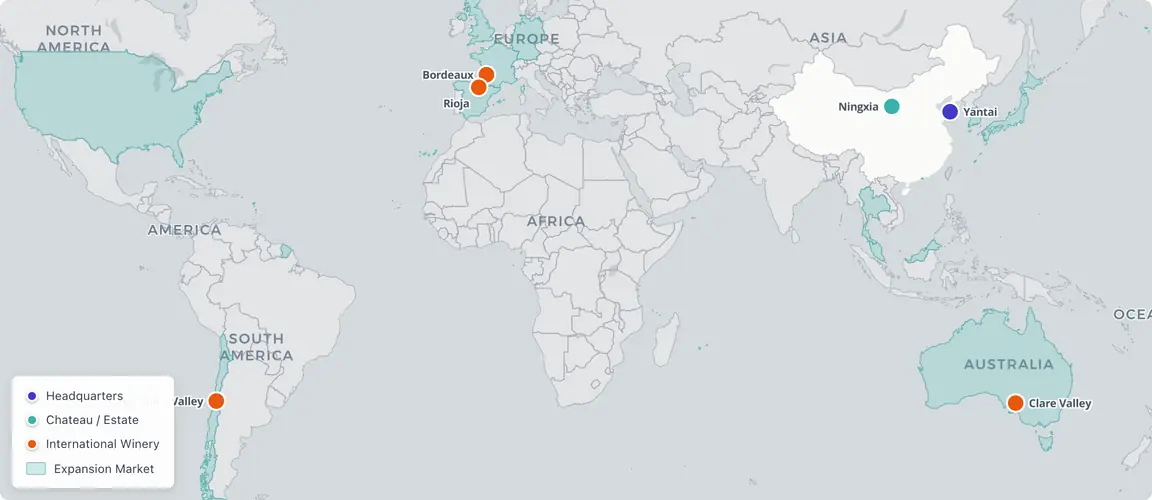
In 2002, a joint venture with France’s Castel Group produced Chateau Changyu-Castel in Yantai — China’s first professional wine chateau and a template for the expansion that followed. Eight domestic estates now span six provinces and six distinct terroirs: Shandong’s maritime coast, where vines need not be buried in winter; Ningxia’s high-altitude Helan Mountain at 1,100 meters, producing China’s most critically acclaimed reds; Xinjiang’s extreme continental climate; Beijing’s Miyun district; Shaanxi; and Liaoning’s Huanren County for ice wine made from Vidal grapes at 41 degrees north.
The premium Chateau Changyu Moser XV — a partnership with fifteenth-generation Austrian winemaker Lenz Moser — represents the brand’s highest ambitions. Its flagship “Purple Air Comes from the East” (紫气东来) earned 16.5 out of 20 from Jancis Robinson, establishing Ningxia as a serious wine region on the global stage. The ultra-premium Longyu (龙谕) estate, also in Ningxia, has won over 150 international awards and exports to fifty countries.
Between 2015 and 2018, Changyu spent over 670 million RMB acquiring wineries across four countries: three properties in France including Chateau Mirefleurs in Bordeaux, Marques del Atrio in Spain’s Rioja, Indomita in Chile’s Casablanca Valley, and Kilikanoon in Australia’s Clare Valley. The four-continent footprint gave Changyu approximately 16,000 hectares of total vineyard holdings — and raised a question Western wine critics found uncomfortable: could a Chinese state-influenced company produce world-class wine?
A critical ownership clarification: Changyu is not controlled by COFCO (中粮集团), which owns competitor Great Wall Wine. Changyu’s parent entity, Yantai Changyu Group, is governed by Yantai Guofeng Investment (a municipal state entity), Italy’s ILLVA Saronno (~33%, the makers of Amaretto di Saronno), and the International Finance Corporation (~10%, the World Bank’s private sector arm).
The 2025 breakthrough — and the crisis behind it
The Noble Dragon N188’s Best in Show at the 2025 Decanter World Wine Awards validated more than a single bottle. The winning wine was a blend of 75% Cabernet Gernischt and 25% Cabernet Sauvignon from Yantai — the same terroir where Zhang Bishi planted his first vines in 1892. DNA analysis by Swiss geneticist Jose Vouillamoz had confirmed Cabernet Gernischt as genetically identical to Carmenere, a presumed-extinct Bordeaux variety. French researcher Jean-Michel Boursiquot estimated in 2014 that China may have roughly 15,000 hectares of Carmenere under the Gernischt name — potentially fifty percent more than Chile, where the grape’s identity as Carmenere was first confirmed in 1994. The award validated both the grape and 133 years of institutional persistence.
Yet behind the trophy sits the most dangerous crisis since the 1930s bankruptcy. Revenue fell 25.3% in 2024 to RMB 3.28 billion, with net profit down 42.7% to RMB 305 million. The 2025 forecast is grimmer still: projected net profit of just RMB 55–75 million, a decline of 75–82%. Q3 2024 marked Changyu’s first quarterly net loss since its IPO. The entire Chinese domestic wine industry is in what management described as “survival mode” (艰难保命) — crushed by competition from baijiu, lifted tariffs flooding the market with Australian imports, and the collapse of banquet-drinking culture that drove corporate wine sales for decades. China’s wine consumption fell 19.3% in 2024 alone to just 5.5 million hectoliters.
The market has contracted from 120 billion yuan at its peak to roughly 20 billion yuan. Changyu, which produces approximately 93,000 metric tons of wine and brandy annually with capacity for 300,000 tons, and distributes through 5,000 domestic and international partners, is fighting for relevance in a market that may be structurally shrinking. Management is repositioning toward premium lines — Longyu, Moser XV, and Koya brandy — while targeting younger consumers with new products like the Long-tailed Cat white wine brand.
The brand has outlasted dynastic collapse, foreign occupation, communist revolution, and a Cultural Revolution. Each of those crises had a political actor who could be petitioned, appeased, or outlasted. The current one does not: the domestic drinkers who sustained the wine market for three decades are the ones disappearing.