 Skip to main content
Avgvst
A polisher who once finished sniper-rifle scopes now sets rock crystal into silver at Avgvst's Yekaterinburg factories. When sanctions severed the brand's international infrastructure overnight, the founder split it into two legally independent companies on two continents and rebuilt European supply chains in six months. Revenue grew 40%.
Two Companies, Two Continents
A sniper-scope polisher who split a brand across two continents
On February 24, 2022, Natalia Bryantseva lost a Paris flagship lease, two global brand collaborations, and her company’s international future in a single morning. Avgvst (Август) — a Yekaterinburg-born demi-fine jewelry brand built on hand-cut Ural rock crystal and silver treated with gold-level finishing — had sixteen days earlier opened its fifth store. Six months later, it would be operating as two legally independent companies on two continents. Revenue rose 40%.
The polisher’s hands
The craft tradition that made Avgvst possible predates the brand by centuries. Yekaterinburg sits in Sverdlovsk Oblast, the heart of Russia’s Ural stone-cutting and lapidary heritage — a regional industry founded by Catherine the Great’s lapidary factory in 1726 and codified through the nineteenth century as the imperial state’s official source of carved gemstones, palace inlay, and the malachite columns of St. Isaac’s Cathedral. The Pavel Bazhov tales that every Soviet schoolchild grew up reading are set in these mountains; the Mistress of the Copper Mountain is a Ural figure, and the stonecutters she watches over are not invented. When Natalia Bryantseva walked into a local jewelry workshop in 2013 with no metalwork training, she was entering an ecosystem, not a vacuum.
That ecosystem proved decisive. Avgvst’s three Yekaterinburg factories employ more than fifty production workers who turn out roughly 3,000 handmade pieces per month. One of the polishers previously spent his career finishing optics for sniper rifle scopes — the same exacting hand that once calibrated precision glass now sets rock crystal and citrine into sterling silver. The production philosophy treats silver with techniques typically reserved for gold: proprietary finishing standards, hand-cut gemstones processed at a dedicated Sverdlovsk Oblast lapidary facility, and quality tolerances that most Russian jewelers apply only to precious metals. The Ural gem-cutting trade has always run on apprenticeship rather than school certification, and the Avgvst workshop sits inside that continuity — a polisher who arrives with twenty years of defense-optics experience is a coincidence elsewhere and an expectation in Yekaterinburg.
This was the foundation of a deliberate market position. Russian jewelry bifurcated between ultra-luxury artisans like Ilgiz F and mass-market volume players like Sokolov and Sunlight. Avgvst occupied the space between them — what the global industry calls demi-fine — anchoring the aesthetic in Constructivist minimalism rather than ornament. The debut Malevich collection, featured in Vogue Russia in 2015, announced the brand’s intention: art-referenced design at accessible price points, made by the same hands that once served the defense industry.
Yellow walls and rising revenue
By 2017, Bryantseva had renamed the brand from her own name to Avgvst — a reference to Boris Pasternak’s poem about August, suggested by her mother — and begun a partnership with Harry Nuriev’s Crosby Studios that would define the brand’s visual identity across five retail locations. Nuriev chose the brand’s signature yellow from a notepad Natalia brought to their first meeting. What started as an interior design commission for the first Moscow store in the Patriarshiye Prudy district in 2018 expanded into product collaborations, pop-up installations, and eventually the Berlin flagship concept. Nuriev’s studio became the brand’s de facto art direction office, threading a continuous spatial vocabulary — the yellow walls, the displaced restaurant fixtures, the punk-elegant lighting — from Moscow to St. Petersburg and, later, to Berlin and Paris.
The commercial trajectory matched the creative ambition. Revenue reached 120 million rubles in 2019, a figure Bryantseva disclosed in a Forbes Russia column where she argued that “a purchase today is a political act.” The brand had publicly supported the Yekaterinburg square protest, released a pendant for detained journalist Ivan Golunov, and introduced a queer collection — each act of civic positioning coinciding with growth, not retrenchment. The same year, Avgvst’s customer base began to skew explicitly toward values-driven purchasing; subsequent brand research would show that the single word customers most associated with the brand was “свободный” (free). COVID doubled the business in 2020. By early 2022, estimated group-wide revenue approached 500 million to one billion rubles (~$5.5–11M USD), the team had grown to roughly sixty to seventy-five people across three Russian cities, and the creative studio in Moscow had become the design and brand-strategy centre while Yekaterinburg ran production at scale. Natalia had also quietly registered a dormant Berlin entity — Avgvst Jewelry UG — in February 2020, parking €500 of registered capital in an e-commerce shell built to take European orders. It was a corporate footnote intended to simplify cross-border invoicing. Two years later it would prove existential.
The country that got cancelled
On the morning of February 24, 2022, Western sanctions triggered by Russia’s invasion of Ukraine severed Avgvst’s international infrastructure in its entirety. A signed 44-square-metre Paris flagship lease near the Palais-Royal: gone. Two global brand collaborations: cancelled. Farfetch distribution: frozen. The Italian enamel and rhodium suppliers that Avgvst had relied on for its finishing pipeline cut ties within weeks; the raw materials that gave the brand its surface character could no longer cross the border. The brand’s second Moscow store, in Basmanniy, had opened on February 8 — sixteen days before the invasion rendered its international ambitions radioactive.
Simultaneously, a Russian domestic blow landed. Law No. 47-FZ eliminated the simplified tax regime for jewelry businesses effective January 2023, requiring taxation at both the production and retail stages of a sale — a change Bryantseva publicly estimated would close 1,200 Russian jewelry stores and clear roughly 45% of the domestic market. The sanctions architecture was being built from both sides at once. The international channel was severed by Western governments; the domestic channel was thinned by Russian regulators.
“It’s the first case that we can remember when the whole country got cancelled,” Natalia told Superfuture in June 2022. The customer-perception consequence was unsubtle. A 2022 brand survey, later reported by the émigré outlet Karta Media in its 2023 long-form interview, showed that “свободный” — the word that for years had sat at the centre of the Avgvst word cloud — had disappeared entirely from how customers described the brand. The replacements were “стильный” and “модный” — “stylish” and “fashionable.” Revenue had not collapsed. Meaning had.
The decision to continue did not arrive as a strategy memo. It arrived, by Natalia’s own account, in conversation with her husband Anatoly Belikov, who handles motion design and 3D work for the brand. «Послушай, красоту нельзя закенселить» — “Listen, beauty can’t be cancelled.” It was the line that turned three months of paralysis into a project plan. For three months after February 24, Avgvst paused European expansion entirely. By June, Natalia had decided to proceed; by July, she had moved.
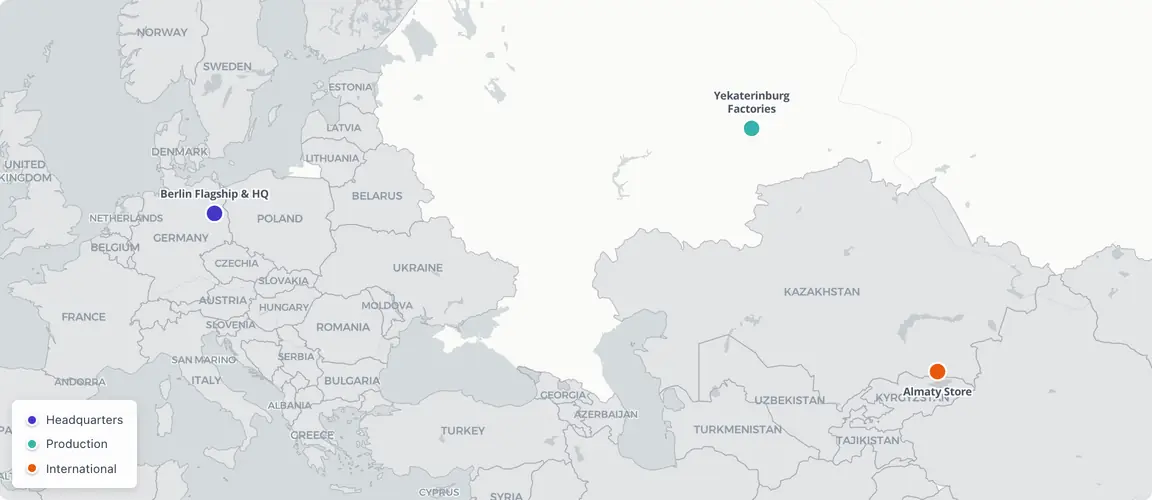
What followed was a piece of jurisdictional engineering executed without a single investor dollar. In July 2022, the dormant Berlin UG was converted into a full GmbH — Avgvst Jewelry GmbH, registered as HRB 214813 B in the Charlottenburg commercial court — establishing it as a legally and financially independent entity from the Russian operations. The two companies would share a name, a founder, and a design language. They would share nothing else: no capital flows, no production dependencies, no supply chains that sanctions could sever, and no banking infrastructure that could route money between Russia and Europe in either direction. The separation was the asset. An efficient logistics integration between the two entities would have made the entire architecture illegal.
Within six months, the Berlin entity had rebuilt its production infrastructure across three countries. An Italian enamelling partnership replaced the lost Italian suppliers — only this one was contracted directly with the German entity, not the Russian one. Lapidary and stone-setting work moved to Thailand, where the cost and quality of small-batch coloured-stone setting suited demi-fine production better than the European alternatives. The remaining metalwork and finishing was contracted in Germany, close enough to the Berlin warehouse to support weekly fulfilment. The team redistributed across five cities: Berlin for leadership and retail, Moscow for the creative studio, Yekaterinburg for Russian production, Istanbul and Yerevan for operations coordination through non-sanctioned jurisdictions. The Russian operations continued — six domestic stores, three factories, the Ural production base — but the European channel was now a separate corporate organism.
What the split proved
The Berlin flagship opened in June 2023 at Alte Schönhauser Strasse 27 in Mitte, designed by Crosby Studios as a “dark kitchen” concept that integrated a tattoo studio and a small enclosed garden into the retail floor — the same studio that had drawn the yellow walls of the first Moscow store five years earlier. Projected payback on the Berlin store was three years, triple the timeline the Moscow stores had run on, but acceptable for a brand building European credibility from scratch. The German landlady, when asked about the optics of leasing to a Russian-founded brand in 2022, had reportedly told Bryantseva that everyone had their propaganda and she had no interest in either side’s — she wanted to see a business model.
What followed was acceleration. The Almaty store opened in February 2024 — the first international retail location outside Russia and Germany, served by the Russian entity through Kazakhstan’s non-sanctioned jurisdiction. A Crosby Studios-designed pop-up launched simultaneously at Palais-Royal in Paris, returning the brand to the same Parisian district where its 2022 flagship lease had evaporated. By February 2025, Avgvst was staging a residency at Le Bon Marché Rive Gauche with an exclusive OUI/NON ring and a Crosby Studios spiral installation — full-circle validation, three years and a corporate restructuring after the original Paris lease had been lost. The Berlin GmbH was the legal vehicle that made the return possible; the Russian entity could not have completed the residency contract.
Avgvst now operates six owned stores across three countries, distributes through SSENSE, Zalando, and HBX, and ships internationally from Berlin via DHL. Revenue grew 40 to 69% in 2022 depending on the entity measured — the crisis year, and the year in which most observers of Russian creative business expected a brand of Avgvst’s profile to fold. The brand remains 100% founder-owned, bootstrapped, and vertically integrated on both sides of the sanctions divide. Whether the word “свободный” returns to the customer word cloud is a longer question than three years of operating history can answer; what the dual-entity architecture has demonstrated is that the production and the channels survived. The Ural workshop continues to send roughly 3,000 silver pieces a month into a Russian market reshaped by Law No. 47-FZ. The Berlin GmbH continues to ship from Germany, Italy, and Thailand into a European retail ecosystem that re-opened its doors at Le Bon Marché. Both organisms remain answerable to one founder, one design language, and one Yekaterinburg polisher whose hands once calibrated glass for a different kind of precision and now set rock crystal into silver.
Researched 27 sources in English, Russian, German.