 Skip to main content
Almaz-Holding
When Russia's ruble crashed 70% in 1998, Almaz-Holding acquired a bankrupt factory with six months of unpaid wages — at the regional government's request. An 82-million-ruble rescue transformed Krasnoselsky Yuvelirprom into the production core of a vertically integrated jewelry company that peaked at 285 stores in 2013-2014.
From a Millennium of Filigree to 200 Stores Across Four Countries
An ₽82M rescue in the 1998 crash that built a 285-store peak
In August 1998, as Russia’s ruble lost 70 percent of its value in a single month, Almaz-Holding (Алмаз-Холдинг) acquired a bankrupt factory with six months of unpaid wages in a village where jewelry had been made for a thousand years. The factory was Krasnoselsky Yuvelirprom, one of the most storied names in Russian craft. The acquisition was not opportunism. It was a formal rescue requested by the Kostroma Oblast government. Within four years the factory employed over a thousand workers and became the production core of Russia’s first vertically integrated jewelry company.
The barter economy’s accidental jeweler
Almaz-Holding did not begin in jewelry. It began in Chinese jackets.
In the chaos of early-1990s Russia, barter was the operating system of commerce. A construction cooperative run by Flun Gumerov took on a contract for the Institute of Nuclear Engineering, whose Chinese counterparts paid not in cash but in goods. Those goods were jackets, and selling them proved far more profitable than any construction project. Then a colleague suggested dealing in gilded silver. “When we put it on the market,” Gumerov later recalled, “it turned out to be even more profitable than Chinese jackets. So we decided to redirect our modest financial resources to jewelry.”
In 1993, he registered AOZT Almaz as a jewelry trading company. A year later, the first production workshop opened in Kostroma, making wedding rings. By 1995, Almaz had acquired shares in the Kostromskoy Jewelry Factory and opened retail stores in Moscow. The logic was already becoming clear: control every link in the chain. Production, wholesale, retail. Each acquisition moved the company closer to a model that did not yet exist in Russian jewelry — vertical integration from workshop bench to display counter.
By 1997, Almaz-Holding had become a shareholder of Krasnoselsky Yuvelirprom, an eighty-year-old factory in the village of Krasnoye-na-Volge. The factory was the company’s main contract manufacturer. It was also dying.
The 1998 rescue
Krasnoselsky Yuvelirprom carried a lineage that few enterprises in Russia could match. Founded in April 1919 as the artel Krasnoselsky Kustar, it stood in a village where archaeological evidence dates jewelry production to the tenth century. The factory had won a gold medal at the 1937 Paris World Exhibition, produced a filigree USSR coat of arms for the 1939 New York Exhibition, and manufactured cockades and badges for the entire Soviet Army. By 1997, it had fallen into what official documents described as an “extremely grave financial-economic situation” — six months of unpaid wages, ineffective management, and active discussions about bankruptcy.
Then the national economy collapsed around it.
On August 17, 1998, Russia defaulted on its domestic debt and devalued the ruble. The currency crashed from six to twenty-one rubles per dollar. Gold prices in rubles tripled overnight. Consumer purchasing power evaporated. For a factory that depended on gold as raw material, the arithmetic was devastating: costs had trebled while customers could barely afford bread.
The Kostroma Oblast administration formally requested Almaz-Holding’s intervention. Gumerov’s company purchased 20 percent of shares from the state and acquired the remaining controlling stake on the secondary market. Two investment programs followed — one for 12 million rubles, another for 70 million rubles — funding equipment modernization, supply chain restructuring, and the wage arrears that had left workers unpaid for half a year. Gumerov took the role of General Director and relocated to Krasnoye-na-Volge, a village of roughly eight thousand people.
The timing contained a paradox that Gumerov would later articulate with characteristic bluntness: “During devaluation, people turn toward jewelry.” Paper currency was collapsing, but physical gold held its value. Within a year of the default, the Russian jewelry industry was growing at 15 percent annually, outpacing every other sector. The contrarian logic of the acquisition — buying a gold-dependent factory at the precise moment gold became unaffordable — had found its vindication not in cost reduction but in demand psychology. Russians who had watched their savings disappear twice in a decade understood something Western consumers rarely need to: gold is insurance, not decoration.
By 2002, the factory employed over a thousand workers and was generating profit. “Workers returned, life began to boil,” Gumerov’s brother Farid told Kommersant’s Ogonyok magazine.
Building Russia’s first vertically integrated jeweler
The factory rescue was not an end but a foundation. Almaz-Holding now controlled something no Russian jewelry company had assembled before: production capacity, wholesale distribution, and branded retail under a single corporate structure. “We are the first vertically integrated company in Russia that itself produced, itself traded wholesale, and opened retail stores,” Gumerov stated — a claim repeated across multiple sources and never publicly challenged.
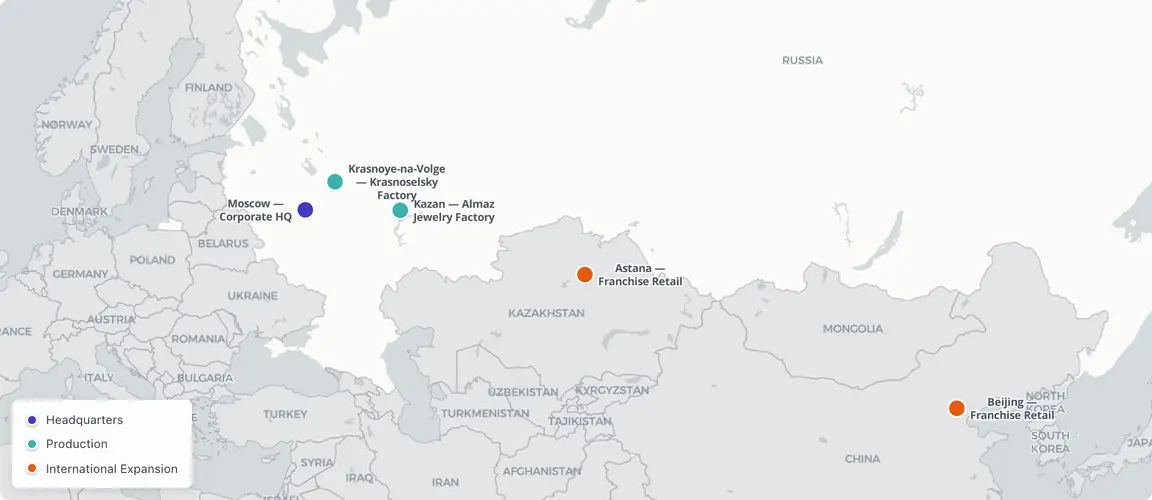
The retail network expanded through a franchise model. Individual entrepreneurs operated branded Almaz-Holding salons using the company’s products and systems, paying for inventory rather than reporting revenue upward. This structure explains a persistent gap in industry rankings: because franchisees’ sales are their own, Almaz-Holding’s consolidated revenue understates its true market footprint. First stores had opened in Moscow in 1995 and Naberezhnye Chelny in 1996. By the company’s twentieth anniversary in 2013, the network reached 250 stores across 118 cities. At peak, approximately 285 stores operated across Russia, Kazakhstan, Belarus, and China.
Revenue reached approximately $150 million in 2009 according to Federal Tax Service data. Forbes Russia ranked the company among its top three jewelry enterprises from 2009 to 2012. The holding simultaneously operated Russia’s largest pawnshop chain — a complementary business that recycled precious metals back into the production system. By any measure, a company born from barter trade in Chinese jackets had become one of Russia’s most formidable jewelry operations in under two decades.
Five crises and five survivals
If the 1998 rescue was the defining crisis, it was far from the last. Almaz-Holding’s subsequent history reads as a stress test of the vertically integrated model — repeated at roughly four-year intervals, each time with higher stakes.
The 2008 global financial crisis hit Russian jewelry demand severely. Yet by 2009, Almaz-Holding reported its peak revenue and operated the country’s largest wholesale and retail jewelry network, suggesting the company’s production base provided a cushion that pure retailers lacked.
The 2014–2015 sanctions and ruble crisis was more brutal. The gold jewelry market collapsed by 40 percent, reaching a fourteen-year low. Gumerov’s response was structural rather than incremental: he consolidated all manufacturing from six dispersed production facilities onto the single Krasnoselsky factory in Krasnoye-na-Volge. “Almaz-Holding itself, thanks to a complete restructuring of production, managed to neutralize the negative consequences and return to modest growth,” he stated in 2017. The consolidation sacrificed geographic diversification for operational efficiency — a bet that only a company with a factory capable of absorbing six facilities’ output could make.
COVID-19 in 2020 cratered jewelry demand by 70 percent in a single month. Stores closed for two to four months. Nationally, the number of jewelry factories fell from 4,500 to 3,500, and 20,000 workers in the Kostroma production cluster faced lockdown. Reports from this period describe Almaz-Holding firing staff because there was physically no money to pay them.
The 2022 sanctions crisis drove gold prices from 4,500 to 8,500 rubles per gram — an 88 percent spike — while Women’s Day sales, traditionally Russia’s largest jewelry occasion, dropped 60 percent year-over-year. The company pivoted to affordable products: silver, 375-grade gold, and a patented karat-gold alloy priced roughly ten times cheaper than the standard 585-grade gold that had long been the Russian market’s default. Asked whether the departure of Western luxury brands — Cartier, Tiffany, Swarovski — had benefited domestic producers, Gumerov was characteristically direct: “There was no plus.”
A more existential threat emerged in parallel. A tax investigation alleging “business splitting” — the practice of maintaining dozens of separate legal entities to exploit simplified taxation — resulted in a reported 1.2 billion ruble back-tax assessment and a search of the Krasnoselsky factory. The investigation’s outcome remains unknown, but the structural risk to the holding’s franchise architecture is significant.
Heritage and provenance
What separates Almaz-Holding from the companies that now dominate Russia’s jewelry market — SOKOLOV, Sunlight, 585*Zolotoy, each operating 770 to 956 stores with revenues in the tens of billions of rubles — is not scale. It is provenance.
Krasnoselsky Yuvelirprom’s signature technique is Krasnoselskaya skan (красносельская скань) — an intricate metal filigree lacework that is entirely handmade, a tradition unique to the village and its surrounding settlements. The craft dates to at least the sixteenth century, when masters from Krasnoye-na-Volge were summoned to work in Moscow’s Silver Chamber. The “poor soil” thesis holds that metalworking developed here precisely because the land could not sustain agriculture; peasant families turned to goldsmithing as a matter of survival. By the nineteenth century, nearly thirty villages in Kostroma Governorate produced jewelry.
The factory produces over 57,000 SKUs across gold, silver, platinum, and palladium — with roughly 3,000 new models introduced annually. Prices range from 731 rubles for a silver ring to over a million rubles for high-end gold with diamonds. Since 2000, the factory has produced religious items under the Moscow Patriarchal Workshops program, blessed by Patriarch Alexy II — icons, crosses, liturgical vessels, and Quran covers. Items have been commissioned for the Presidential Gift Fund.
International recognition came in 2015, when a ring designed for Almaz-Holding won the Grand Prix and Champion of Champions at the International Jewellery Design Excellence Award in Hong Kong — the highest honour at one of Asia’s most prestigious design competitions. For a factory in a village of eight thousand people, producing filigree by techniques unchanged in centuries, the award validated something that scale metrics alone could not: craft endures.
The dynasty transition
Almaz-Holding is, at its core, a family enterprise. At least seven members of the Gumerov family are active across the holding’s operations. Brother Farid, a retired police colonel who served 27 years in the MVD, runs the Kazan Jewelry Factory. Sister Khidaya served as General Director of the entire retail network from 2000 to 2011. Sister Dania manages franchise stores in Bashkortostan. The business maps onto family geography: Tatarstan operations stay within Tatarstan family, Bashkortostan within Bashkortostan, Moscow and Kostroma at the centre.
The second generation has already assumed operational control. Felix Gumerov holds the vice-presidency. Artur Gumerov serves as General Director and chairs the board of Krasnoselsky Yuvelirprom. A third son, Renat, manages regional operations in the family’s homeland of Aktanyshsky District, maintaining the dynasty’s Tatarstan roots through entities including a hotel on Kazan’s Bauman Street.
No single heir has been designated. The distributed model — three sons in complementary roles, each responsible for different operational domains — suggests a shared succession rather than a consolidated handover. Gumerov has progressively withdrawn from operational roles, leaving the Krasnoselsky Yuvelirprom directorship in 2019 and the Kostroma Oblast Duma in 2022.
The question facing the next generation is whether a model built on one founder’s relationships — with a factory village, with regional governors, with the franchise entrepreneurs who bet their livelihoods on the brand — can survive the transition to committee leadership. The franchise architecture helps: 200 stores run by independent operators do not require a single charismatic centre. They require reliable production, competitive pricing, and a brand that means something. The factory in Krasnoye-na-Volge has been delivering all three since 1919. Its newest owners are merely the latest stewards of a tradition that predates them by a millennium.
Researched 21 sources in Russian, English.