 Skip to main content
Almacenes La 14
Almacenes La 14 commanded 30% of Valle del Cauca's retail demand — a 57-year empire built across two generations. When Jaime Cardona Parra died suddenly in 2015 with no succession plan, outside managers and a failed reorganization could not stop the slide. Liquidation was decreed in 2021; assets went to rivals; ~COP $202,657M in equity was destroyed.
Concentration, then dispersal
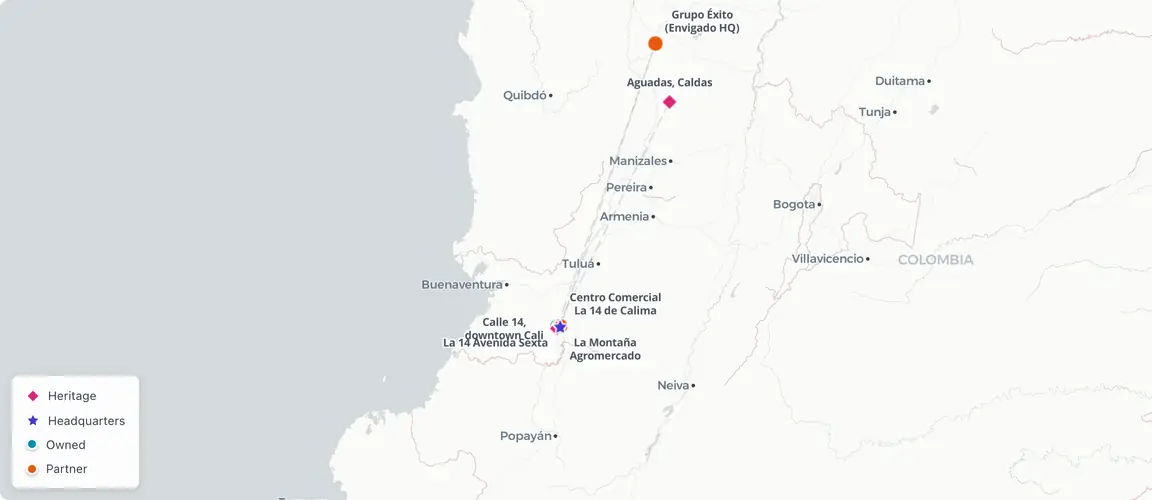
How a 57-year retail empire dissolved in six years
For 57 years, La 14 was where Cali grew up — the amusement rides at the Calima store, the red logo, the Christmas jingle. Founded in 1964 as a downtown variety shop, it became the Valle del Cauca’s dominant supermarket. Then its founding leader died without a succession plan, and the region’s unsinkable retailer quietly sank.
A cacharrería on Calle 14
Almacenes La 14 began as a partnership between two men chasing a modest opportunity, not a family dynasty in waiting. In 1950 Abel Cardona Franco left Aguadas, a coffee town in the department of Caldas, and settled in Cali, joining Antonio Villegas in a small downtown venture called La Gran Cacharrería — a general-goods store of the kind that dotted Colombian city centers at mid-century. By 1963 Cardona had bought out his partner, annexed a neighboring shop on Calle 14, and renamed the combined store Cacharrería La 14. The following year, the business formally became Almacenes La 14. It was an unremarkable beginning: a single downtown storefront selling household goods in a regional city that had not yet grown into Colombia’s third-largest.
The son who built the empire
The company’s real expansion began under the founder’s son. Jaime Cardona Parra took full leadership in 1983, opened the Avenida Sexta store, and launched an era of growth that would make La 14 the Valle del Cauca’s dominant retailer. The building blocks of that expansion had already been laid in the 1970s and early 1980s: La 14 pioneered Cali’s “tienda por departamentos” — department-store — format in 1977, and in 1981 it became the anchor tenant at Centro Comercial Cosmocentro, its first shopping-center presence. But 1987 produced the store that would define the company for the next three decades: Centro Comercial Calima, in Cali, financed and built by the family’s own sister company, Calima Desarrollos Inmobiliarios S.A. Calima became simultaneously La 14’s largest store and its corporate headquarters — the physical and symbolic center of an empire that eventually reached roughly 29 to 30 points of sale. By 1992 the company had crossed its first departmental border, opening in Manizales; over the following two decades it added stores across Valle del Cauca — Buenaventura, Jamundí, Palmira, Tuluá, Yumbo, Cartago — and reached as far as Popayán, Pereira, Armenia, Neiva, and Girardot.
Thirty percent of a region
By the early 2000s La 14 was more than a retailer — it was a regional institution with the market position to prove it. The company commanded roughly 30 percent of Valle del Cauca’s retail demand and ranked fourth nationally in retail sales, trailing only Grupo Éxito, Olímpica, and the larger multinational chains that had entered Colombia over the preceding decades. Its three-red-squares logo, its Christmas jingle, and the children’s amusement rides permanently installed at the Calima store made it a fixture of Cali civic life — what Radiónica would later describe as part of the Valle del Cauca’s intangible cultural heritage. The family also owned Canal 14, a local Cali television channel created specifically to give La 14’s own suppliers an affordable advertising outlet, extending the company’s reach into the region’s media landscape. The retail model itself was built on diversification and personalized service — the “everything under one roof” assortment that Colombian shoppers came to expect from La 14 — plus a private-label program the company approached with unusual caution. As Cardona himself put it in a 2004 interview with El País, reflecting on decades in the business, the company would not release a private-label product “mientras no tuviéramos un producto de alta calidad” — until it had one of genuinely high quality. The same interview captured a founder still confident in the model: a family enterprise built on the trust of collaborators and customers, resistant to selling out to the multinationals that had already reshaped Colombian retail. Asked in that interview whether buyers had approached, he said many offers had come and the answer had been no; after his death El País reported that one of the offers received over the years was from Walmart, and the family did not deny it. He chose instead to keep operating, in his words, “como una empresa de familia.”
Four hundred and fifty kilometres too far
The turn came from overextension, not from a single external shock. In 2011 La 14 opened its furthest-flung store yet: a second Centro Comercial Calima, this one in Bogotá, more than 450 kilometers from the company’s Cali base and its first foray into the country’s largest and most competitive retail market. The expansion strained a balance sheet built for a regional retailer, not a national one — and the timing could not have been worse. Hard-discount chains had been quietly reshaping Colombian grocery retail throughout the 2010s: by mid-2019, per Nielsen data reported in La República, D1 alone commanded just over half of all discount-channel sales nationally, with Ara taking roughly 23 percent and Justo y Bueno another 11 percent, and D1’s household penetration approaching 55 percent. These were categories of competitor La 14 had not been built to fight — hyper-efficient, no-frills chains competing on price in a market La 14 had always won on assortment and relationship.
By 2017, the Bogotá over-leverage had become unmanageable enough that the board hired an outside manager, Manuel Guillermo Escobar, brought in that May — the first time in the company’s history that day-to-day operational control passed outside the Cardona family circle. It did not stabilize the business. The debt spiral that began in 2017 deepened through 2018 as hard-discount competition intensified further, and then COVID-19 delivered a compounding blow in 2020: sales fell 19.6 percent year over year, the loss-making Bogotá store closed permanently on 16 November of that year, and the company reported losses of roughly COP $72,282 million for the period. A second outside manager, Mauricio Mantilla Pinilla, took over in 2019 as the family cycled through leadership in search of a formula that could arrest the decline; family members themselves also rotated back into operational roles, with Gustavo Andrés Cardona Mejía serving as manager and Leila Cardona Parra presiding over the board. None of it reversed the trajectory. A creditor debt-restructuring agreement worth roughly COP $404,000 million was signed in May 2019 but was not ultimately honored, and the company sold its Bogotá real estate outright — first steps toward what would become a full unwind.
The long unwind
By January 2021, La 14 filed for a Ley 1116 corporate reorganization — Colombia’s equivalent of Chapter 11 — under expediente N° 10314. Government support was reportedly explored, including a Bancóldex-linked credit facility for suppliers, but even a proposed credit line on the order of COP $200,000 million was judged insufficient to save the company. The reorganization attempt failed, and judicial liquidation was decreed in September 2021. What followed was not a sale but a dismantling. Grupo Éxito — the very rival that had long dwarfed La 14 nationally — acquired operating rights to five, and later six, of its stores. Businessman Tulio Gómez’s La Montaña Agromercado leased five of the remaining flagship locations. Roughly 1,800 employees remained at the point of liquidation, down from about 3,400 the year before, and 2,047 suppliers — more than 1,800 of them small and medium enterprises, representing an estimated 18,000 jobs across the supply chain — were directly affected by the collapse. The “La 14” name and trademark itself were not adjudicated to any single buyer.
The liquidation has proven to be a long, methodical unwind rather than a swift resolution. By the end of 2022, reported assets of roughly COP $728,714 million still roughly offset liabilities of COP $667,307 million, with supplier claims continuing to work through the process. By 2025, Supersociedades — Colombia’s corporate-oversight regulator — reported that cumulative labor claims of approximately COP $53,970 million had been paid in full to former employees, closing out one major category of creditor. And as of a January 2026 court order (Auto 2026-01-072369) consolidating La 14 with its real-estate sister company, the liquidation remained formally open — net assets of roughly COP $652,557 million measured against liabilities of COP $621,202 million, more than four years after the company’s operations had effectively ended.
What the numbers obscure is how completely this outcome depended on one person’s absence, not on competition alone. La 14’s founder-family equity — the value the Cardona family had built across 57 years — was measured at roughly COP $202,657 million at the end of 2020, and under Colombian liquidation law, shareholders rank last behind creditors in any recovery. The company had already survived decades of multinational retail expansion into Colombia, currency volatility, and the arrival of global competitors long before 2015. It lost its footing only after the one person who had run it for three decades — and who had told a reporter, without irony, that no one is indispensable — was suddenly gone, and no structure existed to prove him right.
Almacenes La 14 was never structured to survive its own scale. Its multi-format retail business — hypermarkets, neighborhood stores, the Rapitiendas convenience format, and an early 24-hour e-commerce store — sat alongside a substantial owned real-estate portfolio built and held through Calima Desarrollos Inmobiliarios S.A., the family’s sister company. That arrangement had worked for decades in Cali, where the company both operated its stores and owned the buildings and shopping centers around them. It became a liability the moment the company tried to replicate the same capital-intensive model in a market — Bogotá — where La 14 had neither the brand recognition nor the balance-sheet depth of its established competitors. In a pre-liquidation transaction separate from the later judicial process, the company sold the Bogotá Calima center for roughly COP $485,000 million, first to IC Constructora and later reflagged under Mallplaza — a quiet acknowledgment that the national ambition of 2011 had been abandoned years before the formal liquidation began.
The Cali flagship met a different fate. Unlike the Bogotá property, the original Centro Comercial Calima — La 14’s largest store and headquarters since 1987 — was never sold outright; it was leased, not sold, to La Montaña, and as of the most recent reporting, its real-estate realization within the liquidation was still ongoing. The liquidator overseeing the wind-down, Felipe Negret Mosquera, has indicated that the “La 14” brand and trademark itself would eventually be formally appraised, with La Montaña’s Tulio Gómez expressing interest in acquiring it — but no completed transaction for the name had been confirmed as of the most recent court filings. Even the company’s own identity, in other words, remains an open question inside a liquidation process that has already run longer than many of the competitors it once outlasted.
Today, Almacenes La 14 exists only as a case under active liquidation supervision by the Superintendencia de Sociedades. Its stores operate under other owners’ names. Its brand and trademark sit unclaimed, unsold, in a legal limbo now five years old. What remains is the shape of what a founder-owned regional retailer can build across half a century of sustained execution — and how quickly that structure can come apart when the person holding it together leaves no plan for what comes next.
Ownership Transition
"Founder-leader Jaime Cardona Parra died 2015-11-25 with no succession plan; Ley 1116 reorganization (Jan 2021) failed; judicial liquidation decreed 16 Sept 2021 (expediente N° 10314); assets dispersed piecemeal to Grupo Éxito (5-6 stores) and La Montaña Agromercado (5 stores) rather than a single acquirer; the La 14 brand/trademark remained unadjudicated as of 2026."
Researched 25 sources in Spanish.