 Skip to main content
A Cut Above
From a 428-square-foot salon to Malaysia's premier hairstyling empire, A Cut Above survived an express-cut chain failure and emerged stronger—proving that knowing when to cut losses matters as much as knowing when to cut hair—while preparing to pass the scissors to a son who had already proved he could extend it.
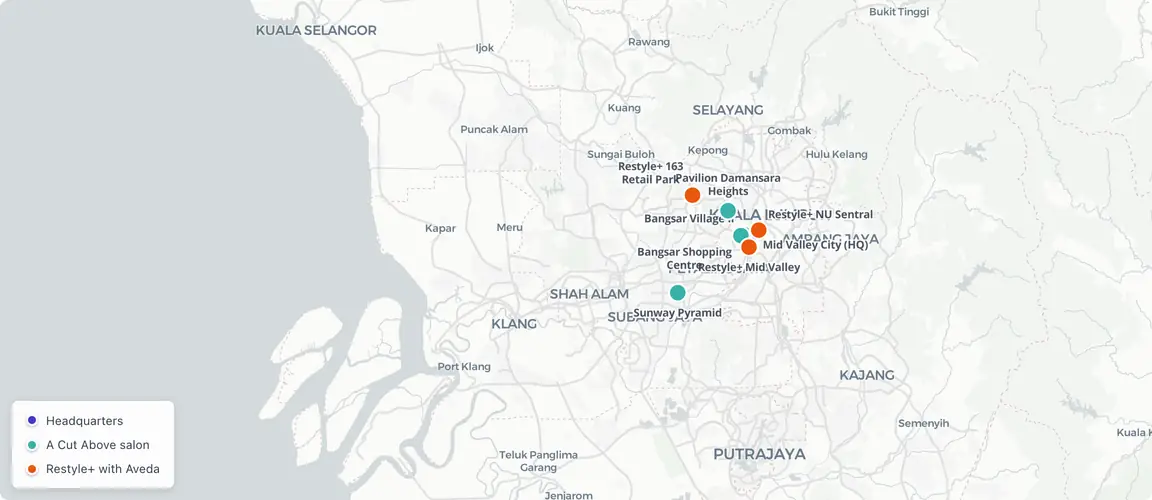
9 Salons Across the Klang Valley
From one 428-square-foot chair to Malaysia's premier salon empire
In 1979, a 23-year-old hairstylist with Vidal Sassoon training and RM20,000 opened a 428-square-foot salon in Kuala Lumpur’s Wisma HLA. The space was barely enough for a reception desk and a handful of stations. Forty-seven years later, A Cut Above operates nine salons across the Klang Valley—five premium flagship locations and three Restyle+ with Aveda eco-salon outlets—and has trained thousands of Malaysian hairdressers through an academy that ran for nearly two decades. Between the 428-square-foot beginning and today’s nine-salon portfolio sits an education institution built from nothing, an express chain that failed and was closed in a single decision, and a succession plan that is already in motion. The throughline is a founder who knew, at each juncture, which direction to cut.
The 428-square-foot beginning
A Cut Above started with an unlikely partnership. A regular client at Winnie Loo’s early Kuala Lumpur salon proposed investing RM20,000 each to open a proper establishment. When that partner later exited, her boyfriend Richard Teo stepped in—eventually becoming co-founder and business manager of what would grow into Malaysia’s premier hairstyling brand.
From the start, the couple divided responsibilities strategically. Richard handled business management, marketing, and operational discipline. Winnie focused on creative direction, client relationships, and the craft itself. The division was not simply convenient—it was constitutive. Each partner brought what the business needed and what the other lacked. Winnie’s Vidal Sassoon training gave the brand technical credibility; Richard’s commercial instincts kept the business solvent through the years when reputation outpaced revenue. This complementary partnership—one of Malaysia’s most durable husband-wife business teams, later recognised with the 2017 BrandLaureate SMEs Business Couple of the Year award—would prove essential when expansion tested the brand’s limits.
By the late 1990s, A Cut Above had grown well beyond its modest 428-square-foot origins. Winnie had built a reputation across Kuala Lumpur’s premium salon market, attracting a clientele that valued craft over convenience and was competing on an international stage. The 1997 World Master of the Craft award—the first for any Malaysian—validated the brand’s technical standard internationally and established Winnie as more than a local success story. Schwarzkopf signed her as Creative Ambassador from 2001 to 2007, a six-year partnership that opened global hairdressing networks and elevated the salon’s professional profile within the industry. The brand seemed positioned for unlimited growth.
When eight locations taught one founder to cut losses
The X-Cut express concept seemed logical in the way that many mistaken ideas do. Budget-conscious consumers wanted quick, professional cuts without premium salon prices. The Malaysian haircare market was large and growing. A Cut Above had brand recognition, trained staff, and operational experience. The question was whether that equity could be leveraged into a different price point.
A Cut Above launched X-Cut offering 15-minute cuts at RM16–18, eventually expanding to eight or nine locations across the Klang Valley. The positioning was deliberate: professional quality at express-chain prices, backed by the training infrastructure that distinguished A Cut Above from its competitors. The concept had the look of disciplined diversification.
The numbers never worked. Express pricing couldn’t generate sustainable revenue per location. The economics of high-volume, low-margin haircuts required throughput that the locations couldn’t consistently achieve. Unlike a truly no-frills express format—where low costs offset low prices—X-Cut carried the operational overhead of a brand with professional training standards. The formula required either higher volume than the locations generated or lower costs than the brand’s identity permitted. Neither proved achievable. Each month that the chain operated at a loss was a month that capital and management attention flowed away from the premium salons that had made A Cut Above’s name.
Rather than continuing to pour resources into a struggling concept, the Teo family made a decisive choice.
“They weren’t churning enough revenue to be sustainable,” Winnie later reflected. “The thing is, you must always be willing to cut your losses.” The chain was cut from its eight-to-nine-location peak down to a single site. No gradual wind-down elsewhere, no attempts to find a buyer for the closed locations—a clean strategic retreat that freed resources for the core business.
The failure taught a lesson that now shapes A Cut Above’s expansion philosophy: sustainable growth requires profitable units, not maximum locations. Today’s nine salons generate healthy margins. The peak count of 19 locations and 300-plus staff represented overextension, not success. The X-Cut episode was expensive, but the clarity it produced proved more valuable than any single location would have been. Winnie emerged from it with a sharper understanding of the brand’s actual competitive advantage: not scale, but standard. One X-Cut Express location survives today—a deliberate single site that serves the express segment without the structural drain of a chain.
The school that changed what a haircut could mean
If X-Cut represented failed diversification, the A Cut Above Academy represented successful vertical integration. Founded in 2004 in Bandar Sunway, the academy addressed an industry-wide challenge: transforming hairdressing from what Winnie calls “an auntie business” into a respected profession.
“People aren’t willing to invest in hairdressing lessons to gain the skills,” she observes. “It’s because parents think their children have better things to do for work rather than hairdressing. What they forget is, no matter how bad the crisis is, your hair still grows.”
The curriculum ran one year: eight months of classroom instruction combined with three-month internships rotating through company salons. Students earned Malaysia Skills Certificates and City & Guilds Vocational Diplomas. For three consecutive years, City & Guilds London named it the best hairdressing academy in Malaysia. Winnie documented the philosophy behind this model in her 2005 autobiography, A Cut Above: Built on Hard Work, True Grit and a Pair of Scissors.
The model was self-reinforcing: the academy trained talent who then staffed A Cut Above salons, ensuring consistent quality while building industry credibility. This vertical integration—education feeding employment feeding brand reputation—created advantages that express haircut chains could not replicate. A salon that trains its own stylists to City & Guilds standard does not compete on price; it competes on craft, and craft cannot be commoditised the way a 15-minute cut can. The academy made that argument structural rather than merely aspirational.
The industry recognition followed. The EY Woman Entrepreneur of the Year award in 2010 acknowledged what the academy represented beyond the brand: an investment in Malaysian professional infrastructure that benefited the sector, not just A Cut Above. City & Guilds London’s three consecutive years of naming it the best hairdressing academy in Malaysia validated the curriculum against an international benchmark that most regional vocational programmes never attempted.
The academy closed in 2022, a casualty of COVID-19 disruptions that made sustained in-person education unviable. Eighteen years of operation, thousands of graduates, and a City & Guilds-certified curriculum came to an end not through strategic choice but through external force. But its legacy endures in the standards it set: the graduates who now staff A Cut Above salons are, in a direct sense, the academy’s most visible product—a talent pipeline that no competitor can simply purchase. The institutional knowledge Winnie built into the curriculum lives on in every stylist the academy trained.
Nine salons, no compromises
Today’s A Cut Above operates through two complementary brands. The flagship A Cut Above salons occupy premium mall locations including Mid Valley Megamall, Bangsar Village II, Bangsar Shopping Centre, Sunway Pyramid, and the newest addition at Pavilion Damansara Heights—opened in 2024 to mark the brand’s 45th anniversary. The Restyle+ with Aveda concept, launched in partnership with the eco-conscious beauty brand, extends the group’s presence to three additional locations and serves customers seeking sustainable luxury alongside professional styling.
International brand partnerships remain central to positioning. After Schwarzkopf, A Cut Above aligned with Milbon and Aveda—brands that signal professional expertise and premium quality to a clientele that understands the difference. These partnerships provide training, products, and credibility that independent salons cannot match without similar institutional investment. They also serve a curatorial function: each partnership validates A Cut Above’s technical standard in the eyes of brands that have their own reputations to protect.
The strategic mall locations reflect lessons from the X-Cut failure. Rather than chasing volume through numerous low-cost locations, A Cut Above concentrates on high-traffic premium venues where customers expect—and will pay for—excellence. The current portfolio of five flagship A Cut Above salons, three Restyle+ with Aveda locations, and one X-Cut Express represents the discipline that earlier failures installed: every addition evaluated not just for visibility, but for whether its revenue can sustain it for the next five years.
Beyond the salon
Winnie Loo’s 2022 appointment as first female President of the Branding Association of Malaysia—after 22 years of exclusively male leadership—extended A Cut Above’s credibility beyond the beauty sector. The appointment reflected a recognition that had accumulated over decades: Winnie was not only a practitioner of craft but a builder of industry infrastructure. An adjunct professorship at Asia Metropolitan University and judging roles at international competitions in Japan, London, and Shanghai now carry the brand’s reputation to stages where Malaysian hairdressing had previously been absent.
These external roles are not peripheral to the business. They create the conditions under which the next generation can inherit something more than a salon group—they can inherit a brand whose name carries weight in markets and contexts that A Cut Above’s salons alone could not reach. A hairstylist who judges international competitions in London and Shanghai is not competing with other Malaysian salons; she is operating on a different plane of credibility altogether. The same instinct for building institutions rather than just a business shaped the 2005 autobiography, A Cut Above: Built on Hard Work, True Grit and a Pair of Scissors—a record written not for nostalgia but because the founder understood early that a salon group’s most transferable asset is the story of how it was built.
The 2024 opening at Pavilion Damansara Heights signalled more than an anniversary celebration. It marked the beginning of a succession transition, with son Marcus Teo—who co-developed the Restyle+ with Aveda concept alongside his father Richard, demonstrating both strategic judgment and operational capability before being formally elevated—receiving increased operational authority as Business Development Director.
The succession is not a handover in the traditional sense. Winnie continues as Chief Creative Director and remains the brand’s public face. What changes is the distribution of operational authority—Marcus now carries the decisions that Richard once handled, while Winnie focuses on the creative and reputational dimensions that have always been her domain. The structure that made A Cut Above durable for nearly five decades is being replicated one generation down: a creative leader and a commercial operator, working in complementary partnership.
A Cut Above enters its 47th year with the nine salons, the trained staff, the City & Guilds legacy, the international brand partnerships, and the discipline that closed X-Cut when it had to—all of that already built and already proven. Marcus now holds the operational authority his father once carried, in the same complementary structure that has run the business since 1979. The scissors have been passed to him.
Researched 15 sources in English.